EBSI Verifiable Diplomas 2026: How Is the Holder Actually Bound?
How EBSI actually binds a Verifiable Diploma to the person holding the wallet — the W3C VCDM 2.0 specification, the Confidence Method Working Draft, the did:ebsi vs did:key asymmetry, and where DPoP stops being a sufficient proof of identity. The engineering walk-through for teams implementing EBSI in 2026, and the parallel confidence method that closes the provisioning-time gap DPoP was never meant to solve.
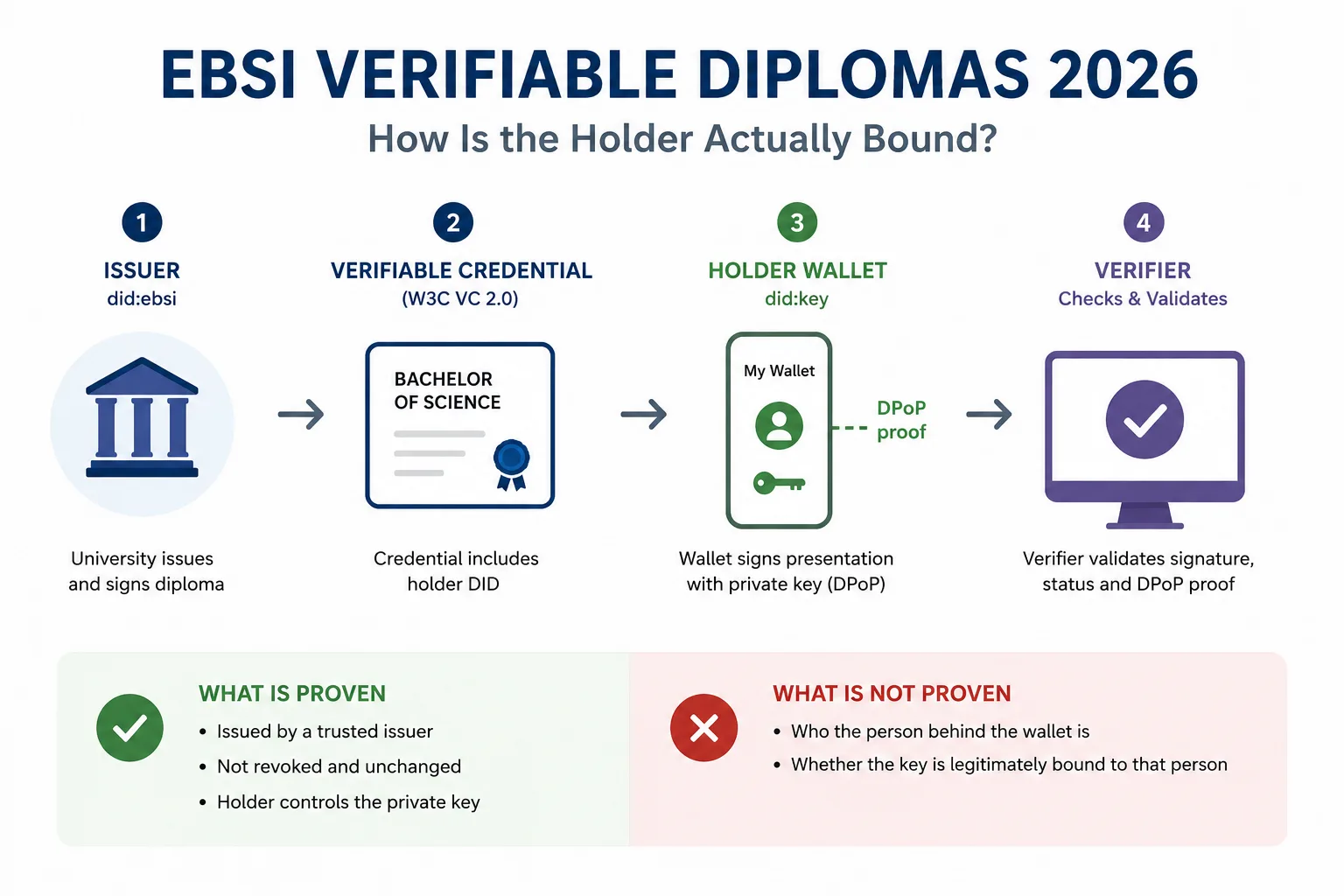
W3C published Verifiable Credentials 2.0 in May 2025 and the Confidence Method draft in October 2025. EBSI uses did:ebsi for legal entities and did:key with DPoP for natural persons. The spec proves the wallet holds a key. It does not prove who holds the wallet. That gap is what 2026 has to close.
Post 3 of this cluster looked at the verifiable-diploma trust chain conceptually and where it breaks at the holder side. This post goes one layer down into the actual protocol mechanics — what the W3C 2.0 specification says, what EBSI's DID methods do and explicitly do not do, and where the wallet's key-binding semantics stop being a sufficient proof of who is presenting the credential. The engineering gap turns out to be smaller than the conceptual story suggests, but more load-bearing.
What Does W3C Verifiable Credentials 2.0 Actually Specify About Holder Binding?
The short answer: a credential format, a signature model, and an explicit hand-off to a separate confidence layer.
The W3C published Verifiable Credentials Data Model 2.0 as a Recommendation on 15 May 2025 (W3C press release — Verifiable Credentials 2.0 published). The 2.0 data model defines how a credential is structured, how an issuer signs it, how revocation status is referenced, and how a verifier checks the signature against the issuer's public key. What it does not define — explicitly, by design — is the mechanism that proves the entity presenting the credential is the entity to whom it was issued. That mechanism is delegated to a separate, optional layer: a confidence method.
The W3C is working on the Confidence Method specification as a Working Draft published 30 October 2025. The draft enumerates two broad families: claim-bound attestations, where the binding is asserted by claims inside the credential, and key-bound attestations, where the binding is established by signing a presentation with a key whose binding is referenced from the credential. EBSI's current implementation uses the key-bound family — the holder's wallet signs a Verifiable Presentation with a private key that resolves to a DID that the issuer included in the credential at issuance time.
The thing worth noting in the spec text is the careful asymmetry: the issuer-signature side is normative — what counts as a valid VC signature is specified to a technical level a third-party implementer can build against. The holder-binding side is informative — the Confidence Method draft enumerates families but lets each profile (EBSI, EUDI, OpenID4VP, mDL) choose the mechanism. That asymmetry exists because identity proofing is unavoidably jurisdictional, and the W3C cannot make decisions about which national ID, which biometric vendor, or which document-issuance regime an implementation accepts. So it leaves the question open in a principled way and lets the profile fill it in.
How Does EBSI Resolve a Natural Person's DID Today?
Asymmetrically — and that asymmetry is the lever.
EBSI's DID framework defines two methods, one per actor class. Legal entities (issuers — universities, employers, accreditation bodies) use did:ebsi, which registers the DID and its associated public-key material on the EBSI ledger so any verifier can resolve it publicly. The trust path for an issuer's signature is therefore ledger-anchored: a verifier checks the credential's signature against a key it can independently look up in the EBSI DID Registry, and the registry's contents are protected by the ledger's consensus.
Natural persons (holders — students, graduates, employees) use did:key at DID Method v2, which encodes the holder's public key directly inside the DID string and stores nothing on a public ledger. This is the right design under GDPR — a natural-person identifier on a public, immutable ledger is a compliance problem, not a feature — but it means the holder DID's binding to a real person is not something the verifier can look up at presentation time. The verifier sees a public key, can verify a signature against it, and has to accept on faith from the issuer that the key belongs to the original holder.
EBSI's recommended holder-binding protocol at presentation time is Demonstrating Proof of Possession (DPoP) — the wallet generates a fresh nonce-bearing DPoP token signed with the holder's private key, and the verifier confirms that the token's signature validates against the DID's public key encoded in the credential. DPoP, layered with OpenID for Verifiable Presentations 1.0, gives the verifier strong evidence that whoever is presenting the credential right now has access to the private key the issuer wrote into the credential at issuance time.
Reading the EBSI DID natural-person spec carefully, the part the documentation is honest about is that DPoP closes the technical binding loop — the wallet holds the key — but the question of whether the wallet's controller is the original holder is moved up to the credential issuance event. The issuer decided this at admission. The protocol presumes the issuer got that right.
Why Doesn't Wallet-Based Key Binding Close the Gap on Its Own?
Because every threat against "the right person holds the wallet" survives DPoP.
DPoP is a strong proof that the entity completing the presentation has the private key. It is not a proof of who that entity is. Four scenarios survive the DPoP check.
- Wallet share or transfer. Original holder shares the wallet's seed phrase or device with a third party. DPoP verifies; the holder presenting is not the original holder.
- Device theft with credential extraction. Attacker exfiltrates the private key from a compromised wallet device. DPoP verifies against the extracted key.
- Coerced presentation. Original holder is present but compelled — by social engineering, financial pressure, or organised employment fraud — to present a credential on someone else's behalf during an interview, exam, or contract sign-off.
- Issuance-time fraud. The credential was issued correctly under DPoP rules to a synthetic identity whose admission was never proofed against an external document. DPoP cannot rewind to fix this; see Post 2 in this cluster on FAFSA fraud for the empirical scale at the admission end.
The failure mode that worries me most is not the technical one. It is the operational one. A wallet is a smartphone application — installed, lost, replaced, restored, screen-shared, factory-reset, occasionally remote-wiped. The persistence model of a wallet on a consumer device, over a multi-year credential lifetime (a diploma is forever; a student loan is twenty years), does not match the persistence model of a binding event that happened at admission and was supposed to anchor everything downstream. The wallet is the right object to hold the credential. It is not the right object to be the sole binding to the holder's real identity.
What the W3C Confidence Method draft is doing, structurally, is acknowledging that the proof-of-possession layer is necessary but not sufficient. The draft enumerates families precisely because no single family solves the operational lifecycle problem. The conformance question every EBSI implementer eventually faces is: which additional confidence method do we use, beyond DPoP, to anchor the wallet's key to a real person at issuance — and how does that anchor survive the wallet's lifecycle?
What Closes the Holder-Binding Gap End-to-End?
A second confidence method, anchored externally to the wallet, at the moment the wallet's holder DID is first created.
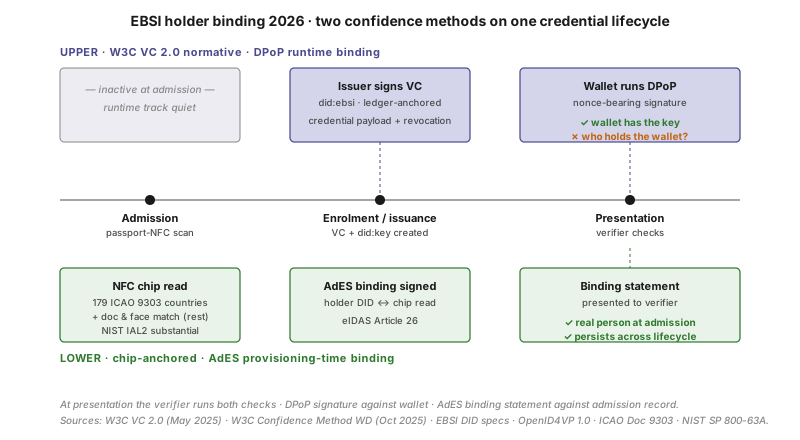
The mechanism is straightforward. At admission, the student scans the NFC chip of their biometric passport with a smartphone. The chip data is verified offline against the ICAO trust list (ICAO Doc 9303); Chip Authentication confirms the chip is not cloned; PACE binds the read to physical presence. The result is a cryptographic record signed by the issuing state. The wallet's did:key is generated locally on the student's device. The two are bound together in a single signed statement, retained as an Advanced Electronic Signature (AdES) under eIDAS Article 26 by the institution: this holder DID was provisioned to a person verified by ICAO 9303 chip read on [date] [time] [location].
For applicants whose document is pre-NFC or who present a non-ICAO national ID, document authenticity verification combined with biometric face match (FaceTec liveness) runs through the same flow and produces a confidence-equivalent record at substantial assurance — NIST SP 800-63A IAL2. Both routes cover every applicant: NFC for the 179 ICAO 9303 countries and document-plus-face-match for every remaining country. This is the layer we ship as the Identity Verification product, with the resulting AdES record retained via the Signatures product.
The downstream effect is two-fold. At every later presentation, the verifier checks two things rather than one: the DPoP signature (the wallet holds the key, which W3C VC 2.0 already specifies), and the issuer's signed binding statement (the key was provisioned at admission against a state-signed document chip). The first check answers "is this the right wallet?". The second answers "was this wallet issued to the right person?". The combination is what the W3C Confidence Method draft enumerates as the combined-confidence pattern.
The engineering observation I'd push back with against the standard "DPoP solves holder binding" framing is that DPoP solves the runtime binding question — at this moment, the wallet has the key — without solving the provisioning-time binding question — who got the key to begin with. EBSI's specification is honest about this; the wallet-vendor marketing layer often is not. The architectural fix is not to extend DPoP — DPoP is correct as far as it goes — but to add a parallel confidence statement at issuance that survives the wallet's lifecycle. The chip-based admission record is that parallel statement.
Where the Cluster Goes Next
This is Cluster Post #5 of 6 on international student identity. The series:
- Post 1 (29.05.2026, Gustav) — International Student Identity 2026: Where Does It Break? — architectural overview across the full lifecycle.
- Post 2 (01.06.2026, Mairi) — FAFSA Fraud 2026: How Did $1B+ Almost Reach Ghost Students? — admission-stage synthetic-identity fraud.
- Post 3 (04.06.2026, Gustav) — Diploma Mills 2026: Where Does Cryptographic Verification Hold? — the conceptual trust chain and the holder-binding gap.
- Post 4 (06.06.2026, Mairi) — Remote Proctoring 2026: Can Deepfakes Beat Selfie ID Verification? — exam-stage attack surface and the AI Act 2 August 2026 deadline.
- Post 6 (10.06.2026, Mairi) — A university identity stack for 2027: the practical playbook combining all five threads.
More in this cluster
- University Identity Stack 2027: Where Should You Actually Start?
- How Do You Verify Student Identity for Attendance, Access, and Exams Under GDPR and the AI Act?
FAQ
What does W3C Verifiable Credentials 2.0 say about holder binding? The W3C VCDM 2.0 (published as a Recommendation on 15 May 2025) defines the credential format, the issuer signature model, and the revocation reference, but leaves holder binding to a separate Confidence Method layer. The Confidence Method v1.0 specification is in W3C Working Draft as of 30 October 2025 and enumerates two broad families: claim-bound and key-bound attestations. The choice between families is delegated to each implementing profile — EBSI, EUDI, OpenID4VP, mDL.
Why does EBSI use did:key for natural persons and did:ebsi for legal entities? Legal entities (issuers) need their DIDs to be publicly resolvable so any verifier can check a credential's signature without coordinating with the issuer. did:ebsi achieves this by registering DIDs on the EBSI ledger. Natural persons (holders) need privacy and GDPR compliance; storing a natural-person identifier on an immutable public ledger creates compliance problems. did:key encodes the public key inside the DID string itself and stores nothing on the ledger, satisfying GDPR while keeping signature verification possible.
What is DPoP and what does it prove? Demonstrating Proof of Possession (DPoP) is a runtime binding protocol that the wallet uses at presentation. The wallet generates a DPoP token containing a fresh nonce and signs it with the holder's private key. The verifier confirms the signature against the public key encoded in the credential's holder DID. DPoP proves the entity presenting the credential right now has access to the private key. It does not prove who that entity is — that question is answered at credential issuance, not at presentation.
Does this require qualified electronic signatures (QES)? No. Advanced Electronic Signature (AdES) under eIDAS Article 26 is sufficient for the admission-time holder-binding record. eIDAS Article 25 non-discrimination makes AdES admissible across Member States; QES is the legal ceiling for public services under Article 27, not the floor for institutional identity proofing. The AdES record produced at chip-read time carries enough evidentiary weight to survive a regulator's verification request without the qualified-certificate machinery.
How does the biometric passport chip closing the gap not conflict with GDPR?
The chip read at admission produces a signed record retained by the institution under its existing data-processing basis for student admission (Article 6(1)(b) GDPR — performance of a contract — or Article 6(1)(c) — legal obligation, depending on the jurisdiction's higher-education law). The record is not published on a public ledger. The holder's did:key continues to be the only identifier the verifier sees on-chain; the chip-derived binding is held server-side at the issuer and presented as a confidence statement only when the verifier asks for it.
Sources
Primary — W3C Verifiable Credentials
- W3C — Verifiable Credentials Data Model 2.0 (Recommendation, 15 May 2025)
- W3C — Confidence Method v1.0 (Working Draft, 30 October 2025)
- W3C press release — Verifiable Credentials 2.0 published as a Standard
Primary — EBSI DID methods and protocols
- EBSI Hub — DID Method for Legal Entities
- EBSI Hub — DID Method for Natural Persons
- EBSI developers hub — DID Method for Natural Person specification
- EBSI Hub — EBSI W3C VCs and VPs
- European Commission — EBSI Glossary
Primary — Identity proofing, presentation, and document standards
- OpenID Foundation — OpenID for Verifiable Presentations 1.0
- ICAO Doc 9303 — Machine Readable Travel Documents
- NIST SP 800-63A — Digital Identity Guidelines: Identity Proofing and Enrollment
- Regulation (EU) 2024/1183 — eIDAS 2.0 / EUDI — EUR-Lex
About the author
Gustav Poola is co-founder of IdentiGate. He focuses on the technical architecture of passport-chip identity verification, advanced electronic signature production under eIDAS, and the engineering of identity flows that survive regulator and auditor walk-back.