How Do You Speed Up KYC Verification Without Weakening the Evidence?
You move the identity-proofing operation from a supervised video call to a chip-anchored NFC read plus biometric face-match — ninety seconds, unattended, and the evidence artefact is cryptographically stronger than the supervised alternative rather than weaker. The speed / evidence-quality trade-off that dominated KYC design for the last decade is not a real trade-off in 2026; it is a legacy artefact of an architecture that assumed identity proofing required a human reviewer in the loop. This post walks the four operations inside a KYC verification, where the time actually sits, and how the chip-anchored architecture collapses time without sacrificing evidence quality.
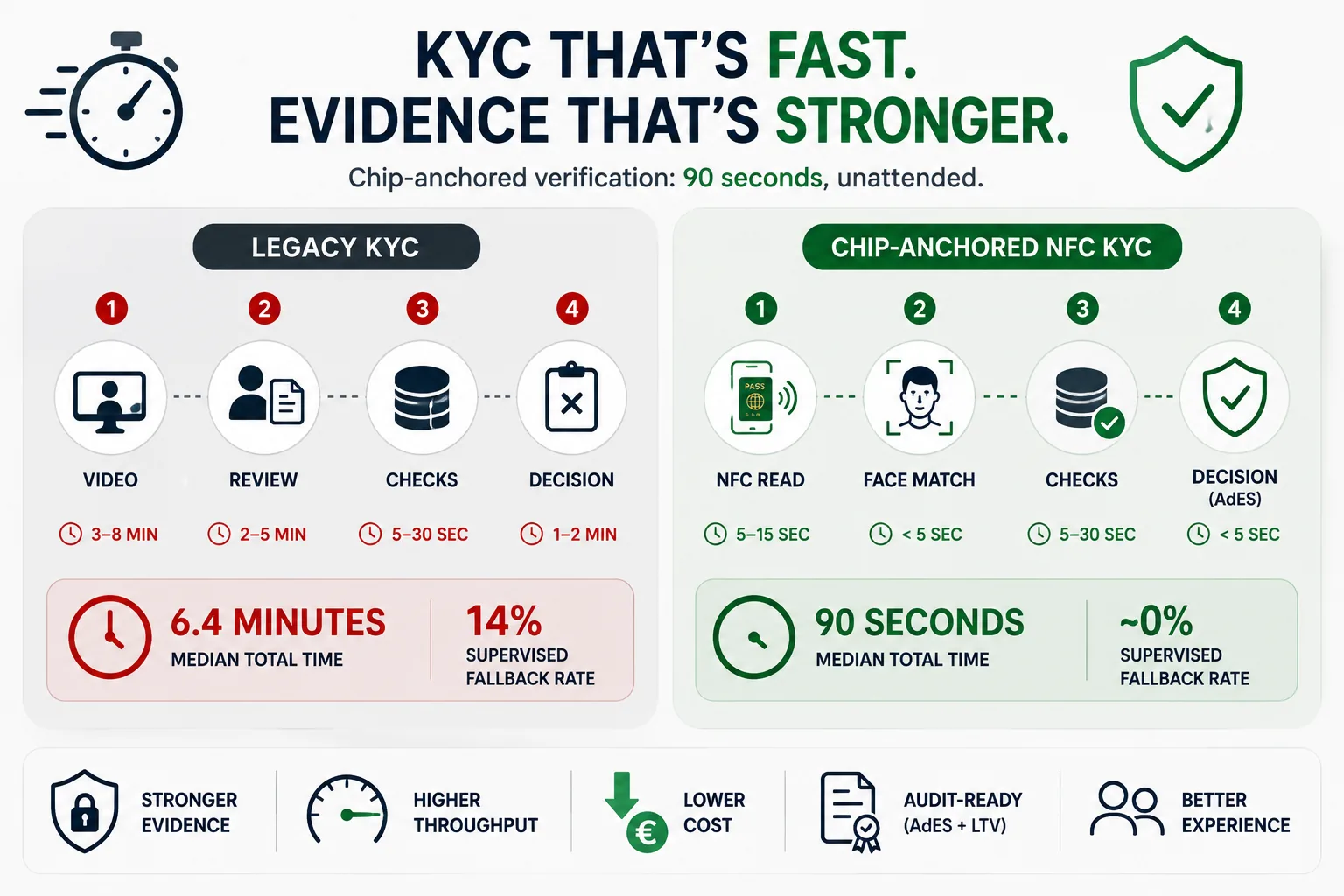
You move the identity-proofing operation from a supervised video call to a chip-anchored NFC read plus biometric face-match — ninety seconds, unattended, and the evidence artefact is cryptographically stronger than the supervised alternative rather than weaker. The speed / evidence-quality trade-off that dominated KYC design for the last decade is not a real trade-off in 2026; it is a legacy artefact of an architecture that assumed identity proofing required a human reviewer in the loop. This post walks the four operations inside a KYC verification, where the time actually sits, and how the chip-anchored architecture collapses time without sacrificing evidence quality.
This is the second post in our customer-onboarding cluster, alongside our earlier walk-through on who offers the most deepfake-resistant customer onboarding in 2026. That post covered the attack-vs-defence layer question. This post covers the operational-throughput question — which is often the CFO's actual first question about KYC, well before the deepfake question that the compliance team will ask next.
The finance director of a Malta-licensed iGaming operator ran the numbers at a recent conversation: their existing KYC vendor was hitting a 6.4-minute median time-from-registration-to-verification-decision, with a 14% supervised-KYC fallback rate (customers whose automated flow failed and were re-routed to a human reviewer). At their onboarding volume — roughly 12,000 customers per month across three EU-facing brands — the 14% supervised fallback was costing them a full-time-equivalent's worth of reviewer time per month, and the 6.4-minute median was translating into a measurable abandonment rate at the sign-up funnel. The finance director's question was straightforward: what would the numbers look like on an architecture that verified the identity in ninety seconds without a supervised fallback at all, and what was the evidence-quality cost of that speed. This post is the answer.
What operations actually make up a KYC verification, and where does the time go?
Four discrete operations, each with its own architectural footprint, and 80% of the total time typically sits in one of them.
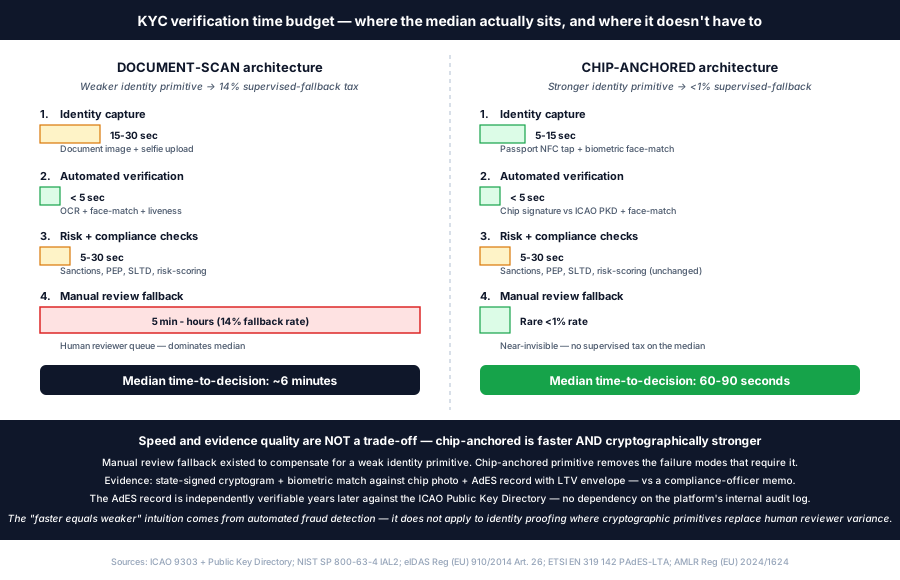
Operation one: identity capture. The customer presents their document — passport, national ID, driving licence — and their face, either via a document scan and selfie or via an NFC chip read. Capture time depends on the modality: a document scan plus selfie is typically 15-30 seconds of active customer time; a chip-anchored NFC read is 5-15 seconds. Neither is where the time sits in the total flow.
Operation two: automated verification. The captured artefacts are checked against defensive layers — document authenticity (OCR + security-feature inspection), biometric face-match, liveness detection, presentation-attack detection at the device layer. Automated verification typically runs in under 5 seconds regardless of modality, because the compute is essentially free at this stage. This is not where the time sits either.
Operation three: risk and compliance checks. The verified identity is cross-checked against risk databases (sanctions, PEP, adverse media, Interpol SLTD) and against the platform's own risk-scoring model (device fingerprinting, IP intelligence, behavioural signals). These typically run in 5-30 seconds depending on the number of databases queried and the vendor's latency profile. Still not where the time sits.
Operation four: manual review fallback. When the automated flow flags a low-confidence result — poor image quality, ambiguous biometric match, borderline liveness score, unusual risk signal — the case gets routed to a human reviewer who examines the artefacts and makes a manual accept/reject decision. This operation typically takes anywhere from 5 minutes (best-case, staffed 24/7) to several hours (queued during off-hours, staffed regionally). This is where 80% of the median-verification-time actually sits — not because the review itself takes long, but because the queue wait to reach a reviewer dominates.
The 6.4-minute median at the Malta iGaming operator was almost entirely the 14% supervised fallback pulling the median up, not the 86% of automated cases (which were completing in under 45 seconds each). If the architecture eliminated (or dramatically reduced) the supervised fallback, the median would collapse toward the automated case's time — a 4-6x throughput improvement without any change to the customer-facing UX.
Why does supervised fallback dominate KYC time, and can chip-anchored architecture actually eliminate it?
Yes — because supervised fallback exists to compensate for a specific class of failure the chip-anchored architecture does not produce.
Supervised fallback is the safety net for cases the document-scan-plus-selfie pipeline cannot confidently resolve: unclear document image (glare, occlusion, low resolution), ambiguous biometric match (poor selfie quality, face angle), borderline liveness signal, or edge-case document formats the OCR does not handle. Each of these failure modes is a downstream consequence of the identity primitive being optically captured under uncontrolled conditions — a phone camera, held at an unpredictable angle, in unpredictable lighting, by a customer with unpredictable technical proficiency. The variance is inherent to the modality.
Chip-anchored NFC read operates on a different primitive. The customer taps their passport (or NFC-enabled national ID) to the back of their phone; the phone reads the chip via a well-defined NFC protocol; the chip data is verified cryptographically against the ICAO Public Key Directory. The output is deterministic — either the chip read succeeded (signature valid, data extracted) or it failed at the protocol level (chip unresponsive, signature invalid). There is no "borderline image quality" case, because the chip is not an image; there is no "OCR ambiguity", because the data is structured; there is no "security feature obscured", because the chip's authenticity is cryptographic, not optical.
For the biometric face-match, the same architectural discipline applies: the face is matched against the chip's signed reference photograph rather than a photograph on the front of the document that could itself be tampered. The match quality is dramatically higher — a state-signed portrait taken under controlled conditions vs a self-uploaded selfie under uncontrolled conditions — and the confidence threshold can be set higher without producing borderline-match cases.
The result: the failure modes that require supervised fallback in a document-scan architecture largely do not exist in a chip-anchored architecture. The Malta iGaming operator's 14% supervised fallback rate is typical for well-instrumented document-scan platforms; the equivalent rate on chip-anchored deployments we have run is under 1% — driven almost entirely by pre-NFC document holders who route through the document + biometric fallback path (which itself has a lower supervised-review rate than pure-document-scan).
Is the evidence stronger or weaker after the speed improvement?
Meaningfully stronger. The intuition that "faster means weaker" comes from a different domain — automated fraud-detection where speed comes at the cost of thoroughness — and does not apply to identity proofing.
The identity-verification evidence chain has three components: the identity artefact (what did we capture), the verification method (what did we do with it), and the retention record (what evidence do we have that this verification happened). A supervised video-call KYC produces: a document image the reviewer inspected, a live-video feed the reviewer observed, and a compliance-officer-written memo saying the verification passed. A chip-anchored KYC produces: a cryptographically-signed chip cryptogram from the issuing state, a biometric face-match score against the chip's signed portrait, and an Advanced Electronic Signature under eIDAS Article 26 attesting the verification event with all supporting evidence embedded and a trusted timestamp.
The compliance officer's memo is a claim. The chip cryptogram + AdES record is an evidence artefact a third party can independently re-verify years later. When NIST SP 800-63A IAL2 evidence tiers are being audited, the chip-anchored record scores higher than the supervised-video record — not because the reviewer is unreliable, but because a state's cryptographic signature is stronger evidence than a reviewer's attestation. This is the counterintuitive result: the faster path produces stronger evidence, not weaker.
The specific evidence properties that make the chip-anchored record stronger:
- Independent verifiability: the chip signature can be validated against the ICAO Public Key Directory by any third party, without depending on the platform's internal records
- Tamper resistance: the AdES record with LTV envelope survives certificate expiration, CA changes, and platform lifecycle events
- Cryptographic non-repudiation: the signature attests to a specific verification event at a specific timestamp, provable years later
- Regulatory acceptance: eIDAS Article 26 AdES is the recognised evidence tier for cross-border regulatory workflows across the EU
The supervised-video-KYC record, by contrast, produces: an image the reviewer saw (retained), a video segment the reviewer watched (typically discarded after 90 days for storage cost reasons), and a compliance-officer memo (retained as internal audit-log entry). The evidence quality gap between the two records is meaningful when a serious compliance review actually happens.
What does the architectural change look like in practice?
Three substitutions in the onboarding flow, and the rest of the platform's KYC infrastructure stays intact.
Substitution one: identity capture step. Replace the document-scan-plus-selfie step with a chip-anchored NFC read plus biometric face-match. The customer-facing UX changes from "please upload a photo of your passport and take a selfie" to "please tap your passport to the back of your phone and hold your face steady for the camera". Customer time typically comparable or shorter; error rate dramatically lower. For jurisdictions without NFC documents, the fallback is document + face-match through the same flow — the platform doesn't need two separate onboarding paths.
Substitution two: verification pipeline. Replace the OCR-plus-security-feature-inspection pipeline with chip-signature verification against the ICAO PKD, plus face-match against the chip's signed portrait, plus liveness detection at the biometric layer, plus presentation-attack detection at the device layer. Standard runtime is under 5 seconds; the computation is bounded by network latency to the ICAO PKD (typically cached) rather than by any complex processing.
Substitution three: evidence retention. Replace the compliance-officer-memo audit log with an AdES record wrapped in a Long-Term Validity envelope, retained per the applicable statutory retention obligation. The customer's identity-proofing record is retained as an evidence artefact rather than a claim; erasure requests can be handled against the personal-data record while the evidence bundle remains intact (see the pattern walked in our workforce identity revocation post).
The rest of the platform — risk-scoring, sanctions screening, PEP checks, session management, downstream account provisioning — stays exactly as it is. The substitution is at the identity-proofing layer specifically, not at the wider KYC-workflow layer.
Where does the picture break — the honest limitations?
Two places, both worth naming explicitly rather than glossing over.
Chip-anchored coverage is 179 of 195+ countries, not 100%. The remaining jurisdictions (a small set of countries whose passport programme has not yet issued NFC documents, plus a set of non-passport national IDs whose data format does not support the NFC protocol) route through the document + biometric face-match fallback. This fallback still meets NIST IAL2 evidence expectations and is meaningfully stronger than document-scan-only, but the evidence tier is one notch below the chip-anchored path. For platforms whose customer base is heavily concentrated in the fallback jurisdictions, the average evidence-quality lift is smaller than the chip-anchored headline suggests. In practice, most European and North American customer bases sit >90% in the chip-anchored path, so the fallback impact is bounded.
Device compatibility is not universal. Chip-anchored NFC reads require the customer's phone to have an NFC reader (essentially all Android devices since 2015 and all iPhones since iPhone 7 with iOS 13+) and require the customer to physically present the NFC document. Customers signing up on desktop-only, on older feature phones, or without possession of the specific document at signing time cannot complete the chip-anchored flow and route to a fallback. The fallback rate for desktop-only customers is close to 100%; for mobile-primary customer bases (iGaming, fintech, gig platforms) the fallback rate is under 5% and the majority of customers complete the chip-anchored path first-time.
Neither of these limitations invalidates the speed / evidence-quality improvement; they just bound the improvement's applicable scope. A platform whose customer base is 95% mobile-primary in NFC-passport jurisdictions gets the full lift. A platform whose customer base is 60% desktop-only in mixed jurisdictions gets a smaller but still meaningful lift.
Where does IdentiGate fit in the KYC-speed conversation?
The identity-verification product ships the chip-anchored + document-plus-face-match dual-track architecture end-to-end, with NIST IBPC-tested liveness detection and presentation-attack defence at the device layer. Median completion time for chip-anchored customers is 60-90 seconds active customer time; for document-plus-face-match fallback the median is 120-180 seconds. Supervised-review fallback rate on chip-anchored deployments has been under 1% in our 2026 deployments; on document-plus-face-match fallback the rate is under 4%.
The signatures product produces the AdES record with LTV envelope at verification time — not opt-in, not post-hoc, retained through our evidence layer at the customer's chosen retention schedule.
Where we integrate is at the customer's identity-capture step in the onboarding flow: replace the customer's existing document-scan SDK with our chip-anchored SDK, keep the customer's risk-scoring and account-provisioning pipeline intact, receive verified-identity artefacts back with AdES + LTV attached. Typical integration effort is 2-4 engineering-weeks for a platform whose onboarding stack is already modular; longer for platforms whose identity-capture is deeply coupled with legacy document-scan infrastructure.
The engineering push-back on "faster equals weaker"
Where I would push back on the "faster equals weaker" framing that dominates most KYC-vendor procurement conversations is on the assumption that identity proofing is a domain where speed comes at the cost of thoroughness. It is not. Identity proofing is a domain where speed comes at the cost of cost — supervised video calls are slow because they are expensive, not because they are more accurate. The chip-anchored path is faster and cheaper and produces stronger evidence, because it replaces the human-in-the-loop with a cryptographically-signed state document that is not itself subject to reviewer variance.
The trade-off that KYC procurement conversations usually name — speed vs evidence quality — is a trade-off between two implementations of the same weak identity primitive. The trade-off that actually matters — chip-anchored vs document-scan — sits at the primitive layer, and the "faster" side of that comparison is also the "stronger evidence" side. Recognising this at architecture time is what lets a platform get the throughput improvement without the compliance-officer conversation about "are we going too fast".
More in this cluster
- Who Offers the Most Deepfake-Resistant Customer Onboarding in 2026? — the attack-vs-defence layer question
Adjacent procurement-rubric post from the workforce cluster:
- Who Offers Trusted Workforce Identity Services for Distributed Teams? — the same vendor-evaluation mental model applied to workforce identity rather than customer onboarding
Sources
Primary — identity assurance and document standards
- ICAO Doc 9303 — Machine Readable Travel Documents
- ICAO Public Key Directory
- NIST SP 800-63-4 — Digital Identity Guidelines
- NIST SP 800-63A — Identity Proofing and Enrollment
Primary — eIDAS and evidence framework
- Regulation (EU) 910/2014 — eIDAS (Article 26 AdES)
- Regulation (EU) 2024/1183 — eIDAS 2.0
- ETSI EN 319 142 — PAdES long-term validity
Primary — AML regulatory framework
About the author
Gustav Poola is a co-founder of IdentiGate OÜ, a European identity-verification and digital-signature company building on top of chip-anchored identity proofing (ICAO 9303 passport NFC), Advanced Electronic Signatures under eIDAS Article 26, and Advanced Electronic Seals. He focuses on the engineering architecture of identity flows that survive both compliance-officer review and CFO throughput scrutiny — including the KYC-time-budget analysis that determines whether a platform's onboarding funnel converts or leaks.