Who Offers the Most Deepfake-Resistant Customer Onboarding in 2026?
Vendors that combine chip-anchored passport-NFC verification with liveness-plus-injection-attack detection, wrapped in an AdES evidence record. Deepfake-resistance in customer onboarding is not a single feature — it is the intersection of four defence layers, each of which blocks a different attack vector (document forgery, real-time face-swap, presentation injection, synthetic identity). This post walks the four attack vectors, the four defence layers, and the rubric for evaluating any onboarding vendor's actual deepfake posture in 2026.
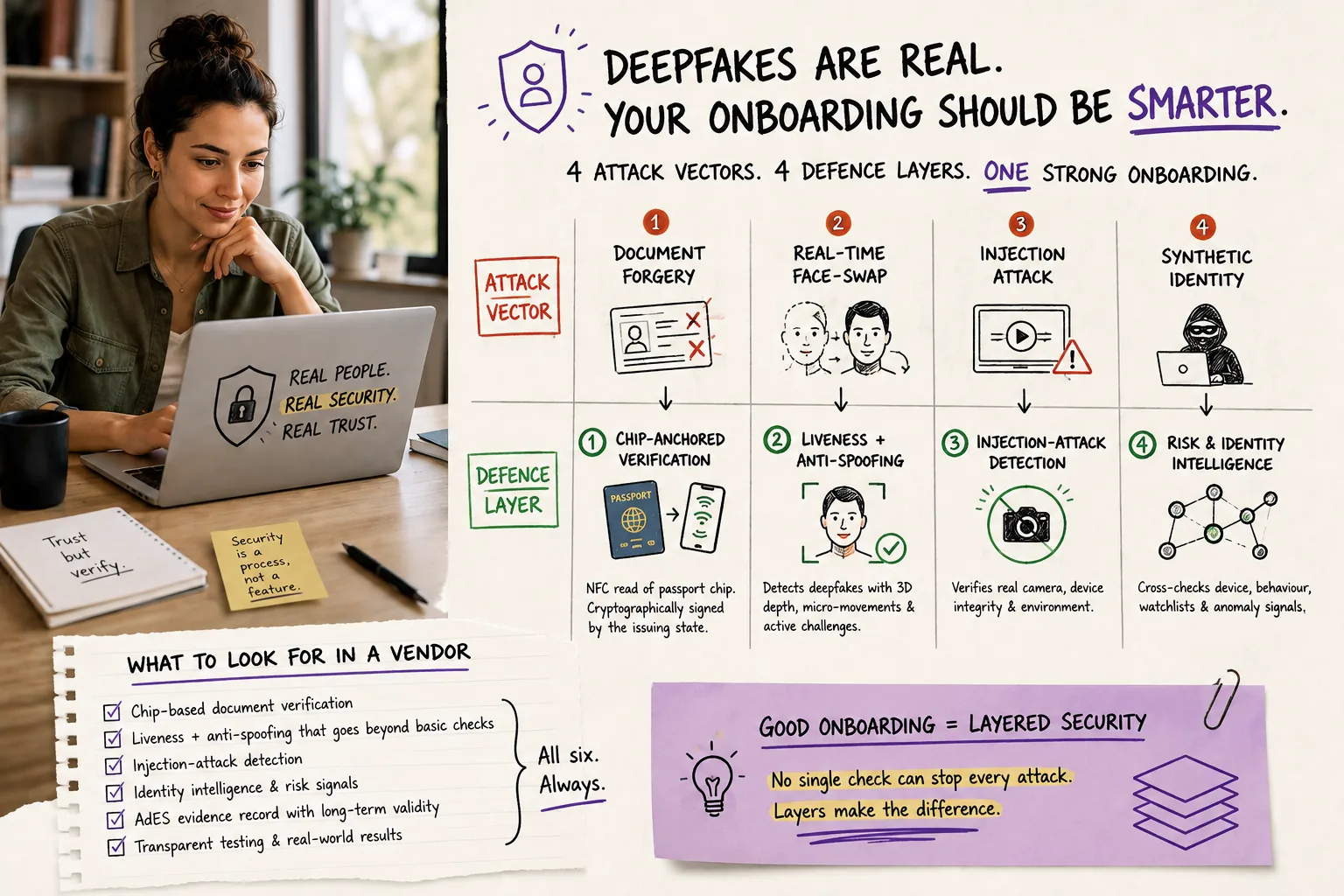
Vendors that combine chip-anchored passport-NFC verification with liveness-plus-injection-attack detection, wrapped in an AdES evidence record. Deepfake-resistance in customer onboarding is not a single feature — it is the intersection of four defence layers, each of which blocks a different attack vector (document forgery, real-time face-swap, presentation injection, synthetic identity). This post walks the four attack vectors, the four defence layers, and the rubric for evaluating any onboarding vendor's actual deepfake posture in 2026.
The compliance lead of a Malta-licensed iGaming operator forwarded a Reddit thread last week from a customer-onboarding architect at a Copenhagen-based fintech: the fintech's onboarding vendor had reported a 0.02% deepfake-attempt rate against their onboarding pipeline over Q2 2026 — a number that read as reassuring until you did the volume math. The fintech was onboarding roughly 45,000 customers per quarter; 0.02% is nine successful deepfake-based onboarding events per quarter, sixteen going undetected past the initial screen and caught only later at behavioural-anomaly review. In an iGaming context, where regulator-facing incident reports flag every one of those cases, the same rate would produce reportable events at a pace that would attract Malta Gaming Authority attention within one filing cycle. The compliance lead's question was direct: which vendors can actually claim deepfake resistance, and what does "deepfake resistance" mean as an evaluation criterion? This post is the answer at the layer a serious procurement review actually operates at.
What does "deepfake resistance" actually mean at the customer-onboarding layer?
It means the onboarding pipeline blocks each of the four distinct deepfake attack vectors with a defence layer specifically designed for that vector. There is no single "deepfake detection" feature that covers all four — vendors that claim otherwise are either simplifying for the marketing site or genuinely missing one or more layers.
The four attack vectors, each with its own defence surface, are the mental model that lets the procurement conversation move past "does your product detect deepfakes" (which every vendor will answer yes to) into "which specific attack vector does each of your defence layers block, and can you demonstrate each one with a red-team test". The second conversation is where the actual capability differences surface.
What are the four deepfake attack vectors in customer onboarding?
Four distinct attack patterns, each targeting a different point in the verification pipeline.
Attack vector one: document forgery. The attacker presents a physically forged or digitally altered document — a fake passport photo page, a manipulated national ID card, a tampered driving licence. For document-scan-only onboarding pipelines, the defence is optical anti-fraud inspection (holograms, microprinting, MRZ consistency checks, security-feature detection). This defence is real but bounded — the sophistication of the forgery-detection algorithm has to keep pace with the sophistication of the forgery-generation tools, and 2026 forgery generation is dramatically better than it was in 2023.
Attack vector two: real-time face-swap deepfake. The attacker holds up a real (or forged) document, but the face captured by the camera during the biometric step is a real-time face-swap output — either the attacker's own face manipulated to match the document photo, or a completely synthetic face matched to the document. This is the vector most public discourse means when it says "deepfake". The defence is liveness detection — a combination of subtle-motion analysis, 3D depth inference from monocular camera, active-challenge prompts (blink, turn head, smile), and comparison of the presented face's biometric signature to the document photo's signature.
Attack vector three: injection attack. The attacker bypasses the camera entirely — feeding a pre-recorded or synthetically-generated video stream directly into the biometric pipeline through a virtual camera driver, a browser extension, or a modified mobile app. The camera the vendor thinks it's reading from is not the physical camera on the device. Standard liveness detection does not defend against this because the video the pipeline receives is technically "live" in the temporal sense — it just isn't coming from the physical device the pipeline believes it's coming from. The defence is presentation-attack detection at the hardware/software boundary — device-attestation signals, camera hardware fingerprinting, browser API integrity checks, and mobile-app anti-tamper detection.
Attack vector four: synthetic identity onboarding. The attacker presents a real document (issued to a real person) plus a real live face (the attacker's own or a coerced participant's) — but the person is a legitimate individual being used as a mule for a synthetic-identity onboarding flow whose downstream account will be used for fraud. This is not technically a deepfake attack at the verification layer — the verification legitimately passes. The defence is upstream: cross-checking the person's identity against risk databases, matching device-fingerprinting signals against known-fraud device patterns, and applying behavioural-anomaly detection at the account-activation and first-transaction layers. This vector is where most published "verification passed but fraud occurred" cases actually sit.
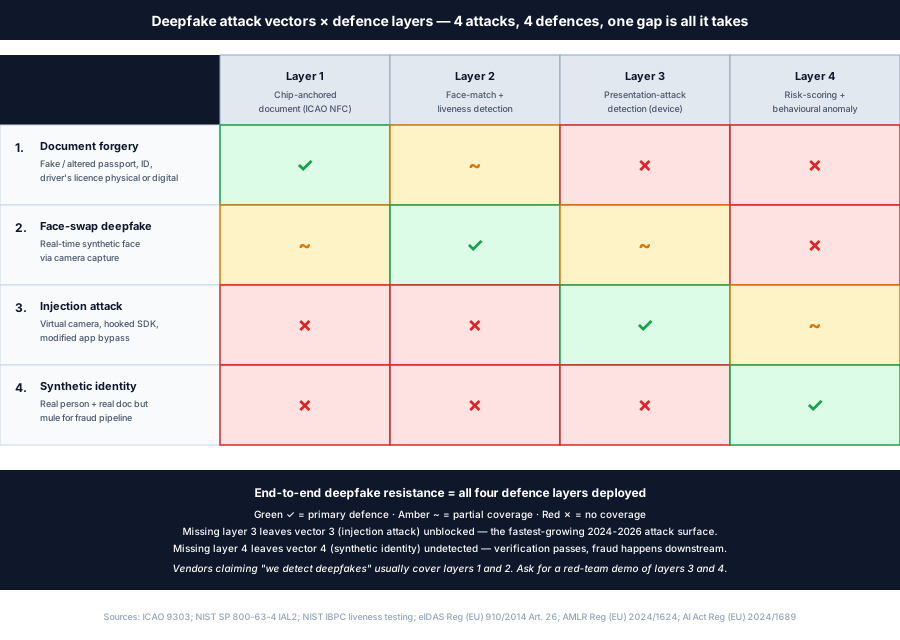
The four vectors are architecturally independent. A vendor whose product blocks vectors one and two but not three and four is providing partial deepfake resistance — and the partial coverage is exactly where sophisticated attackers focus.
Which four defence layers make onboarding actually deepfake-resistant?
Four layers, each blocking a different vector, and the vendor needs all four to claim end-to-end deepfake resistance.
Layer one: chip-anchored document verification. For ICAO 9303 passport-carrying jurisdictions, reading the passport's NFC chip and verifying its signature against the ICAO Public Key Directory produces a cryptographic guarantee that the document was issued by a real state and has not been tampered with. Chip Authentication (part of the ICAO 9303 mechanism) confirms the chip is not cloned; PACE (Password Authenticated Connection Establishment) binds the chip read to physical presence. This layer blocks attack vector one (document forgery) with cryptographic evidence rather than optical inspection. For jurisdictions without an NFC document, document authenticity verification via a well-instrumented vendor stack is the fallback — meaningfully weaker than the chip-anchored path but still meaningfully stronger than an OCR-plus-photo scan.
Layer two: biometric face-match against the chip photo, plus liveness detection. The biometric face-match step compares the live face to the chip's signed photograph (not the front-of-document printed photo, which could be manipulated). The liveness detection layer within this compares the presented face against a battery of liveness signals — subtle skin-texture microexpressions, 3D depth inference, active-challenge responses, motion coherence — designed to distinguish a live face from a manipulated video feed. NIST IBPC-tested liveness algorithms (FaceTec being the reference implementation for many vendors) close attack vector two.
Layer three: presentation-attack detection at the device layer. This is the layer most vendors under-invest in and where the fastest-growing attack surface currently sits. Defence includes device-attestation (SafetyNet on Android, DeviceCheck on iOS), camera-hardware fingerprinting, browser API integrity checks (detecting virtual camera drivers), and mobile-app anti-tamper detection (detecting hooking frameworks, jailbroken or rooted devices, and modified app binaries). The pattern: block the attacker's ability to feed a synthetic video into the pipeline at the boundary between the physical camera and the biometric pipeline. This layer blocks attack vector three.
Layer four: cross-database risk-scoring plus behavioural-anomaly detection. This is the layer that catches attack vector four — the synthetic-identity onboarding that legitimately passes the verification layers because the person and the document are both real. Defence signals include device-fingerprinting matched against known-fraud device patterns, IP geolocation vs claimed jurisdiction, behavioural patterns during onboarding (typing cadence, form-fill patterns, session duration), Interpol Stolen and Lost Travel Documents (SLTD) database checks, sanctions/PEP list checks under AMLR Regulation (EU) 2024/1624, and (for higher-risk verticals) known-mule database checks. This layer does not block onboarding — it flags it for enhanced due diligence.
A vendor with all four layers can claim end-to-end deepfake resistance. A vendor with three of four has a specific weakness at whichever vector is unblocked, and that weakness is where the incident report will surface.
Where does most vendor coverage actually fall short?
Layer three is the current gap for most published onboarding vendors, and the gap that fastest-growing attack sophistication is exploiting.
Injection attacks are a 2024-2026 arms race. Virtual camera drivers, deepfake browser extensions, and modified mobile apps that feed synthetic video into biometric pipelines are commercially available (sometimes as legitimate developer tools, sometimes as underground offerings). Vendors whose liveness detection was designed for the world of "the camera shows what the physical camera captures" are systematically under-defended against a world where the "camera" is a driver that can substitute any video stream.
Vendors that invested early in presentation-attack detection at the device layer are the ones producing the "deepfake attempts blocked" numbers that hold up under third-party audit. Vendors whose product still evaluates presented-face liveness without evaluating the device presenting the face are producing numbers that measure detections at the camera-frame level while missing detections at the video-source level.
The procurement question that surfaces this: ask any vendor to demonstrate a red-team test where the attacker uses a commercially-available virtual camera driver to inject a face-swap video into the onboarding flow, and observe whether the vendor's pipeline blocks the attempt or accepts it. Vendors whose layer-three defence is real will demonstrate the block confidently; vendors whose defence is only layers one and two will hedge on the demonstration.
Where does IdentiGate fit — and the honest posture
The identity-verification product ships layer one (chip-anchored passport-NFC verification across all 179 ICAO 9303 countries plus document + face-match for the remaining jurisdictions) and layer two (biometric face-match against the chip photo plus NIST IBPC-tested liveness detection via a specialised liveness vendor stack). Layer three (presentation-attack detection at the device layer) is a component we ship in partnership with device-attestation infrastructure — SafetyNet, DeviceCheck, and browser integrity checks integrate cleanly into our verification flow.
Layer four (cross-database risk-scoring plus behavioural-anomaly detection) is where our posture is honest about the boundary: we produce the verified identity artefact under an AdES record per eIDAS Article 26 that the customer's fraud-detection stack consumes as one input, but we do not (today) ship the fraud-detection stack itself. Customers typically pair our verification output with a specialised fraud-detection vendor whose signal library covers device-fingerprinting, IP intelligence, behavioural patterns, and PEP/sanctions data — the output of our layer 1-3 verification becomes the identity anchor that the fraud-detection stack scores against.
The pattern I would recommend for a compliance-serious customer-onboarding architecture: our layers 1-3 for the identity-verification event; a specialised fraud-detection vendor for layer 4 signal collection and scoring; the customer's risk engine to combine both into an accept/enhanced-due-diligence/reject decision. Splitting the responsibilities at the boundary between "identity verification" and "fraud detection" gives cleaner accountability than trying to source all four layers from a single vendor whose depth on any one layer is diluted.
The engineering push-back on "we detect deepfakes"
Where I would push back on the "we detect deepfakes" claim on most onboarding vendor pages is that the claim usually refers to attack vectors one and two — document forgery and face-swap at the camera frame — without addressing vector three (injection attack at the video-source layer) or vector four (synthetic identity that legitimately passes verification). Both of those are the vectors that produce the incident reports at the far end of an onboarding architecture, and both need explicit defence rather than an assumption that the earlier layers cover them.
The procurement conversation that moves past marketing into architecture reality is the four-vector question: which specific attack vector does each of your defence layers block, and can you demonstrate each one with a red-team test the customer can independently verify? Vendors whose answers are precise per vector are the vendors whose deepfake-resistance claims survive contact with a serious compliance review; vendors whose answers collapse into general reassurance are the ones whose deepfake-resistance is a marketing overlay on a partial product.
The customer-onboarding architects who get this right in 2026 are the ones whose procurement rubric asked all four questions specifically — not the ones who accepted "yes we handle deepfakes" as the vendor's whole answer.
More in this cluster
Companion earlier posts on adjacent identity-verification patterns:
- How Do You Verify a Gig Worker's Identity Without Re-KYC on Every Task? — the reusable-identity primitive that anchors this deepfake-defence architecture at first-verify
- Deepfake Attack Surface at the Passport-Chip Layer — the technical deep-dive on why the chip-anchored path is the defence at vector one
- Remote Proctoring 2026: Can Deepfakes Beat Selfie ID Verification? — the deepfake angle applied to education / exam-supervision contexts
Sources
Primary — identity assurance and document standards
- ICAO Doc 9303 — Machine Readable Travel Documents
- NIST SP 800-63-4 — Digital Identity Guidelines
- NIST SP 800-63A — Identity Proofing and Enrollment
Primary — eIDAS and evidence framework
Primary — AML + regulatory frameworks
About the author
Mairi Kutberg is a co-founder of IdentiGate OÜ, a European identity-verification and digital-signature company building on top of chip-anchored identity proofing (ICAO 9303 passport NFC), Advanced Electronic Signatures under eIDAS Article 26, and Advanced Electronic Seals. She works with customer-onboarding architects, KYC compliance leads, and iGaming and fintech operators on the intersection of deepfake-resistant verification and AMLR/AI-Act regulatory posture.