International Student Identity 2026: Where Does It Break?
6.9 million students study cross-border each year (UNESCO 2024). EUDI covers 27 EU states, eduGAIN is web-only with gaps. The biometric passport is the only universal primitive.
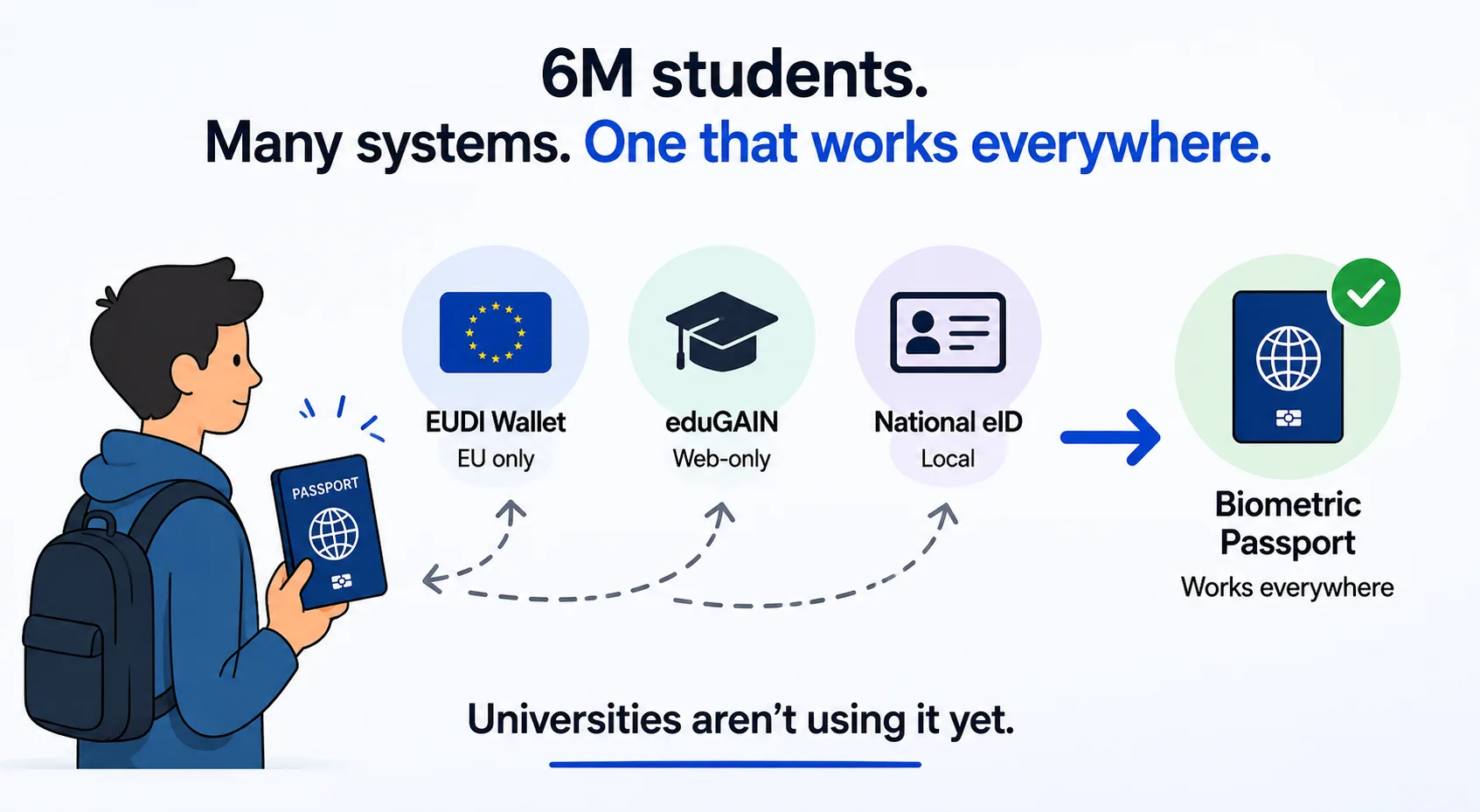
International student identity broke at three million students; at 6.9 million it is openly failing. EUDI Wallet covers 27 EU Member States. eduGAIN is web-only with geographic gaps. National eIDs work locally. The biometric passport — NFC chip in 179 ICAO 9303 countries, document plus face match for every remaining country — is the only proofing route that reaches every international student.
A 19-year-old from Lagos applies to a Master's programme in Munich. Her admission file moves through a German university's intake system; once admitted, she gets eduGAIN-federated credentials to access library resources, course platforms, and exam systems; at graduation, the university issues a Verifiable Diploma on the European Blockchain Services Infrastructure (EBSI). Each of those layers makes a different assumption about who she is and how that was proven. None of the assumptions are coordinated across the layers. Each layer is a separate identity-proofing exercise. And none of those layers were built for the non-EU student — which is to say, for most of the 6.9 million students moving across borders this year (UNESCO Institute for Statistics, 2024).
How Many Students Move Across Borders Each Year?
International student mobility passed 6.9 million students in 2024, a record high projected to exceed 10 million by 2030 according to UNESCO's Institute for Statistics (UNESCO — Record number of higher education students; IOM World Migration Report 2024 — International students). The OECD's Education at a Glance 2024 records an 18 percent increase in international students hosted by OECD countries between 2018 and 2022, with Asia accounting for 58 percent of all internationally mobile students in OECD destinations in 2023 (OECD — International student mobility; OECD — What are the key trends in international student mobility?).
The number combines:
- Inbound EU mobility — students from non-EU countries arriving in EU universities (largest source countries: India, China, Türkiye, Morocco, Ukraine, Nigeria, Vietnam).
- Intra-EU mobility — Erasmus+ alone moved almost 1.5 million participants in 2024 under a €4.7 billion annual budget (European Commission — Erasmus+ 2024 statistics).
- Outbound EU mobility — EU citizens studying in the US, UK, Switzerland, and other non-EU destinations.
The mix matters because each of these flows hits a different combination of identity infrastructure. Intra-EU mobility benefits from eIDAS interoperability and the EUDI Wallet roadmap. Inbound non-EU mobility — the largest segment by volume — does not benefit from either of those, because both are designed for EU-citizen identity. Outbound EU mobility hits the same wall in reverse: an EU student in Boston cannot present an EUDI Wallet credential to a US institution that does not interface with the EU trust framework.
The administrative response to this scale has been to lean on manual processes: scanned passport copies, courier-delivered transcripts, embassy-stamped attestations, paid background-check vendors. Each is a separate trust assumption, each cost borne somewhere in the system, each with a different fraud window. In my view, the structural problem is that universities are not treating identity proofing as architecture — they are treating it as paperwork. That works for 60,000 international students a year, the volume European universities saw in the 1990s. It does not work for 6.9 million.
What Each Identity Layer Actually Covers (and Where It Stops)
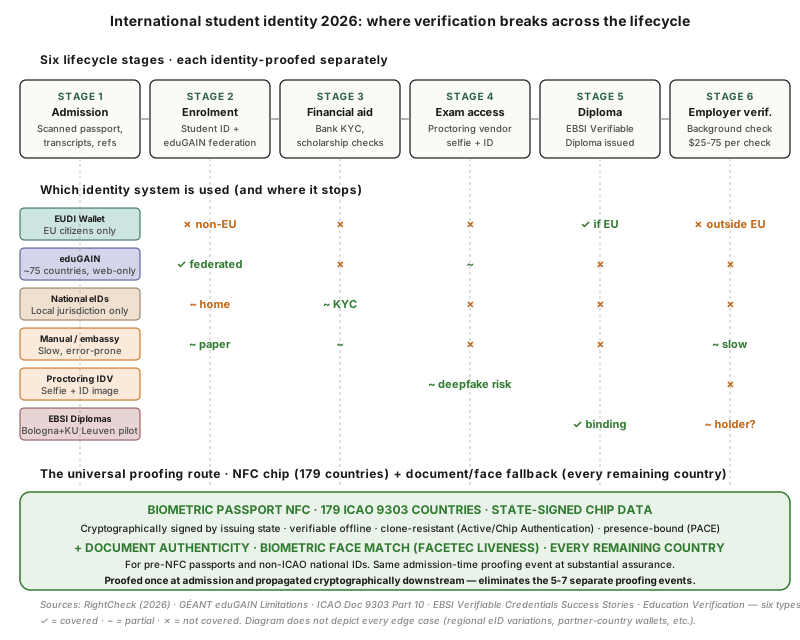
Universities operating today layer four identity systems on top of the same student, with each system covering a different population and a different lifecycle stage.
EUDI Wallet (EU citizens and residents, 27 Member States). Regulation (EU) 2024/1183 obliges every Member State to make a wallet available by December 2026 (Regulation (EU) 2024/1183 — EUR-Lex). Rollout is uneven; several Member States will miss the deadline. Even fully deployed, EUDI covers EU citizenship plus residency permits — not the inbound non-EU student. See the 27 vs 153 country gap analysis for the broader pattern.
eduGAIN (academic federated identity, GÉANT). eduGAIN interconnects national academic identity federations across roughly 75 countries. Its limitations are explicit in its own published documentation (eduGAIN Limitations — GÉANT wiki): web-only authentication, no large-scale non-web flows, REFEDS Single-Factor and Multi-Factor profiles inconsistently deployed across federations, and countries can opt-in to national federation but not eduGAIN. Once a student is admitted, eduGAIN works well for library access and course platforms. It does not solve the upstream question of how the student's identity was proofed at admission.
National eID schemes. A Polish student in Krakow uses Polish national eID; the same student on Erasmus in Belgium presents a Belgian-issued document. Cross-border recognition under eIDAS is partial. National eID schemes do not interoperate cleanly with non-EU identity issuance.
ICAO 9303 biometric passport (with a document-and-face-match fallback). Issued by 179 countries under ICAO Doc 9303 specifications. The chip carries data signed by the issuing state, verifiable offline through ICAO trust lists, clone-resistant via Chip Authentication and Active Authentication, and bound to physical presence through the PACE protocol. For applicants whose document is pre-NFC, or who present a non-ICAO national ID, document authenticity verification combined with biometric face match (FaceTec liveness) provides the same admission-time proofing event at substantial assurance. Together these two routes cover every international student already at the border.
The architectural observation here is straightforward. Three of those four layers are built for specific national or regional ecosystems. The fourth — the biometric passport — is the only one whose footprint matches the footprint of the international student population. From an engineering angle, the missing piece in university identity infrastructure is the layer that connects the passport-as-proof to the credentials issued downstream. That layer is not a product universities buy today; it is a primitive that has to be bolted onto admission systems, learning platforms, exam platforms, and diploma-issuance pipelines, separately.
Why Does the International Student Identity Gap Compound Across the Lifecycle?
The identity-proofing problem looks small at any single stage of a student's lifecycle, and bigger when you look at all of them at once.
- Admission. Documents arrive as scans, often through third-party application platforms. Universities re-verify nothing beyond document plausibility. INTERPOL has documented persistent growth in forged-document fraud across visa-application pipelines (INTERPOL — Document and identity fraud); forged transcripts and bogus reference letters are common in the same fraud category. The cost is real but diffuse: universities treat individual forgeries as exceptions rather than evidence of a verification-method failure.
- Enrolment. Once admitted, the student gets credentials — student ID, university account, eduGAIN federation entry. The credential is bound to whichever identity record the admission process produced. If the admission record was a scanned passport copy, the chain of trust starts with a scan.
- Financial aid / fee payment. Identity verification re-runs in financial systems — bank KYC, scholarship office checks, sometimes embassy-level confirmation. The US Department of Education prevented over $1 billion in federal student aid fraud between January 2025 and May 2026 by tightening FAFSA identity verification (US Department of Education — $1 billion in student aid fraud prevented). Each financial-system check is a separate workflow. None are coordinated with admission.
- Exam access. Online exams introduce a different identity question: is the person taking the exam the person the credential was issued to? Remote proctoring vendors run their own document-and-selfie verification, separate from everything above. Deepfake-enabled impersonation makes selfie-only verification less reliable each quarter.
- Diploma issuance. EBSI Verifiable Diplomas are in production at the University of Bologna and KU Leuven, with the multi-university pilot launched in July 2021 expanding to dozens of institutions (EBSI Verifiable Credentials Success Stories — European Commission). EBSI cryptographically binds a diploma to a holder identifier. The holder identifier still has to be tied to a verified human — and that tying step is still done locally.
- Employer verification. A graduate in Lagos presents an EBSI Verifiable Diploma to a Dubai employer. The diploma's authenticity is cryptographically verifiable; the linkage to the candidate sitting in the interview is not. The wider academic-credential fraud market is estimated in the multi-billion dollar range globally according to UNESCO's higher-education recognition work (UNESCO — Global Convention on the Recognition of Qualifications concerning Higher Education).
The cumulative effect is that the same student is identity-proofed five to seven times across the lifecycle, by five to seven different systems with five to seven different trust assumptions. The gaps in any one of them propagate through the rest. What I would push back on is the assumption that this is each system's individual problem. It is not — it is an architecture problem about the absence of a shared identity-proofing layer underneath them all.
What Could Universities Be Doing Differently in 2026?
The honest architectural answer is to push the identity-proofing event upstream to a single anchored moment and propagate the result downstream cryptographically.
A practical 2026 implementation has four characteristics:
- Passport-NFC enrolment, with a document fallback for the rest. At admission, the prospective student scans the NFC chip of their biometric passport with a smartphone. The chip's data is verified offline against the ICAO trust list; Active or Chip Authentication confirms the chip is not cloned; PACE binds the read event to physical presence. The output is a cryptographic record signed by the issuing state — not a photocopy in a vendor's database. The NFC route works for the 179 countries that issue ICAO 9303-compliant passports. For applicants outside that set, or whose passport pre-dates the chip, document-authenticity verification plus biometric face match runs as a fallback through the same admission flow — closing the remaining countries without a fragmented vendor stack.
- Identity record persistence. The proofing event produces an advanced electronic signature (AdES) under eIDAS bound to the verified identity, retained as an audit-defensible artefact. AdES is the right level here: it carries evidentiary weight, is admissible under eIDAS Article 25 non-discrimination, and does not require the qualified-certificate machinery that QES does for a use case where QES is not legally required.
- Downstream propagation. The verified identity record connects to the eduGAIN-federated credential issued at enrolment, to the financial-aid record, to the exam-platform identity, and to the EBSI Verifiable Diploma at graduation. Each downstream system trusts the upstream proofing event rather than redoing it.
- Cross-border verification at exit. When the graduate presents a diploma to an employer outside the EU, the employer can verify both the diploma cryptographically (via EBSI) and the holder-to-diploma binding (via the original proofing record). The chain runs end-to-end across jurisdictions without depending on any single national eID system.
This architecture does not require the EU to extend EUDI Wallet to non-EU citizens; it does not require eduGAIN to operate outside its current scope; it does not replace EBSI. It sits beneath all three as the identity-proofing primitive that they currently assume but do not specify.
In my view, the universities that solve this in 2027 will not be the ones with the biggest IT budgets — they will be the ones that recognise that the proofing layer is architecture, not paperwork, and treat it accordingly. The current trajectory has admissions offices upgrading anti-fraud checks one form at a time; the lever is the underlying primitive, not the form.
Where the Cluster Goes Next
This post sits at the front of a 6-post cluster looking at international student identity from different angles. The following posts go deeper into specific layers of the problem:
- Post 2 — Ghost students and FAFSA fraud (Mairi, 31.05.2026): the California Community College 31% fraud rate, the April 2026 US FAFSA verification rollout, and why camera-plus-government-ID still has gaps.
- Post 3 — The diploma mill industry and the cryptographic fix (Gustav, 02.06.2026): how chip-based authentication closes the credential-fraud window at the employer side.
- Post 4 — Remote proctoring when deepfakes beat selfie IDs (Mairi, 04.06.2026): Q1 2026's first commercial deepfake-detection module, the AI Act high-risk biometrics implications, and chip-based binding to enrolment identity.
- Post 5 — EBSI Verifiable Diplomas and the holder-binding gap (Gustav, 06.06.2026): the architecture detail under the EBSI rollout, and why the holder side is the unsolved half.
- Post 6 — A university identity stack for 2027 (Mairi, 08.06.2026): the practical playbook combining all five threads.
More in this cluster
- Passkeys Solve Authentication — Not Identity. Here's Why.
- EU AMLR 2027: Your KYC Stack Needs a Non-EU Identity Layer
- FAFSA Fraud 2026: How Did $1B+ Almost Reach Ghost Students?
- Diploma Mills 2026: Where Does Cryptographic Verification Hold?
- Remote Proctoring 2026: Can Deepfakes Beat Selfie ID Verification?
- EBSI Verifiable Diplomas 2026: How Is the Holder Actually Bound?
- University Identity Stack 2027: Where Should You Actually Start?
- What Is a Zero-Knowledge Proof — and Why Should You Care?
- Do You Really Have to Verify Your Age Every Time Online?
- What's the Difference Between a Digital ID and a Digital Wallet?
- How Do You Verify Student Identity for Attendance, Access, and Exams Under GDPR and the AI Act?
FAQ
How many international students are there each year? 6.9 million in 2024, a record high, according to the UNESCO Institute for Statistics — up from 2.5 million in 2002 (+176% over two decades). UNESCO projects the total to exceed 10 million by 2030. The largest sending countries to EU universities are India, China, Türkiye, Morocco, Ukraine, Nigeria, and Vietnam.
Does the EUDI Wallet cover international students? No. The EU Digital Identity Wallet is designed for EU citizens and residents of EU Member States under Regulation (EU) 2024/1183. It does not extend to non-EU students arriving in EU universities, who remain the largest segment of cross-border student mobility.
What is eduGAIN and where does it stop working? eduGAIN is an interfederation service interconnecting national academic identity federations, run by GÉANT. It works well for federated access to library resources, course platforms, and inter-institutional services once a student has been admitted. It is web-only and depends on the upstream identity proofing done by each university at admission — which is the step it does not standardise.
What is ICAO 9303 and why does it matter for universities? ICAO Doc 9303 is the international standard for machine-readable travel documents, including biometric passports. The chip carries data signed by the issuing state, is verifiable offline, and is issued by 179 countries. For applicants whose documents fall outside that scope — pre-NFC passports, non-ICAO national IDs — document-authenticity verification combined with biometric face match (FaceTec liveness) provides the same proofing event. Together the two routes cover every international student already.
Does this require a qualified electronic signature (QES) for the audit chain? No. Advanced electronic signature (AdES) under eIDAS Article 26 is sufficient for the identity-proofing audit chain. eIDAS Article 25 non-discrimination makes AdES admissible; Article 27 establishes QES as a ceiling for public services, not a floor. Universities adopting QES for routine identity-proofing logs would over-buy.
How does this relate to EBSI Verifiable Diplomas? EBSI's role is to cryptographically bind a diploma to a holder identifier. The question of how the holder identifier was tied to a verifiable human in the first place is currently left to each issuing institution. The passport-NFC proofing event at admission is one way to close that gap — and the focus of Post 5 in this cluster.
Sources
Primary statistics on international student mobility
- UNESCO — Record number of higher education students (6.9M in 2024)
- UNESCO Institute for Statistics — UIS Data Browser
- OECD — International student mobility (Education at a Glance 2024)
- OECD — What are the key trends in international student mobility?
- IOM — World Migration Report 2024: International students
- European Commission — Erasmus+ 2024 annual statistics (1.5M participants)
Regulatory and architecture sources
- Regulation (EU) 2024/1183 — eIDAS 2.0 / EUDI — EUR-Lex
- eduGAIN Limitations — GÉANT wiki
- EBSI Verifiable Credentials — European Commission
- EBSI Verifiable Credentials Success Stories — European Commission
- ICAO Doc 9303 — Machine Readable Travel Documents
Fraud and qualifications recognition
- INTERPOL — Identity and travel document fraud
- US Department of Education — $1B+ federal student aid fraud prevented
- UNESCO — Global Convention on the Recognition of Qualifications concerning Higher Education
About the author
Gustav Poola is co-founder of IdentiGate. He focuses on the technical architecture of passport-chip identity verification, advanced electronic signature production under eIDAS, and the engineering of identity flows that survive regulator and auditor walk-back.