Diploma Mills 2026: Where Does Cryptographic Verification Hold?
The diploma mill industry runs at roughly $7B/year. EBSI Verifiable Diplomas cryptographically bind a credential to a holder identifier — but the holder identifier itself is still proofed locally. The chain holds at the issuer; it breaks at the person.
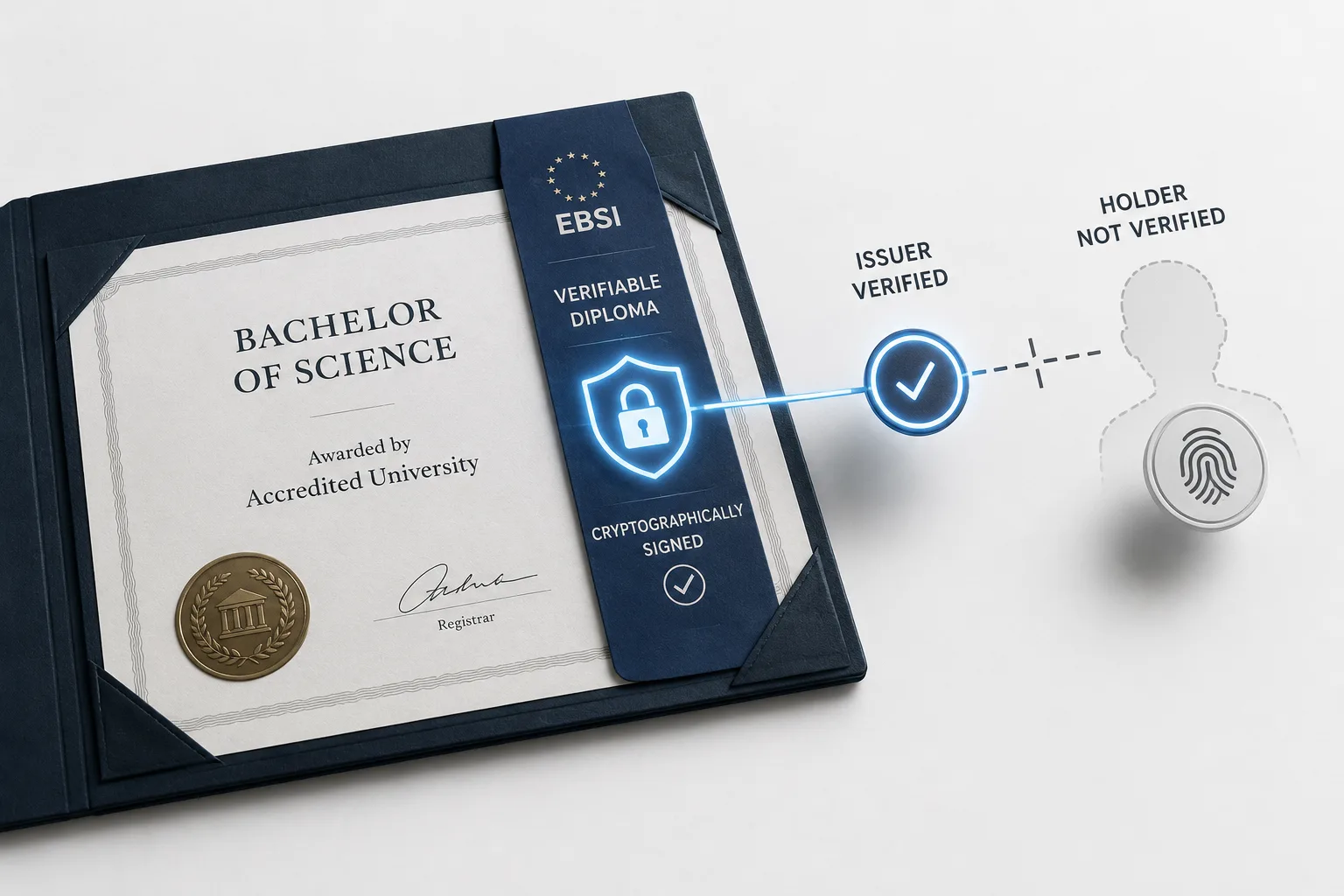
The diploma mill industry generates roughly $7 billion in annual revenue worldwide. Cryptographic verification through EBSI Verifiable Diplomas binds a credential to a holder identifier — but the holder identifier itself is still proofed locally. The chain holds at the issuer; it breaks at the person. Closing that step is what 2026 actually changes.
If you read the EBSI Trust Framework documentation cover to cover, the holder binding step is the bit that isn't standardised. Issuer signing — standardised. Revocation lists — standardised. Credential schema — standardised. The question of how the person presenting the credential is the person it was issued to is passed back to each issuing institution to handle locally. That's the design. Honestly, that's also the right design at the EBSI layer. But it's where the trust chain becomes only as strong as the institution's admission-time proofing, which is the gap Post 1 in this cluster walks through end-to-end.
How Big Is the Diploma Mill Industry, Really?
Estimates of the diploma mill market vary by source and definition, but the centre of the range is now firmly above $7 billion per year. The Council for Higher Education Accreditation has called diploma mills "an old problem and a new threat" and tracked their expansion into online channels and AI-generated transcripts over the past two reporting cycles (Council for Higher Education Accreditation — Degree Mills: An Old Problem & A New Threat). The broader academic-fraud ecosystem — contract cheating, fake transcripts, manipulated grades, diploma resale — sits closer to $21 billion when measured on the same basis. UNESCO's Global Convention on the Recognition of Qualifications work catalogues credential fraud as one of the four standing obstacles to cross-border qualification recognition (UNESCO — Global Convention on the Recognition of Qualifications concerning Higher Education).
Then there is the single-operator end of the distribution. The Pakistan-based Axact operation is the most-documented single diploma mill in modern history: eight million fake diplomas sold across 190 countries, gross revenue past $1 billion, exposed publicly through investigative reporting in 2015 and partially prosecuted since (AACRAO — Academic Fraud and the World's Largest Diploma Mill). Smaller operations measured by the US Federal Trade Commission have run on the order of tens of millions of dollars before being shut down. The volume of successful prosecutions runs in the dozens; the volume of operations runs in the thousands.
What surprises me about the $7B figure isn't the scale. It's that the industry survived this long with so little technical pressure on it. The cryptographic fix existed in standards work from the late 2010s. The deployment didn't catch up until EBSI started shipping pilots in 2021, and even now the deployment footprint is measured in dozens of institutions — not thousands.
What Does Cryptographic Diploma Verification Actually Prove?
Three things, narrowly. A cryptographic verification answers: was this credential issued by an accredited institution; has it been revoked; and is the credential's data unchanged since issuance.
The technical mechanism is consistent across implementations: the issuing institution signs a credential against a key that is registered in a trusted issuers list. The verifier checks the signature against the published key, then checks the revocation status against the issuer's status list, then checks the credential's data against the signed payload. EBSI implements this on a shared ledger with the European Commission's Digital Building Blocks team running the Trusted Issuers infrastructure (European Commission — EBSI Verifiable Credentials; EBSI Hub — Verifying credentials). The W3C Verifiable Credentials Data Model is the underlying spec (W3C — Verifiable Credentials Data Model 2.0).
EBSI's revocation framework white paper walks through this in detail, including the trade-offs between status-list approaches, herd-privacy implications, and the operational cost of running revocation at EU scale. It is, on its own terms, a serious engineering artefact.
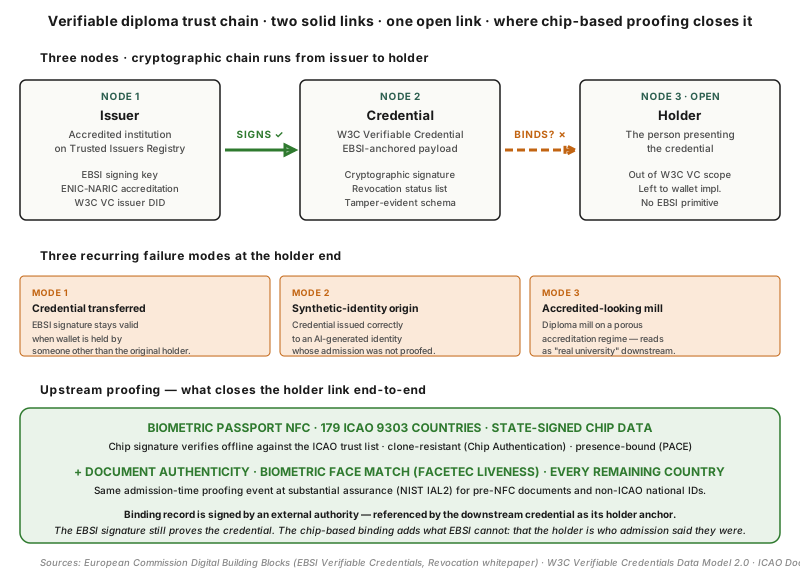
What it does not answer: is the person presenting the credential the same person to whom it was issued. The cryptographic chain proves the document is genuine. It does not, by itself, prove the holder is real, or the right person. The W3C data model defines holder binding as out-of-scope for the credential format — it has to be supplied by an authentication or identity-proofing layer underneath. That layer is what every implementation has to choose, and where the design choices actually matter.
Where Does the Verification Chain Break?
It breaks at the human end. Three failure modes recur in published EBSI pilot reports and in equivalent US verifiable-credential rollouts.
First, the credential is presented by someone who claims to be the holder but isn't. The cryptographic verification passes; the holder is wrong. Without a strong binding to the holder's identity, the credential becomes transferable in practice — the EBSI signature stays valid no matter who walks in with the wallet. This is the case that "show me your diploma at the interview" was designed for, and the case that a vendor-provided photo on a credential cannot reliably solve.
Second, the credential was issued correctly but the underlying identity was a synthetic. The issuing institution proofed the student at admission with a smartphone-captured document image, the student turned out to be an AI-generated identity, the institution issued a legitimate diploma to the AI-generated identity, and the diploma is cryptographically valid forever. EBSI cannot detect this; it isn't supposed to.
Third, the credential ecosystem includes legitimate-looking institutions that are themselves diploma mills with a thin layer of cryptographic packaging. The Trusted Issuers Registry is the safeguard here — ENIC-NARIC and equivalent national recognition bodies maintain the accreditation lists that feed it (ENIC-NARIC — Non-recognised HEIs and Diploma Mills). The safeguard works inside Europe. It works less reliably for diplomas issued by an accredited-looking institution in a country whose accreditation regime is itself porous, and which still gets read as "issued by a real university" by an HR system in Frankfurt or Dublin.
Sitting with the actual EBSI spec, you can see the engineering team made the right architectural choice — solve issuer authenticity first, leave holder binding to the wallets and the identity layer underneath. The cost is that every wallet implementation is now making its own decisions about how to prove the holder, and none of those decisions are standardised across the EBSI footprint.
How Does Chip-Based Holder Binding Close It?
By moving the proofing event upstream and anchoring it on a primitive that is hard to forge at scale: the biometric passport NFC chip for 179 ICAO 9303 countries, with document authenticity plus biometric face match (FaceTec liveness) for every remaining country. Both routes produce a binding record signed at admission, retained as an Advanced Electronic Signature (AdES) under eIDAS, and verifiable independently of the receiving institution. The full protocol walk-through — how a chip-derived binding integrates with W3C Verifiable Credentials 2.0, EBSI's did:key resolution for natural persons, and the DPoP presentation flow at verification time — is the subject of the companion technical post on EBSI Verifiable Diplomas and holder binding. Here I focus on what the fix means at the fraud-market level.
Where I'd push back on the standard "blockchain solves diplomas" pitch is the framing that the verifiable-credential format is the fix. The verifiable-credential format is the substrate. The fix is the proofing layer underneath. Without it, EBSI verifies the credential beautifully and the diploma mill industry adapts within two quarters by buying or counterfeiting their way onto the Trusted Issuers list, or by serving credentials to AI-generated holders whose admission was never properly proofed. That is the dynamic the $7B market has been sitting on — not the absence of cryptography, but the absence of a proofing layer strong enough at admission that the downstream cryptographic substrate has something real to sign over.
The honest reading of where 2026 differs from 2020 is that the substrate is now production-ready (EBSI shipped, EUDI Wallet legally mandated in December 2026 per Regulation (EU) 2024/1183), and the conversation can finally move to the proofing layer that the substrate assumes but never specified. The next chunk of the $7B market to close is the chunk that survives when the proofing layer catches up with the substrate.
Where the Cluster Goes Next
This is Cluster Post #3 of 6 on international student identity. Companion posts go deeper into adjacent layers:
- Post 1 (29.05.2026, Gustav) — International Student Identity 2026: Where Does It Break? — the architectural overview across the full lifecycle.
- Post 2 (01.06.2026, Mairi) — FAFSA Fraud 2026: How Did $1B+ Almost Reach Ghost Students? — the synthetic-identity and industrial-operator fraud problem at the admission stage.
- Post 4 (06.06.2026, Mairi) — Remote proctoring when deepfakes beat selfie IDs: the AI Act high-risk biometrics angle, and the exam-stage binding gap.
- Post 5 (08.06.2026, Gustav) — EBSI Verifiable Diplomas and the holder-binding gap, in deeper engineering detail.
- Post 6 (10.06.2026, Mairi) — A university identity stack for 2027: the practical playbook combining all five threads.
More in this cluster
- Remote Proctoring 2026: Can Deepfakes Beat Selfie ID Verification?
- University Identity Stack 2027: Where Should You Actually Start?
- How Do You Verify Student Identity for Attendance, Access, and Exams Under GDPR and the AI Act?
FAQ
How big is the diploma mill industry in 2026? Roughly $7 billion in annual revenue from diploma mill operations alone, with the broader academic fraud ecosystem — contract cheating, manipulated grades, transcript forgery — estimated at around $21 billion. The largest single documented operation is Pakistan-based Axact, which sold an estimated 8 million fake diplomas across 190 countries and grossed over $1 billion before its 2015 exposure.
What do EBSI Verifiable Diplomas actually verify? Three things, narrowly: that the credential was issued by an accredited institution on the Trusted Issuers Registry, that it has not been revoked, and that its data has not been altered since issuance. The W3C Verifiable Credentials Data Model defines the underlying format; holder binding — confirming the presenter is the original holder — is explicitly out-of-scope for the credential format and is left to the identity-proofing layer underneath.
Why isn't holder binding part of the EBSI spec? The EBSI engineering team treats issuer authenticity and credential format as the EBSI layer's responsibility, and holder binding as the wallet's responsibility. This is the right architectural separation — EBSI cannot make decisions about which national ID, which biometric primitive, or which liveness vendor a Member State accepts. The cost of the separation is that every wallet implementation makes its own holder-binding decisions, and the quality of the downstream verification depends on those decisions.
How does the biometric passport chip close the holder-binding gap? The passport NFC chip carries data signed by the issuing state under ICAO Doc 9303. Active or Chip Authentication confirms the chip is not cloned; PACE binds the read to physical presence; the verification runs offline against the ICAO trust list. The result is a holder identity proofed by a primitive that the receiving institution did not issue and cannot easily forge. For 179 ICAO 9303 countries, this is the primary route; for the remaining countries, document authenticity plus biometric face match (FaceTec liveness) provides an equivalent admission-time proofing event at substantial assurance.
Does this require qualified electronic signatures (QES)? No. Advanced Electronic Signature (AdES) under eIDAS Article 26 carries enough evidentiary weight for the holder-binding record. eIDAS Article 25 non-discrimination makes AdES admissible across Member States; Article 27 makes QES the legal ceiling for public services, not the floor. Universities issuing diplomas as Verifiable Credentials with an AdES-anchored holder binding meet the legal standard without needing the qualified-certificate machinery that QES carries.
Sources
Primary — EBSI and Verifiable Credentials standards
- European Commission — EBSI Verifiable Credentials
- EBSI Hub — How to verify a credential
- EBSI Revocation Framework Whitepaper (V1.0)
- W3C — Verifiable Credentials Data Model 2.0
- Regulation (EU) 2024/1183 — eIDAS 2.0 / EUDI — EUR-Lex
Primary — Identity-assurance and document standards
- ICAO Doc 9303 — Machine Readable Travel Documents
- NIST SP 800-63A — Digital Identity Guidelines: Identity Proofing and Enrollment
- NIST SP 800-63B — Digital Identity Guidelines: Authentication and Lifecycle Management
Primary — Diploma mill scale and recognition bodies
- Council for Higher Education Accreditation — Degree Mills: An Old Problem & A New Threat
- AACRAO — Academic Fraud and the World's Largest Diploma Mill
- ENIC-NARIC — Non-recognised HEIs and Diploma Mills
- UNESCO — Global Convention on the Recognition of Qualifications concerning Higher Education
About the author
Gustav Poola is co-founder of IdentiGate. He focuses on the technical architecture of passport-chip identity verification, advanced electronic signature production under eIDAS, and the engineering of identity flows that survive regulator and auditor walk-back.