FAFSA Fraud 2026: How Did $1B+ Almost Reach Ghost Students?
On 26 April 2026 the US Department of Education launched real-time identity fraud detection inside the FAFSA. California community colleges flagged 31% of 2024 applications as fraudulent. The architectural answer is upstream proofing, not downstream cleanup.
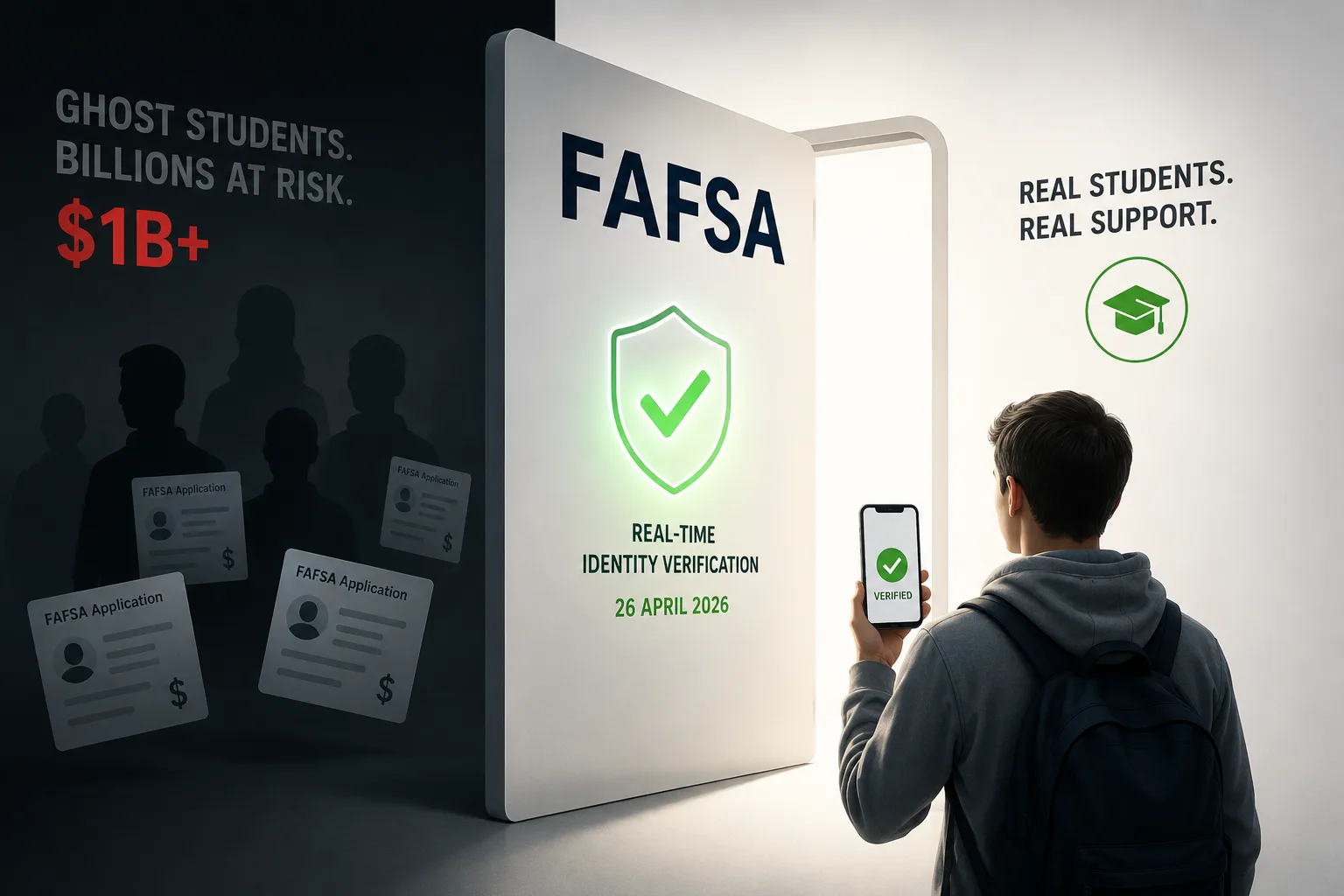
Fraudulent FAFSA submissions cost California community colleges over $11 million in 2024, and the US Department of Education has prevented over $1 billion in federal student aid fraud since January 2025. On 26 April 2026, the Department launched real-time identity fraud detection inside the FAFSA itself. The architectural question that follows is whether camera-plus-government-ID is enough.
For two years the ghost-student problem has been treated as a US community-college problem, a California problem, a fee-waiver problem. It is none of those. It is an identity-proofing architecture problem, and the only reason it surfaced first in US community colleges is that they have the lowest cost of application and the largest federal aid envelope. The proofing primitive failed at the cheapest available door first. What I'd push back on is the framing that this is fixed by tuning fraud-detection rules at the back end — the cheaper, more defensible fix sits at the moment a person first claims to be a student.
How Did Ghost Students Become a Billion-Dollar Problem?
Of all applications submitted to California community colleges between January and December 2024, 31% — more than 1.2 million applications — were determined to be likely fraudulent (California Community Colleges Chancellor's Office data, via CalMatters). The colleges reported losing more than $11 million to financial aid fraud in 2024, and from January through mid-April 2026 a further $4 million in federal aid and over $760,000 in state aid were disbursed and then written off as fraud. The chancellor's office is undertaking what it calls a "complete redesign" of fraud detection (CalMatters — California community colleges crack down on fake students stealing financial aid).
The fraud is operationally simple to describe and operationally hard to stop. Stolen identities, AI-generated personas, and automated application bots act as dozens or hundreds of distinct "students". They submit FAFSA forms, enrol in classes, remain enrolled until the financial aid cheque clears, and disappear. The unit economics work because each fraudulent application costs the operator next to nothing while a successful one returns $5,000-$10,000 in disbursed Pell Grant and state aid.
At the federal layer, the US Department of Education's own number is now public: more than $1 billion in federal student aid fraud prevented between January 2025 and the second quarter of 2026, with additional crackdowns publicly signalled for the remainder of the year (US Department of Education — $1 billion in federal student aid fraud prevented). The Department's parallel announcement framing the rollout as a comprehensive nationwide effort sets out the operating model (US Department of Education — Comprehensive Nationwide Federal Student Aid Fraud Prevention Effort).
What concerns me about the 31% figure is that it is the detected rate, not the actual rate. Detection improved during 2024 because California started taking the problem seriously. The undetected fraud across the rest of the US system — community colleges, four-year institutions, online programmes — almost certainly looks worse, not better. The federal $1B+ prevention number is impressive headline-wise; it is also evidence of how large the window was before anyone closed it.
What Did the US Department of Education Roll Out on 26 April 2026?
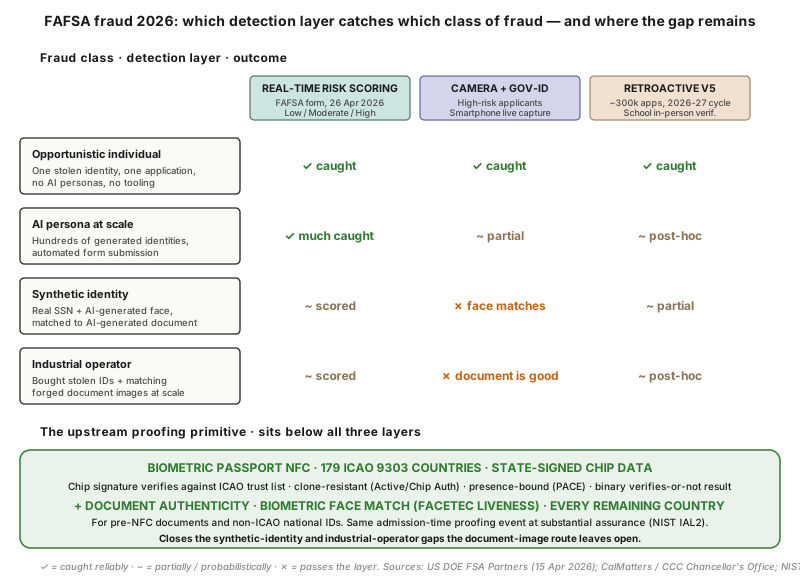
Starting 26 April 2026, the Department implemented a real-time identity fraud detection capability directly inside the FAFSA form. Applicants are screened in real time as they complete the form and placed into three risk categories (Federal Student Aid Partners — FAFSA Real-Time Fraud Detection (Updated 14 May 2026)):
- Low risk — no additional identity verification, no application rejection, no comment code added.
- Moderate risk — no additional verification, application not rejected, but a Comment Code 353 is added to the Institutional Student Information Record (ISIR) so the school knows the application contained elements that raised risk concerns.
- High risk — the applicant is presented with a live automated camera verification step requiring government-issued ID before the application can be completed. Acceptable forms of ID include a driver's licence, US passport, tribal ID, or permanent resident card. A smartphone or tablet is required; a laptop alone will not work.
In parallel, the Department completed a one-time retroactive fraud screening of all previously submitted 2026-27 FAFSA forms. Approximately 300,000 applications from the 2026-27 award year were retroactively selected for Verification Tracking Group V5 as a result. From 3 May 2026, financial aid administrators at institutions can assist affected applicants by completing in-person verification following the documentation guidelines published in the Department's 26 November 2025 Federal Register notice (US Department of Education — 2026-2027 Award Year FAFSA Information to be Verified and Acceptable Documentation).
In my view, the FAFSA team built a v1 of the right idea. The camera-plus-government-ID step puts identity proofing in front of fraud — which is what was structurally missing. But the proofing primitive itself, a smartphone photograph of a driver's licence, still depends on the document not being forged and on the person's face matching the document. That works against opportunistic fraud; it works less well against the operator who has bought 500 stolen identities and the corresponding document images on a credential market. The fraud that the rule was built to catch — opportunistic individual fraud — is also the fraud that the system was already catching reasonably well. The hard fraud is the operator running 500 personas at scale.
Why Does Camera-Plus-Government-ID Still Miss the Hardest Fraud?
Three structural gaps remain after April 2026, and each is independent of the others.
Document trust. A driver's licence or US passport submitted through a smartphone camera is verified against document templates and against the photo on its face. The chain of trust runs from the issuing state's document, through the image of the document, through the system's template-matching, to a confidence score. The chain does not run through the cryptographic chip on the document, when there is one. US biometric passports (issued under ICAO 9303) carry a contactless chip with state-signed data, verifiable offline against the ICAO trust list (ICAO Doc 9303 — Machine Readable Travel Documents). The new FAFSA flow does not read that chip. The document-image route remains the only route, and it remains the route most fraud operators have practised against.
Face match against a forged document. When the underlying document is forged but well-forged, the face match step confirms only that the live face matches the face on the forgery — not that the forgery represents a real person. NIST's identity-assurance taxonomy explicitly distinguishes the identity-proofing assurance level (IAL) from the authentication assurance level (AAL); a document-and-face flow can deliver substantial assurance at IAL2 only if the document itself is verified to issuance, which a smartphone photo does not do (NIST SP 800-63A — Digital Identity Guidelines, Identity Proofing and Enrollment).
Synthetic identity attacks. Combining real Social Security numbers from breached datasets with AI-generated faces produces a "person" who does not exist but whose identifiers match the official records. Selfie-plus-ID verification matches the live face to the ID's face; both can be the same AI-generated person. The US Federal Trade Commission has documented synthetic identity fraud as one of the fastest-growing fraud categories across multiple sectors (US FTC — Combating online identity theft and fraud). The 2026 FAFSA detector reduces this risk; it does not close it.
The aggregate effect is that the new rule meaningfully raises the cost of casual fraud while doing relatively little against industrial-scale fraud. What I see from the operational angle is that the highest-volume operators do not stop — they shift workload upstream and re-tool. Within two to three quarters we should expect public data on how the 26 April rule actually performed against the operator end of the fraud distribution, not just against opportunistic individuals.
What Closes the Ghost-Student Gap?
The architectural answer is the same one that the wider international student identity gap analysis lands on: proofing has to happen once, at the upstream identity-binding moment, with a primitive that cannot be cheaply forged. For US students the practical version of that primitive is the biometric passport NFC chip (US passports issued since 2007 are ICAO 9303 compliant). For international applicants — the more cross-border-pressed segment — the same passport chip works across 179 countries that issue ICAO 9303 passports. For students whose passport is pre-NFC or who present a non-ICAO national ID, document authenticity verification plus biometric face match (FaceTec liveness) provides the same admission-time proofing event at substantial assurance. Together those two tracks cover every applicant.
In compliance terms, the upstream proofing event produces an advanced electronic signature (AdES) under eIDAS bound to the verified identity, retained as an audit-defensible artefact. AdES is the right level here: it has evidentiary weight under eIDAS Article 25 non-discrimination, it does not require the qualified-certificate machinery that QES does, and the use case (institutional identity proofing for student aid) is well below the QES threshold. The same record can be presented to a US federal agency or a European admissions office and verified against the issuing state's public key without depending on the receiving institution's own fraud-detection rules.
From the operational angle, the cheapest place to solve student-aid fraud is at the moment a person first applies — not at the moment financial aid hits the disbursement queue. Everything later is cleanup. The April 2026 FAFSA rule moves the proofing event up by one step, from the disbursement queue to the application form; it does not move it all the way to the identity itself. Moving it the rest of the way is the work that follows.
Three institutional changes follow from this:
- The proofing event is logged once, cryptographically. When the same student later applies to another federal aid programme, presents at a campus, or graduates and submits a diploma to an employer, the original proofing record is verifiable. The current architecture re-proofs the same student five to seven times across the lifecycle (see Post 1 in this cluster for the full diagram).
- Risk scoring becomes calibrated, not heuristic. Document-image fraud detection scores against templates and known fraud patterns. A chip-anchored or document-plus-liveness-anchored event produces evidence that is binary — either the chip's signature verifies against the issuing state's CSCA key, or it doesn't; either the liveness check passes, or it doesn't — not a probability score that the institution then has to interpret.
- Cross-border applicants stop being an exception. The 26 April 2026 rollout's high-risk path accepts a US driver's licence, US passport, tribal ID, or permanent resident card. An international applicant without a US-issued document goes through a different, slower, and more error-prone path. A chip-anchored primitive — with the document-and-face-match second track for the remainder — covers domestic and international applicants on the same admission flow.
This architecture does not require the US Department of Education to scrap the April 2026 rule. It sits underneath it as the proofing layer the new rule depends on but does not specify.
Where the Cluster Goes Next
This post is Cluster Post #2 of 6 on international student identity. Companion posts go deeper into adjacent layers of the problem:
- Post 1 (29.05.2026, Gustav) — International Student Identity 2026: Where Does It Break? — the architectural overview across the full admission-to-employer lifecycle.
- Post 3 (04.06.2026, Gustav) — The diploma mill industry and the cryptographic fix: why chip-based authentication closes the credential-fraud window at the employer side.
- Post 4 (06.06.2026, Mairi) — Remote proctoring when deepfakes beat selfie IDs: the AI Act high-risk biometrics implications, and chip-binding to enrolment identity.
- Post 5 (08.06.2026, Gustav) — EBSI Verifiable Diplomas and the holder-binding gap: the unsolved half of the diploma chain.
- Post 6 (10.06.2026, Mairi) — A university identity stack for 2027: the practical playbook combining all five threads.
More in this cluster
- Diploma Mills 2026: Where Does Cryptographic Verification Hold?
- Remote Proctoring 2026: Can Deepfakes Beat Selfie ID Verification?
- EBSI Verifiable Diplomas 2026: How Is the Holder Actually Bound?
- University Identity Stack 2027: Where Should You Actually Start?
- How Do You Verify Student Identity for Attendance, Access, and Exams Under GDPR and the AI Act?
FAQ
What is a ghost student? A ghost student is a fraudulent applicant — usually generated by an automated bot, an AI persona, or a stolen identity — who applies for admission and financial aid with no intent to actually attend. The fraud monetises through the federal Pell Grant, state aid, and institutional scholarships disbursed before the institution detects the fraud. California community colleges flagged 31% of applicants as likely fraudulent in 2024.
What did the US Department of Education roll out on 26 April 2026? Real-time identity fraud detection inside the FAFSA itself. Applicants are placed into low / moderate / high risk categories. High-risk applicants must complete a live automated camera verification step using a government-issued ID (US driver's licence, US passport, tribal ID, or permanent resident card) on a smartphone or tablet. About 300,000 already-submitted 2026-27 FAFSA forms were retroactively placed into Verification Tracking Group V5.
Does AdES cover identity proofing for student aid? Advanced electronic signature (AdES) under eIDAS Article 26 provides the right level for institutional identity-proofing audit chains. eIDAS Article 25 non-discrimination makes AdES admissible across EU jurisdictions; QES is not required for this use case. An AdES record produced at the upstream proofing event (passport NFC or document + face match) is verifiable independently of the receiving institution's own fraud-detection layer.
Does the new FAFSA rule replace the need for upstream identity proofing? No. The new rule strengthens detection but still depends on smartphone-captured document images. For high-risk applicants who present a forged-but-good document, or a stolen identity combined with an AI-generated face matching the document, the verification can still pass. Upstream proofing using the document's NFC chip — or document-and-liveness verification at substantial assurance for non-chip documents — sits one architectural layer below the new rule and closes the residual gap.
How does this affect international students applying to US institutions? The April 2026 high-risk path accepts a US driver's licence, US passport, tribal ID, or permanent resident card. An international applicant who holds none of these has to be routed through an alternative verification flow at the institution. A chip-anchored proofing primitive — biometric passport NFC for the 179 ICAO 9303 countries, document plus face match for the rest — gives international applicants the same admission-time proofing event as domestic applicants without a separate flow per country.
Sources
Primary — US Department of Education and Federal Student Aid
- Federal Student Aid Partners — FAFSA Real-Time Fraud Detection (Updated 14 May 2026)
- US Department of Education — Launches Comprehensive, Nationwide Federal Student Aid Fraud Prevention Effort
- US Department of Education — $1B+ federal student aid fraud prevented (Jan 2025 — Q2 2026)
- US Department of Education — 2026-2027 Award Year FAFSA Information to be Verified and Acceptable Documentation
- US Federal Trade Commission — Identity theft and fraud (guidance)
Primary — Standards and identity-assurance frameworks
- NIST SP 800-63A — Digital Identity Guidelines: Identity Proofing and Enrollment
- NIST SP 800-63B — Digital Identity Guidelines: Authentication and Lifecycle Management
- ICAO Doc 9303 — Machine Readable Travel Documents
- INTERPOL — Identity and travel document fraud
State-level data and analysis
- California Community Colleges Chancellor's Office — System data
- CalMatters — California community colleges crack down on fake students stealing financial aid (19 May 2026)
About the author
Mairi Kutberg is co-founder of IdentiGate. She focuses on identity-proofing operations under eIDAS, NIS2, AMLR and adjacent regulatory frameworks, and on the institutional reality of running cross-border identity verification at scale.