University Identity Stack 2027: Where Should You Actually Start?
Universities have eighteen months to put a defensible identity stack in production. AI Act high-risk lands 2 August 2026; EUDI Wallet 6 December 2026; AMLR cross-border identity 10 July 2027. The cheapest place to start is admission.
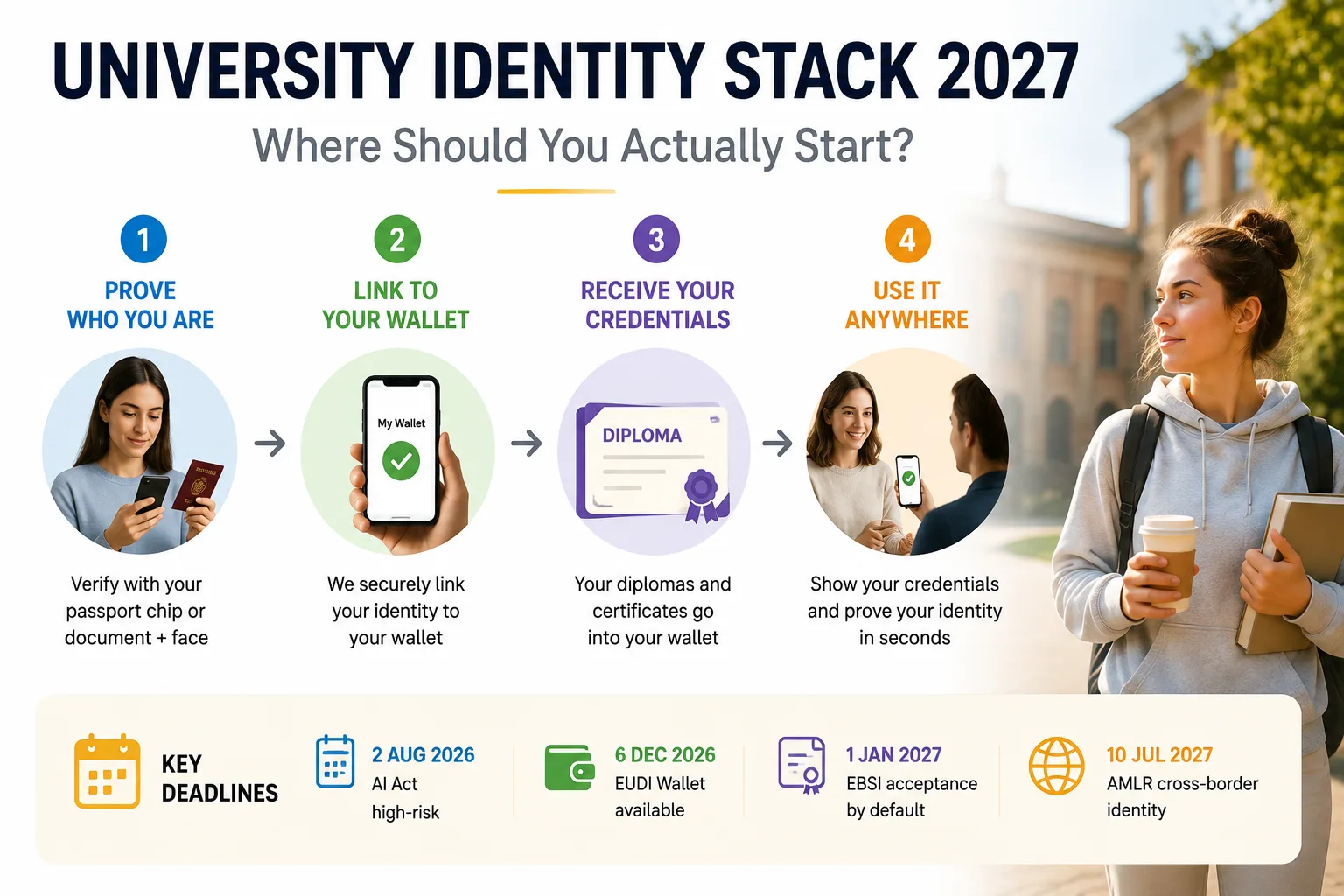
Universities have eighteen months to put a defensible identity stack in production. The AI Act high-risk deadline lands 2 August 2026; EUDI Wallet on 6 December 2026; AMLR cross-border identity obligations on 10 July 2027. The cheapest place to start is admission, anchored on the biometric passport chip and document-plus-face-match for the rest.
This post closes the six-post cluster on international student identity. The earlier five posts laid out where the system breaks — at admission (FAFSA fraud), at the credential layer (diploma mills), at the exam stage (deepfake proctoring), and inside the protocol stack itself (EBSI holder binding). What follows is the operational read on what to actually do about it between now and the end of 2027 — written for the head of IT, the head of admissions, and the compliance lead who together own this problem at a typical mid-sized European or UK university.
What Does a Compliant University Identity Stack Actually Look Like in 2027?
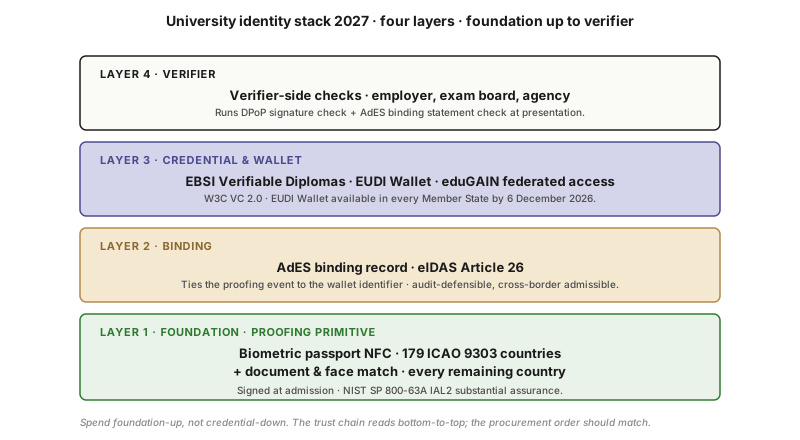
Four layers, stacked from foundation to surface.
The foundation layer is the identity-proofing primitive. For 179 of the world's countries it is the biometric passport NFC chip (ICAO Doc 9303) — chip data signed by the issuing state, verifiable offline against the ICAO trust list, clone-resistant via Chip Authentication, and bound to physical presence via PACE. For every remaining country it is document authenticity verification combined with biometric face match (FaceTec liveness) at substantial assurance (NIST SP 800-63A IAL2). Both routes produce the same shape of record: a state-anchored or vendor-attested identity proofing event signed at a specific moment — what we ship as the Identity Verification product.
The binding layer is the Advanced Electronic Signature (AdES) under eIDAS Article 26 that ties the proofing event to the student's wallet identifier and retains the binding statement as an audit-defensible artefact under Regulation (EU) 2024/1183 — our Signatures product at the implementation level. This layer answers the question that EBSI's protocol cannot answer on its own: whose wallet is this?
The credential layer is what most procurement conversations focus on first, and it should not be: EBSI Verifiable Diplomas, an EUDI Wallet that holds them, course attestations as W3C Verifiable Credentials, federated access through eduGAIN. This layer is solved at the standards level and will be solved at the wallet level by December 2026 across the EU — Member States must each provide at least one EUDI Wallet by then (European Commission — EUDI Regulation timeline).
The verifier layer is the operational policy that says how downstream parties — employers, exam boards, accreditation bodies, mobility platforms — actually check both the credential signature and the binding statement at presentation. This is where the AI Act deadline of 2 August 2026 bites, because the verifier-side AI systems that score, monitor, or rank students are high-risk under Annex III.
What I'd argue with the CFO about is the temptation to start procurement at the credential layer because it's the most vendor-attractive and the most demo-able. The credential layer is where the budget pressure comes from; the foundation and binding layers are where the actual liability sits. Spend the money in the order the trust chain reads, not the order the vendors call.
Which 2026 Deadlines Should Drive Your Roadmap?
Four, and they cluster more than they spread.
2 August 2026 — EU AI Act Annex III high-risk compliance. Education and vocational training AI systems that determine access, score performance, or monitor prohibited behaviour during tests become high-risk on that date (artificialintelligenceact.eu — Annex III; Regulation (EU) 2024/1689 on EUR-Lex). The 1:1 biometric verification carve-out — confirming a person is who they claim to be — is explicitly excluded from the Annex III biometric category. Practical effect: identity proofing under the carve-out is cheaper to ship than systems that fall under category 3.
6 December 2026 — EUDI Wallet availability deadline. Member States must each make at least one EUDI Wallet available to citizens by this date, under Regulation (EU) 2024/1183 (European Commission — EUDI Regulation). For universities this is the date when EU-citizen students can plausibly start presenting credentials and proofs via a state-issued wallet. Rollout is uneven — some Member States will hit the date with a minimum-viable wallet; others have publicly signalled delays. The architecture has to assume mixed-readiness across the student body for at least eighteen months after the deadline.
10 July 2027 — AMLR application date. Regulation (EU) 2024/1624 (AMLR — EUR-Lex) applies directly from this date, including a harmonised customer-due-diligence framework that affects student-loan providers, scholarship trusts, and any university entity engaged in financial activity that brings it within scope. The cross-border identity verification standard the AMLR pushes toward is materially stricter than what most admissions offices currently run.
Late December 2027 — EUDI mandatory acceptance. Specified private-sector relying parties — VLOPs, gatekeepers, regulated sectors — must accept EUDI Wallet identification on user request from this date. Universities are not on the binding-acceptance list, but the precedent is set: the regulated employers and platforms your graduates apply to will be accepting EUDI Wallet by then.
Watching this play out across institutions, what stands out is that the August 2026 deadline gets all the attention while the December 2026 EUDI date is the one with more architectural impact. Universities can paper over the AI Act deadline with documentation; they cannot paper over a December 2026 student presenting an EUDI wallet credential that the admissions IT stack cannot consume.
Where Should You Start If You Have Six Months?
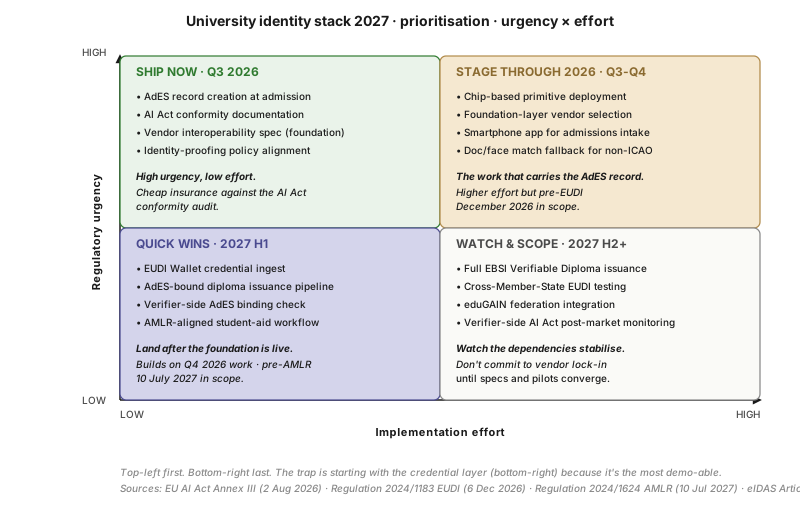
Build the foundation layer and the binding layer first, in that order. Defer the credential layer to 2027.
The minimum-viable build looks like this. At admission, the prospective student scans the NFC chip of their biometric passport with a smartphone application — yours or a vetted vendor's — that reads the chip offline against the ICAO trust list, verifies Chip Authentication, and runs PACE for presence. For students whose document is pre-NFC or who present a non-ICAO national ID, the same application falls back to document authenticity verification plus biometric face match at substantial assurance. The output of either route is a signed identity proofing record that the admissions system retains as an AdES artefact bound to the student's institutional identifier. That artefact is what every downstream system — financial aid, enrolment, exam access, diploma issuance — references when it needs to be confident who this student is.
What the foundation-and-binding-first approach buys you specifically:
- AI Act August 2026 documentation defensibility. When the conformity assessment asks how identity is established before any high-risk system processes the student, the answer is AdES-bound chip read at admission, not vendor liveness on the proctoring vendor's matcher. The first answer survives audit; the second moves the audit to the vendor.
- Cross-border admissions from December 2026 forward. An EU student presenting an EUDI Wallet credential at admission can have that credential bound to the same AdES record; a non-EU student presenting a biometric passport can have a parallel binding produced by the same flow. One admissions pipeline covers both.
- A baseline ready for AMLR July 2027. Student-loan / scholarship workflows that fall under AMLR can reference the institution's existing admission-time proofing record instead of running a second KYC flow, which is the expensive option most universities are quietly assuming they will have to run.
The trap most universities are walking into is procuring proctoring first — because the August 2026 deadline reads as urgent and the proctoring vendor pitch reads as cheap — and treating identity proofing as something to fix in 2027. That sequencing is structurally wrong. If the proctoring vendor's selfie + ID flow is the institution's only identity check, the binding layer is missing and every downstream credential is asserting trust the institution does not have.
What Procurement Trade-Offs Should You Actually Argue About?
Three trade-offs matter; the rest is detail.
AdES versus QES. Universities considering identity proofing under eIDAS often default-procure qualified electronic signatures because "qualified sounds better than advanced". The legal reading is the other way around: AdES under eIDAS Article 26 carries the evidentiary weight required for institutional identity proofing; QES is the legal ceiling for public services under Article 27, not the floor for higher education. Procuring QES infrastructure when AdES is sufficient locks the institution into the qualified-certificate machinery a QTSP carries, and the cost difference compounds across every student record over the multi-year credential lifetime. The right answer for the institutional-identity audit chain is AdES; QES is reserved for the specific public-service flows that legally require it.
Vendor-only liveness versus chip-anchored primitive. Vendor liveness — passive PAD, active PAD, FaceTec — is real engineering and catches presentation attacks well. It does not, on its own, anchor identity to a state-signed document. The procurement question I'd ask first is what the vendor's matcher is the source of truth for: identity at exam time (where it should be the source of truth for continuity, not identity) or identity at admission time (where it should not be the source of truth at all). If the vendor pitch positions liveness as the identity primitive across the lifecycle, the institution is about to take on assurance risk the vendor will not.
Build versus buy at the foundation layer. The chip-reading and document-authenticity infrastructure is mature enough to procure rather than build; it is also stable enough that the institution does not need to commit to a single vendor at the foundation layer. The right procurement shape is an interoperability requirement: the foundation-layer vendor must produce AdES records the institution retains in its own systems, in a format that survives a vendor switch. If the vendor's pitch is "we hold the proofing record on your behalf", that is not a foundation-layer vendor; that is a downstream service hiding the foundation behind itself.
If I had eighteen months and a fixed budget I'd spend it on the foundation layer first and the wallet integration second, with verifier-side compliance documentation in parallel. The credential-layer integration (EBSI Verifiable Diploma issuance pipeline, course attestations as W3C VCs) can land in 2027 once the foundation is producing AdES records the credential layer can reference.
Where the Cluster Ends
This is the final post of the six-post cluster on international student identity. The series:
- Post 1 (29.05.2026, Gustav) — International Student Identity 2026: Where Does It Break? — architectural overview across the full lifecycle.
- Post 2 (01.06.2026, Mairi) — FAFSA Fraud 2026: How Did $1B+ Almost Reach Ghost Students? — admission-stage synthetic-identity fraud.
- Post 3 (04.06.2026, Gustav) — Diploma Mills 2026: Where Does Cryptographic Verification Hold? — the conceptual trust chain.
- Post 4 (06.06.2026, Mairi) — Remote Proctoring 2026: Can Deepfakes Beat Selfie ID Verification? — exam-stage attack surface and the AI Act deadline.
- Post 5 (08.06.2026, Gustav) — EBSI Verifiable Diplomas 2026: How Is the Holder Actually Bound? — DID methods and DPoP holder-binding deep-dive.
- Post 6 (this post) — the practical playbook combining the five threads.
More in this cluster
FAQ
What is the most important 2026 deadline for university identity? Two cluster together. 2 August 2026 — EU AI Act Annex III high-risk compliance — drives the documentation and conformity-assessment work for proctoring and admissions-AI systems. 6 December 2026 — EUDI Wallet availability across Member States — drives the cross-border identity infrastructure that universities have to consume from this date forward. The August deadline gets the press, but the December deadline has more architectural impact.
Where should universities start the implementation? At the foundation layer — identity proofing at admission, anchored on the biometric passport NFC chip for the 179 ICAO 9303 countries and on document authenticity + biometric face match for every remaining country. The output is an AdES-bound record under eIDAS Article 26 that every downstream system references when it needs to be confident about who the student is. The credential layer (EBSI Verifiable Diplomas, EUDI Wallet integration) can land in 2027 once the foundation is producing AdES records.
Does AMLR apply to universities? Partially. Universities themselves are not on the AMLR obliged-entities list directly; student-loan providers, scholarship trusts, and any university entity carrying out financial activity that meets the AMLR thresholds may be. The 10 July 2027 application date matters because the cross-border identity standard the AMLR pushes toward is materially stricter than what most admissions offices currently run, and the entities the university transacts with will start requesting evidence aligned with the AMLR framework.
Should universities procure QES instead of AdES? No. AdES under eIDAS Article 26 carries the evidentiary weight required for institutional identity proofing and is admissible across Member States under Article 25 non-discrimination. QES is the legal ceiling for specific public-service flows under Article 27, not the floor for higher education. Procuring QES infrastructure when AdES is sufficient introduces the qualified-certificate machinery of a QTSP at significant cost without legal benefit.
Can the foundation layer be procured from a single vendor? It can, but the right procurement shape is interoperability: the vendor produces AdES records the institution retains in its own systems in a format that survives a vendor switch. If the vendor offers to "hold the proofing record on your behalf", the institution is no longer at the foundation layer — the foundation has been hidden behind a downstream service.
Sources
Primary — EU regulatory deadlines
- Regulation (EU) 2024/1183 — eIDAS 2.0 / EUDI Wallet — EUR-Lex
- Regulation (EU) 2024/1689 — EU AI Act — EUR-Lex
- Regulation (EU) 2024/1624 — AMLR — EUR-Lex
- Regulation (EU) 910/2014 — original eIDAS — EUR-Lex
- European Commission — EUDI Regulation policy page
- European Commission — The European Digital Identity Regulation (technical hub)
- EU AI Act — Annex III high-risk systems
Primary — Identity-assurance and document standards
- ICAO Doc 9303 — Machine Readable Travel Documents
- NIST SP 800-63A — Identity Proofing and Enrollment
- NIST SP 800-63B — Authentication and Lifecycle Management
Primary — Verifiable Credentials and EBSI
- W3C — Verifiable Credentials Data Model 2.0 (Recommendation, May 2025)
- European Commission — EBSI Verifiable Credentials
About the author
Mairi Kutberg is co-founder of IdentiGate. She focuses on identity-proofing operations under eIDAS, NIS2, AMLR, the AI Act, and adjacent regulatory frameworks, and on the institutional reality of running cross-border identity verification at scale.