How Do You Detect Deepfakes in Driver Onboarding for Freight Platforms?
You detect deepfakes at the point where the driver's identity is bound to the freight platform for the first time — at chip-anchored NFC read of the passport plus biometric face-match against the chip's signed photograph, with presentation-attack detection at the device layer. The four deepfake attack vectors that apply to customer onboarding all apply to driver onboarding, but the freight-platform context adds two operational realities that make the stakes higher: driver identity survives across hundreds of shipments per year, and a fraudulent driver identity onboarded once produces cargo-loss exposure downstream. This post walks the specific deepfake-detection architecture for freight driver onboarding, where the traditional flow breaks, and what the fictitious-carrier fraud pattern looks like when it exploits weak driver identity.
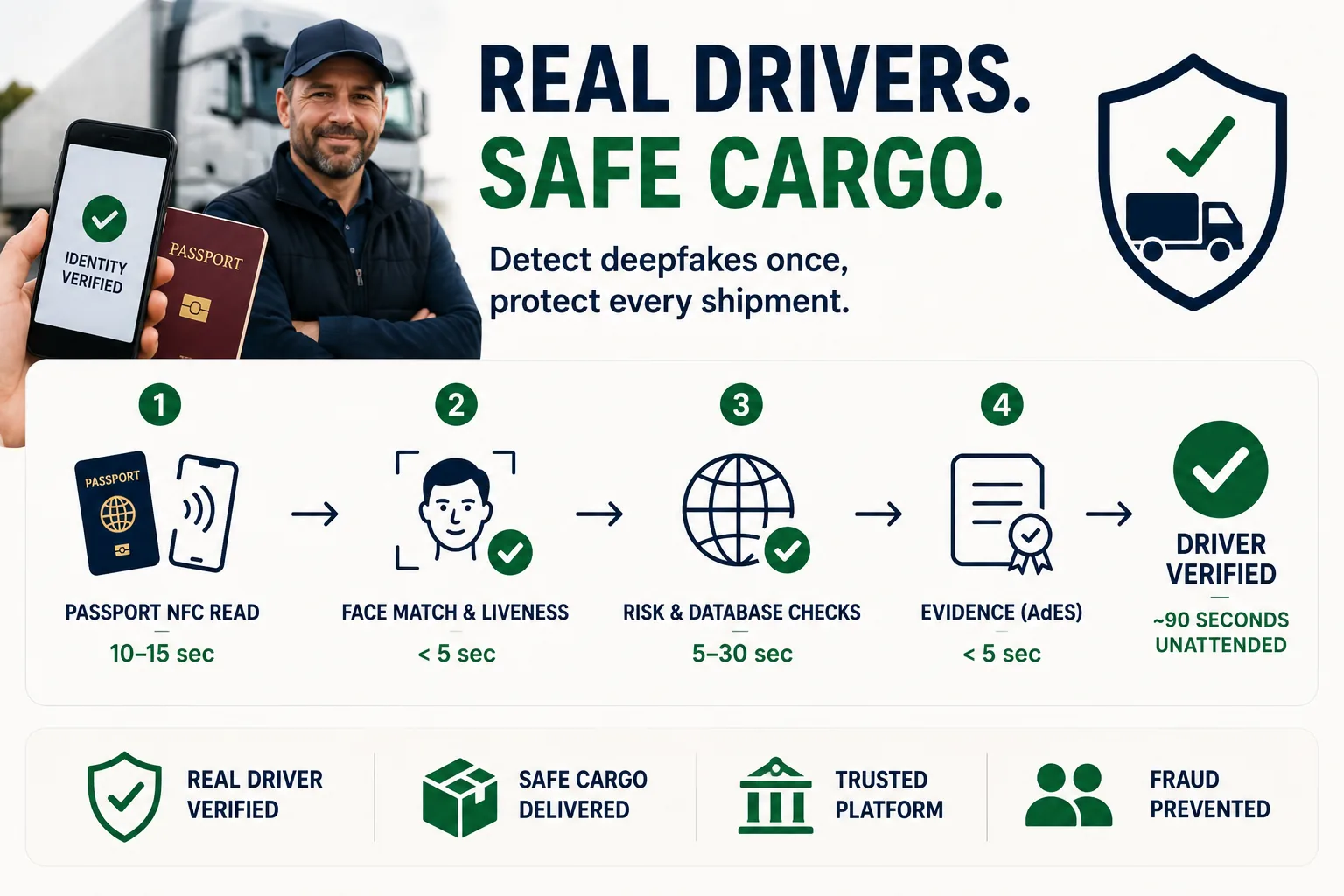
You detect deepfakes at the point where the driver's identity is bound to the freight platform for the first time — at chip-anchored NFC read of the passport plus biometric face-match against the chip's signed photograph, with presentation-attack detection at the device layer. The four deepfake attack vectors that apply to customer onboarding all apply to driver onboarding, but the freight-platform context adds two operational realities that make the stakes higher: driver identity survives across hundreds of shipments per year, and a fraudulent driver identity onboarded once produces cargo-loss exposure downstream. This post walks the specific deepfake-detection architecture for freight driver onboarding, where the traditional flow breaks, and what the fictitious-carrier fraud pattern looks like when it exploits weak driver identity.
This post is part of our customer-onboarding cluster, alongside who offers the most deepfake-resistant customer onboarding in 2026 (the general procurement rubric) and how do you speed up KYC verification without weakening the evidence (the throughput analysis). Driver onboarding for freight platforms is where the same four attack vectors show up in a context with sharper operational consequences — a fictitious driver onboarded once may complete dozens of legitimate-looking shipments before the fraud pattern surfaces at cargo loss.
A Rotterdam-based freight platform's fraud lead sent us a case study last month: over Q2 2026 they had received 340 driver-onboarding applications, 287 completed the automated verification flow, 42 were routed to supervised review, and 11 were rejected. The compliance team's follow-up analysis identified that 3 of the 287 automated-verified drivers had subsequently been implicated in cargo-diversion events — legitimate onboarding, subsequent fraud. The forensic review of those 3 cases showed that the identity-verification records did not contain enough evidence to conclusively distinguish "the person who onboarded was not the person who signed for the cargo" from "the person onboarded was misidentified at onboarding". This is the pattern this post is written for.
What makes deepfake attacks on driver onboarding different from customer onboarding?
Two operational amplifiers that change the stakes without changing the attack surface itself.
Amplifier one: identity persistence across many shipments. A customer onboarded to an e-commerce platform typically has a bounded transaction footprint — they buy something, they return something occasionally, the platform's exposure per customer is measured in the average order value times some multiple. A driver onboarded to a freight platform is bound to the platform for the working relationship — the platform's exposure per driver is measured in cargo value per shipment × shipments per year × years of engagement. A single deepfake-onboarded driver can move millions of euros of cargo before the fraud pattern is detected, particularly if the fraudulent driver operates within apparently-normal shipment patterns for a period before the diversion event.
Amplifier two: physical-world consequences downstream of the digital-only onboarding check. A customer onboarding fraud produces a chargeback, a synthetic account, a laundering conduit — bad, but the bad outcome is confined to the digital layer. A driver onboarding fraud produces a physical vehicle at a physical loading dock picking up physical cargo. The physical-world downstream exposure is what makes freight driver onboarding a specific procurement conversation rather than a generic KYC conversation.
Both amplifiers push the deepfake-detection architecture toward chip-anchored proofing at the driver-onboarding step, because the evidence gap between a document-scan record and a chip-anchored record matters more when the person's identity is going to determine physical-cargo access for the next twelve months.
How does the four-vector deepfake attack pattern apply to driver onboarding specifically?
The same four vectors from our customer-onboarding deepfake analysis, with freight-specific context on each.
Vector one — document forgery — applied to driver context. The attacker presents a physically-forged or digitally-altered driving licence, passport, or Certificate of Professional Competence (CPC) card. Freight-industry-specific: the driver credentials that are unique to driver onboarding (CPC, ADR dangerous-goods certification, tachograph card) are additional attack surfaces beyond the identity documents themselves. Each of these has its own issuer, revocation register, and verification pathway — and each is typically checked against a national or EU database at onboarding, but the checking itself typically relies on optical extraction from a scan.
Vector two — face-swap deepfake — applied to driver context. The attacker holds up a real (or forged) driving licence but presents a real-time face-swap output to the platform's biometric step. Freight-specific: the driver-onboarding flow often happens over a lower-quality mobile network at the driver's terminal (truck cab, terminal parking, dispatch office) rather than in a controlled desktop environment — the biometric capture conditions are noisier, which makes the deepfake harder to detect if the platform's liveness detection was tuned for standard consumer-onboarding capture conditions.
Vector three — injection attack — applied to driver context. The attacker bypasses the camera entirely and injects a synthetic video stream into the driver-onboarding app. Freight-specific: many freight platforms rely on driver-facing mobile apps developed by third-party dispatch software providers, whose device-attestation posture varies widely. The platform's identity-verification layer may or may not know whether it's receiving video from an actual physical camera. The injection-attack surface in freight is proportionally larger than in consumer contexts because the mobile-app tenant is often not the identity-verification vendor.
Vector four — synthetic identity — applied to driver context. The most freight-specific vector, and the one that produces the "fictitious carrier fraud" pattern the industry has been tracking closely since 2022. A synthetic identity is composed from real elements — a real driver's licence issued to a real person, a real face (the attacker's or a mule's), a real CPC card, real ADR certification — but the person operating under that identity is fraudulently using them for cargo diversion. The verification legitimately passes at onboarding; the fraud manifests three to six months later when the "driver" fails to deliver a load and the shipment is untraceable. This vector is not a deepfake in the classical sense — it does not require synthetic media — but it exploits the same architectural gap: verification passes for the identity artefacts, and the platform has no way to detect that the human behind them is a fraud actor.
Fictitious-carrier fraud is the primary threat model for freight-driver onboarding in 2026. The Cargo Theft in Europe: €2.7 Billion Stolen in 3 Years analysis walks the empirical scale of the problem; this post walks the identity-layer architecture that addresses it.
Where does traditional freight-driver onboarding architecture usually fail?
Three failure modes recur in the freight-platform incidents I have seen this year.
Failure mode one: onboarding relies on optical document capture only. The driver photographs their licence and passport with the mobile app; the platform's OCR extracts fields; the biometric step compares a selfie to the printed photo on the licence. This flow is fast (typically under two minutes) and cheap, but it fails against vector one (document forgery) at any level of forgery sophistication that exceeds the platform's OCR's ability to detect security-feature tampering. In 2023 the OCR-vs-forgery gap was manageable; in 2026 the gap has narrowed to the point where document-scan-only architectures are systematically under-defended against motivated forgery attempts.
Failure mode two: no device-attestation at the mobile-app layer. The platform's identity-verification SDK is loaded inside the dispatch app; the SDK receives a camera feed; the SDK does not verify that the camera feed is coming from the physical camera of a legitimate device rather than a virtual camera driver or a hooked SDK. This gap is vector three (injection attack) and is where the fastest-growing 2024-2026 attack sophistication is landing. Freight-driver deepfake attempts in 2025 and 2026 have increasingly used commercially-available virtual camera drivers to inject face-swap video into the onboarding flow — a class of attack that consumer-onboarding platforms are increasingly defending against, but which freight-driver onboarding has been slower to address because the platform-vendor-SDK-integrator chain is more fragmented.
Failure mode three: no downstream fraud-signal integration after verification passes. The platform's identity-verification step produces an "onboarded" state; the downstream operations (dispatch, load matching, payment, cargo release) treat the onboarded state as an ongoing warrant of legitimacy. When vector four (fictitious carrier) manifests months later, the platform's forensic team has to reconstruct what happened from operational logs rather than being able to link an active-shipment fraud signal back to the specific weakness in the identity-verification record. This is why the industry-wide fictitious-carrier fraud numbers keep growing even as identity-verification technology improves — the identity layer got better, and the downstream-signal-integration layer did not.
What does the chip-anchored driver-onboarding pattern look like in practice?
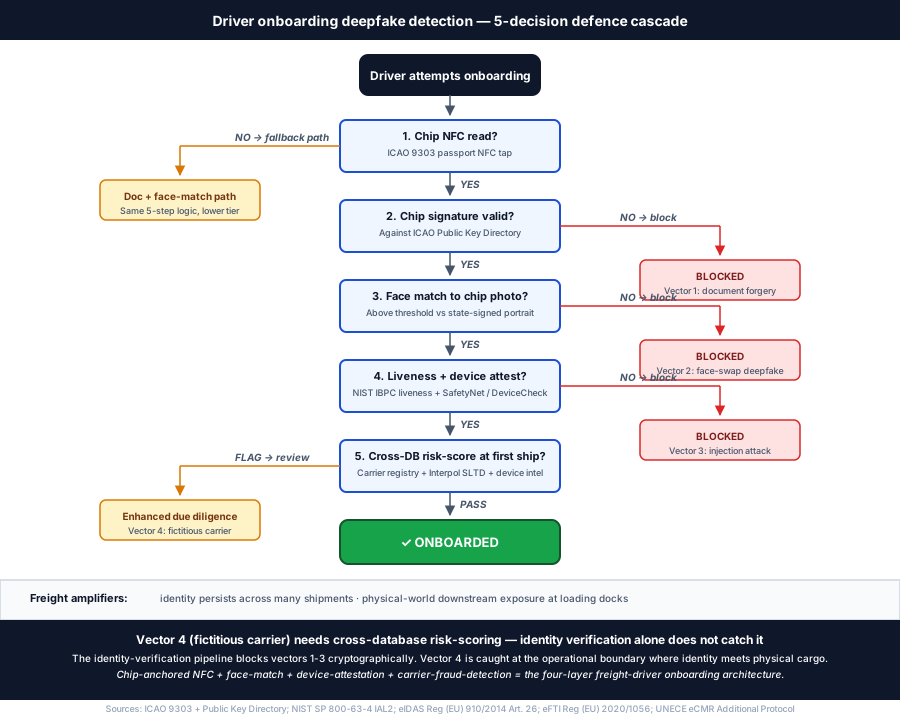
Five steps in the decision tree, each with a specific defence against a specific attack vector.
Step one: chip read attempt. The driver taps their passport (or NFC-enabled national ID) to their phone. The NFC read produces either a valid chip cryptogram signed by the issuing state, or a failure signal (chip unresponsive, phone lacks NFC, non-NFC document). Success proceeds; failure routes to the document + biometric face-match fallback path.
Step two: chip signature validation. The chip cryptogram is verified against the ICAO Public Key Directory. A valid signature blocks vector one (document forgery) with cryptographic evidence rather than optical inspection. Invalid signature blocks the onboarding attempt entirely — this is a hard failure, not a soft flag.
Step three: biometric face-match against chip photo. The driver's live face is captured and matched against the chip's signed portrait (not the front-of-document printed photo). Threshold match blocks vector two (face-swap deepfake). Below-threshold match routes to enhanced review or blocks depending on the platform's risk policy.
Step four: liveness detection + device attestation. NIST IBPC-tested liveness algorithms confirm the presented face is a live human, not a video playback or a synthetic media stream. Device attestation (SafetyNet on Android, DeviceCheck on iOS, browser API integrity checks) confirms the camera feed is coming from the physical device's camera rather than a virtual camera driver. Together these block vector three (injection attack) — the biggest freight-driver-specific gap in most current-generation onboarding architectures.
Step five: cross-database risk-scoring at first shipment. After the identity verification passes, the driver's onboarded profile is enriched with device-fingerprinting signals, jurisdiction pattern analysis, and matched against known-fraud carrier registries and Interpol SLTD checks. The first shipment triggers a validation checkpoint where the driver's identity is re-attested (biometric touch against the enrolled chip binding) and the cross-database risk-signal is applied. This step catches vector four (synthetic identity / fictitious carrier) at the operational boundary where the identity actually meets the physical cargo — closing the loop that pure identity-verification architectures leave open.
The output of the five-step flow is either an onboarded driver with a full AdES-signed evidence record (chip cryptogram, biometric match score, liveness score, device attestation, timestamp) or a blocked / flagged onboarding attempt with the specific vector that triggered the block noted in the evidence record. The evidence record is retained per the applicable freight-industry retention obligations (typically the eCMR record retention window plus the applicable insurance evidence-retention window — usually 5-7 years for cargo-liability contexts).
Where does the picture break honestly?
Two places, both worth naming.
Not every jurisdiction produces NFC-enabled driving licences. The chip-anchored path works cleanly for passports (179 ICAO 9303 countries) but driving licences are a separate document programme with much more fragmented NFC adoption. For freight-driver onboarding, the passport chip is the primary anchor and the driving licence is verified as a secondary credential via document + face-match rather than chip-anchored. This is fine for identity verification per se — the passport is the load-bearing document — but means that the driver-licence-specific credentials (CPC card, ADR certification) still ride on the optical-inspection path unless the platform integrates directly with the issuing national authorities' revocation registers.
Fictitious-carrier fraud (vector four) is not detected by the identity-verification layer. The identity verification will confirm that the driver is a real person with a real chip-anchored document; it will not confirm that the carrier company behind the driver is a legitimate freight operator. Vector four detection requires integration with fraud-pattern databases (industry-specific carrier registries, load-board fraud alerts, past-behaviour signals). This is a separate architectural investment that pairs with — not replaces — the identity-verification layer. Platforms that expect chip-anchored identity verification to solve fictitious-carrier fraud are misaligned about which layer solves what.
Where does IdentiGate fit in the freight-driver onboarding picture?
The identity-verification product ships the five-step chip-anchored driver-onboarding flow — steps one through four end-to-end, with step five (cross-database risk-scoring) integrated via the customer's chosen fraud-detection stack. Coverage is the full 179 ICAO 9303 country footprint via chip-anchored NFC, plus document + face-match for jurisdictions whose passports are not NFC-enabled — which covers essentially any nationality of driver a European freight platform is realistically onboarding.
Where we specifically fit the freight-driver context is the logistics/road product surface — eCMR signing, non-EU driver verification, cross-border eCMR corridors. The chip-anchored driver-onboarding evidence record produced at first-onboarding is the same primitive that authorises the driver to sign eCMR documents at each subsequent shipment — one high-assurance verification event supports many low-friction per-shipment sign-offs (the same pattern our gig-worker reusable-identity post walks in the gig-work context).
Where the picture is honest about limits: we do not (today) ship the fictitious-carrier-fraud detection layer directly — that pairs with our verification output rather than replacing our scope. Freight platforms typically pair our identity-verification with an industry-specific carrier fraud-detection tool whose signal library covers load-board fraud alerts, historical carrier behaviour, and industry watch-lists. Our verified-identity evidence feeds into the fraud-detection stack as one input; the combined signal produces the accept/enhanced-due-diligence/reject decision at the operational boundary.
The engineering push-back on "we do driver KYC"
Where I would push back on the "we do driver KYC" claim on most freight-onboarding vendor pages is on the assumption that driver KYC is a simplified version of customer KYC. It is not. The four attack vectors from customer onboarding all apply, but the two operational amplifiers — identity persistence across many shipments, and physical-world downstream exposure at loading docks — raise the stakes on each vector. A KYC architecture that is adequate for a consumer e-commerce sign-up may be under-defended for a freight-driver onboarding whose fraud outcome is a million euros of missing cargo.
The right architectural posture for freight-driver onboarding is chip-anchored identity primitive at the highest available evidence tier, plus explicit integration with carrier-fraud-detection signals at the operational boundary. The vendors that get this right are the ones whose product spans both — or whose product integrates cleanly with the fraud-detection stack that covers what identity alone does not. Vendors whose "driver KYC" story stops at the identity-verification pass event are leaving vector four exposed, and vector four is where the empirically-growing €2.7 billion European cargo theft number sits.
More in this cluster
- Who Offers the Most Deepfake-Resistant Customer Onboarding in 2026? — the general procurement rubric across four attack vectors and four defence layers
- How Do You Speed Up KYC Verification Without Weakening the Evidence? — the throughput-vs-evidence-quality analysis
Companion earlier posts on adjacent freight-identity patterns:
- Cargo Theft in Europe: €2.7 Billion Stolen in 3 Years — the empirical scale of the freight-fraud market
- How to Verify Non-EU Driver Identity for eCMR — the cross-border driver-identity pattern for eCMR signing
- Deepfake Attack Surface at the Passport-Chip Layer — the technical deep-dive on chip-anchored deepfake defence
Sources
Primary — identity assurance and document standards
- ICAO Doc 9303 — Machine Readable Travel Documents
- ICAO Public Key Directory
- NIST SP 800-63-4 — Digital Identity Guidelines
Primary — eIDAS and evidence framework
Primary — freight and cargo transport
About the author
Mairi Kutberg is a co-founder of IdentiGate OÜ, a European identity-verification and digital-signature company building on top of chip-anchored identity proofing (ICAO 9303 passport NFC), Advanced Electronic Signatures under eIDAS Article 26, and Advanced Electronic Seals. She works with freight platforms, logistics operators, and cross-border transport ecosystems on the intersection of driver-identity verification, deepfake-resistant onboarding architecture, and the fictitious-carrier fraud-detection layer downstream of identity verification.