Remote Proctoring 2026: Can Deepfakes Beat Selfie ID Verification?
Remote proctoring becomes high-risk under Annex III of the EU AI Act on 2 August 2026 — twice over. Deepfake attacks on selfie+ID verification are now industrial. The exam stage needs a different identity primitive than the webcam.
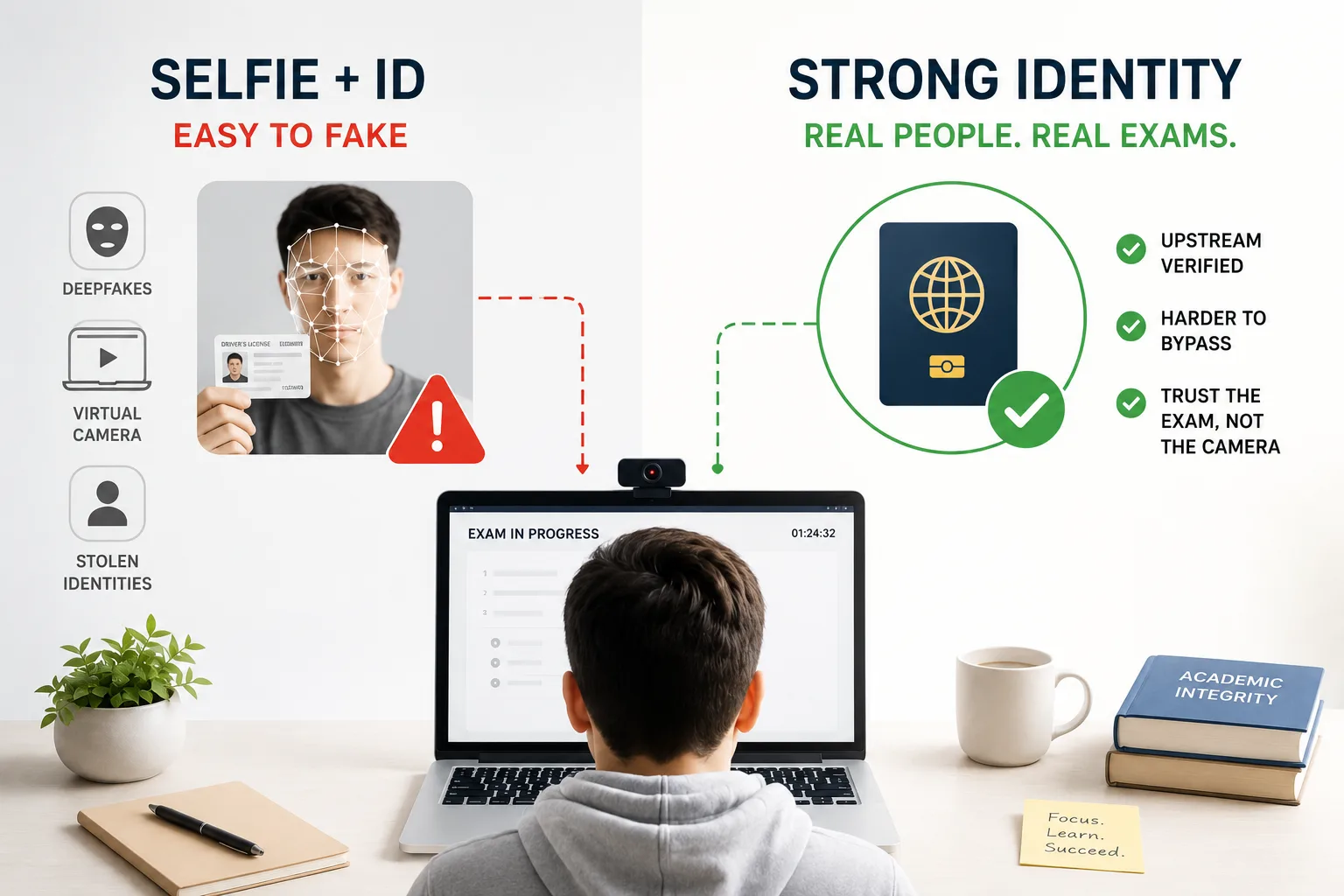
Remote proctoring becomes a high-risk AI system under Annex III of the EU AI Act on 2 August 2026 — twice over, because the same system that monitors exam behaviour also processes biometric data. Deepfakes now beat smartphone-captured selfie + ID at industrial volumes. The exam stage needs a different identity primitive than the camera.
The version of this story you hear in vendor decks is that the AI Act forces a tidy upgrade cycle: add a deepfake-detection module, refresh the fundamental-rights impact assessment, file the conformity assessment, ship. The version I see in compliance audits looks different. The August deadline is the visibility event, not the work. The work is what gets you past the second audit cycle — when a regulator asks why your liveness model still has a 1.5-second window during which an injected stream goes undetected, and the honest answer is "because the model is fighting an arms race it is losing". The architectural fix is to stop relying on the webcam as the proofing primitive at exam time, and to bind the exam-stage identity to a stronger upstream proof.
What Does the EU AI Act Actually Require From Proctoring by 2 August 2026?
Two things, and the second matters more than the first.
The first thing the Act does is classify remote proctoring as a high-risk AI system under Annex III, category 3 — education and vocational training — when the system "monitors and detects prohibited behaviour of students during tests" (EU AI Act — Annex III high-risk systems; the consolidated legal text is in Regulation (EU) 2024/1689 on EUR-Lex). The compliance deadline for Annex III systems is 2 August 2026. From that date, providers and deployers of remote-proctoring systems must comply with the high-risk obligations: risk-management system, data-governance documentation, technical documentation, transparency notices to students, human-oversight design, accuracy and robustness, post-market monitoring, conformity assessment.
The second thing — the more important one — is what isn't in scope. The Act draws a sharp line between remote biometric identification (one-to-many matching against a database, which is high-risk under Annex III category 1) and biometric verification (one-to-one matching to confirm a person is who they claim to be), which is explicitly excluded from that category (EU AI Act — Article 5 prohibited practices and biometric definitions). A proctoring system that runs face-matching against a stored exam-day reference is doing 1:1 verification — outside the Annex III biometric high-risk class. But the same system, if it also surveils behaviour and flags "prohibited" conduct, falls under category 3 anyway because of the education classification. The system can be high-risk under one Annex III category while being explicitly exempt from another.
Honestly, what I see in compliance audits is that institutions hear "high-risk" and reach for paperwork — risk-assessment templates, transparency notices, fundamental-rights impact assessments — when the underlying gap is technical. The Act's documentation requirements are real and audit-defensible, but they do not change whether a deepfake-injected video stream gets through the vendor's liveness model on 3 August 2026 in the same way it gets through on 1 August 2026.
How Do Deepfakes Beat Selfie + ID Verification Today?
By bypassing the camera, not by tricking it.
The popular framing — that deepfake attacks generate convincing fake faces and "fool the AI" — describes only one attack family. The faster-growing family bypasses the verification path entirely. Three patterns recur in 2026 fraud reporting and in the Biometric Update / FinCEN advisories on generative-AI fraud (Biometric Update — AI fraud scheme bypassing verification systems, February 2026):
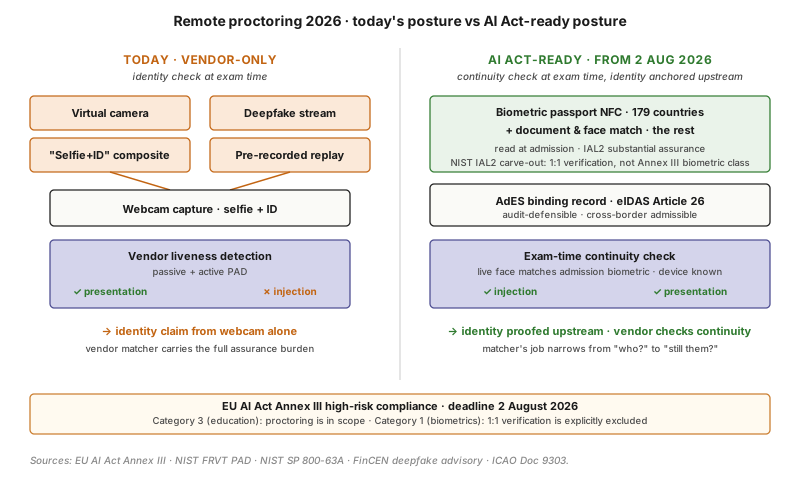
- Virtual camera injection. Software replaces the device's physical camera with a virtual camera that feeds a pre-rendered or live-rendered deepfake video stream directly to the proctoring app. The application sees a continuous, smooth, biometrically-plausible feed; the camera is never on.
- "Selfie with ID" composites. Attackers composite a stolen ID document image, a generated face matching the ID, and a "live selfie" frame into a single image flow that satisfies the smartphone capture flow's checks. The face matches the ID. The ID is real. The person is not.
- Pre-recorded stream replay through synthetic device profiles. Attackers spoof the device fingerprint (camera model, IMU data, network metadata) while replaying a previously-captured legitimate session — sometimes recorded in advance by a paid "professional test-taker" who set up the account.
The volume is no longer theoretical. The Biometric Industry Information Association's 2026 Synthetic Identity Fraud report recorded 8.3% of digital onboarding attempts flagged as suspicious in the first half of 2025, with the trend accelerating through Q4. FinCEN's 2024 advisory on the use of generative AI to circumvent KYC controls remains the authoritative US regulatory citation (FinCEN — Advisory on the use of deepfake media for financial crime, FIN-2024-Alert004).
Liveness detection — passive or active — was designed to catch the presentation attack: a photo, a printed mask, a video held up to the camera. It catches that family well. It is structurally less effective against injection attacks, where the malicious stream replaces the camera feed at the operating-system layer before any vendor code runs. NIST's Face Recognition Vendor Test programme tracks presentation-attack detection performance and publishes the leaderboards; what it cannot test is the injection path, because that lives outside the matcher.
Why Doesn't Vendor Liveness Detection Solve This Yet?
Because liveness checks the camera at exam time. It does not check the person at enrolment.
The bit that doesn't get said out loud in proctoring vendor demos is that even the best liveness model is in an arms race it is structurally losing — every new detection model trains the next generation of attacks. NIST has been measuring presentation-attack detection (PAD) for years; the better the matchers get, the more the attackers move to injection. The arms race is between the vendor's pixel-level detection and the attacker's pipeline-level evasion, and the attacker has a longer rebuild cycle. Vendors ship a model update once a quarter; attackers ship a workflow update once a week.
The defence vendors know this — every liveness vendor product page now talks about deepfake-resistance, and the more honest ones publish the false-acceptance rates against named attack families. The improvements are real. The trajectory of the arms race is real too.
What I'd push back on is the standard "we have liveness" pitch, which conflates two different problems. Vendor liveness checks the camera at exam time. Chip-based enrolment binding checks the person at admission. They solve different halves of the problem, and they are not substitutes — the exam-time check confirms the same body is sitting at the keyboard now as ten seconds ago; the admission-time check confirms that body belongs to the person the credential was issued to. The proctoring industry has historically positioned itself as solving both with the same primitive. It does not.
The honest reading of the August 2026 deadline is that it forces institutions to document the proctoring stack rather than fix it. The documentation requirements are non-trivial — they push institutions toward risk-aware procurement and toward technical audit of their vendors — but they do not change the matcher. They change the paperwork around the matcher.
What Closes the Exam-Identity Gap?
Move the proofing event upstream to admission, anchor it on a primitive that cannot be deepfaked at scale, and let the exam-time check verify continuity rather than identity.
The primitive that travels with every international student already, and that resists scalable deepfake attack because it carries cryptographic data signed by an issuing state, is the biometric passport NFC chip — 179 ICAO 9303 countries (ICAO Doc 9303 — Machine Readable Travel Documents). The chip's data is verified offline against the ICAO trust list; Chip Authentication confirms the chip is not cloned; PACE binds the read to physical presence. For students whose document pre-dates NFC or who present a non-ICAO national ID, document authenticity plus biometric face match (FaceTec liveness) at substantial assurance (NIST SP 800-63A IAL2) provides the equivalent admission-time proofing event — what we ship as the Identity Verification product. Both routes produce an Advanced Electronic Signature (AdES) under eIDAS Article 26 bound to the verified identity.
With that record in place, the proctoring vendor's job at exam time changes meaningfully. It no longer has to establish identity from a webcam; it has to verify continuity — that the live face on camera matches the admission-time biometric, that the keystroke and behavioural pattern is consistent, that no virtual-camera injection has occurred. The first task is what current vendors do badly. The second task is much closer to what their tools are actually built for.
If you sit on the compliance side, the August 2026 deadline is not the work — it's the visibility. The work is what gets you past the second audit cycle, when the regulator asks why the deepfake-detection module's false-acceptance rate is what it is. The answer that holds is "because we don't rely on it for identity; we rely on it for continuity, and the identity is anchored on a state-signed document chip read at enrolment." That answer survives the audit. The "we shipped the liveness update" answer doesn't, for long.
The architectural change here doesn't replace the proctoring vendor. It changes what the vendor is the source of truth for. The vendor remains the source of truth for behavioural integrity during the exam. It stops being the source of truth for "is this the right person".
Where the Cluster Goes Next
This is Cluster Post #4 of 6 on international student identity. Companion posts:
- Post 1 (29.05.2026, Gustav) — International Student Identity 2026: Where Does It Break? — architectural overview across the full lifecycle.
- Post 2 (01.06.2026, Mairi) — FAFSA Fraud 2026: How Did $1B+ Almost Reach Ghost Students? — synthetic-identity and industrial-operator fraud at the admission stage.
- Post 3 (04.06.2026, Gustav) — Diploma Mills 2026: Where Does Cryptographic Verification Hold? — the EBSI Verifiable Diplomas chain and the holder-binding gap.
- Post 5 (08.06.2026, Gustav) — EBSI Verifiable Diplomas and the holder-binding gap, in deeper engineering detail.
- Post 6 (10.06.2026, Mairi) — A university identity stack for 2027: the practical playbook combining all five threads.
More in this cluster
- EBSI Verifiable Diplomas 2026: How Is the Holder Actually Bound?
- University Identity Stack 2027: Where Should You Actually Start?
- How Do You Verify Student Identity for Attendance, Access, and Exams Under GDPR and the AI Act?
FAQ
Is remote proctoring a high-risk AI system under the EU AI Act? Yes. Under Annex III category 3 (education and vocational training), AI systems that "monitor and detect prohibited behaviour of students during tests" are high-risk. The compliance deadline is 2 August 2026. The same system may also fall under Annex III category 1 (biometrics) if it does remote biometric identification — but pure 1:1 biometric verification to confirm a person's claimed identity is explicitly excluded from category 1.
What is the difference between remote biometric identification and biometric verification under the AI Act? Remote biometric identification is 1:N matching — comparing a captured biometric against a database to identify an unknown person. It is high-risk under Annex III category 1. Biometric verification is 1:1 matching — confirming that a person is who they claim to be, against their own previously-enrolled biometric. The AI Act explicitly excludes biometric verification from the Annex III biometric high-risk class. The distinction matters because proctoring vendors often combine the two without flagging the regulatory difference.
How are deepfakes bypassing selfie + ID verification today? Three routes recur. Virtual camera injection replaces the physical camera feed with a generated stream before any vendor code runs. "Selfie with ID" composites combine a stolen real ID, a generated matching face, and a synthetic "live" frame into one capture flow. Pre-recorded session replay with spoofed device fingerprints replays earlier legitimate captures, often originally recorded by a paid "professional test-taker". The Biometric Industry Information Association 2026 report flagged 8.3% of digital onboarding attempts as suspicious in the first half of 2025.
Does AdES cover the proctoring identity audit chain? Advanced Electronic Signature (AdES) under eIDAS Article 26 provides the right level for the identity-proofing audit chain produced at admission. eIDAS Article 25 non-discrimination makes AdES admissible across Member States; the qualified-certificate machinery that QES carries is not required for institutional identity proofing. The AdES record retained at enrolment is what the proctoring vendor verifies continuity against at exam time, not what the vendor itself produces.
Does this require the AI Act conformity assessment to be redone? Switching from "vendor liveness is the identity source" to "chip-anchored enrolment is the identity source" changes the AI system's intended purpose and risk profile. The conformity assessment documentation has to reflect the architectural change. In practice this is a documentation update, not a re-issuance — and the substance of the assessment becomes easier to defend, because the identity claim is now anchored on a state-signed cryptographic primitive rather than on the vendor's matcher.
Sources
Primary — EU AI Act
- Regulation (EU) 2024/1689 — EU AI Act, EUR-Lex consolidated text
- EU AI Act — Annex III: High-Risk AI Systems Referred to in Article 6(2)
- EU AI Act — Article 5: Prohibited AI Practices
Primary — Identity-assurance and biometric standards
- NIST SP 800-63A — Digital Identity Guidelines: Identity Proofing and Enrollment
- NIST SP 800-63B — Digital Identity Guidelines: Authentication and Lifecycle Management
- NIST FRVT — Face Recognition Vendor Test: Presentation Attack Detection (PAD)
- ICAO Doc 9303 — Machine Readable Travel Documents
Primary — Generative AI fraud advisories
- FinCEN — Advisory on the use of deepfake media for financial crime (FIN-2024-Alert004)
- Biometric Update — AI fraud scheme bypassing verification systems (February 2026)
About the author
Mairi Kutberg is co-founder of IdentiGate. She focuses on identity-proofing operations under eIDAS, NIS2, AMLR, the AI Act, and adjacent regulatory frameworks, and on the institutional reality of running cross-border identity verification at scale.