How Do You Verify Student Identity for Attendance, Access, and Exams Under GDPR and the AI Act?
Student identity in a modern educational institution has to work across three moments — enrolment onto a course, daily attendance and physical access, and exam entry — each with a different threat model, frequency, and GDPR + AI Act compliance envelope. The architecture that survives regulatory scrutiny is a single chip-anchored proofing event at enrolment, followed by privacy-preserving 1:1 biometric re-authentication at every subsequent moment. That is a legally defensible way to run student identity — and it is the only one that does not collapse the first time a data-protection authority audits the deployment.
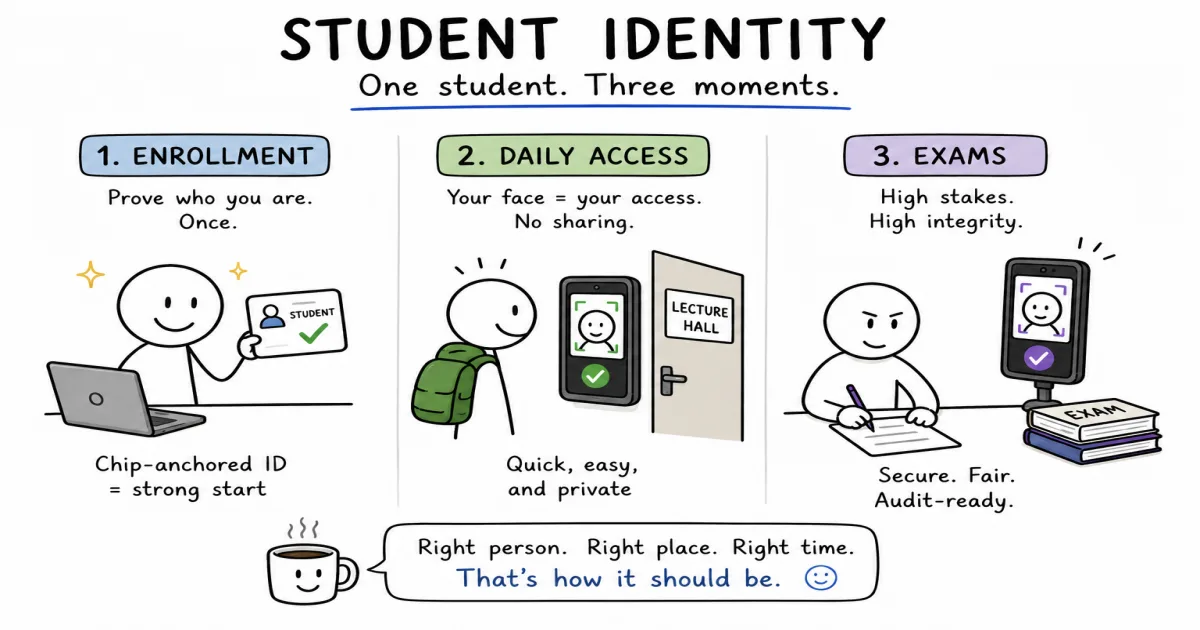
Student identity in a modern educational institution has to work across three moments — enrolment onto a course, daily attendance and physical access, and exam entry — each with a different threat model, frequency, and GDPR + AI Act compliance envelope. The architecture that survives regulatory scrutiny is a single chip-anchored proofing event at enrolment, followed by privacy-preserving 1:1 biometric re-authentication at every subsequent moment. That is a legally defensible way to run student identity — and it is the only one that does not collapse the first time a data-protection authority audits the deployment.
A Nordic technical university's admissions office called us at a recent conversation. Their exam-integrity committee had asked estates and IT to unify three separate identity systems — the enrolment platform's ID upload, the door-badge attendance reader, and the exam-hall face-check station — because each system had a distinct fraud vector and none of them talked to each other. The uncomfortable pattern: enrolment identity was checked once at admission with a scanned ID photo and never again; door badges could be swapped between friends; the exam-hall face check was catching mostly what a manual invigilator would already catch. Three systems, three vendor contracts, three separate consent flows — and still a gap wide enough that a determined proxy-attender could walk through the whole term. This post is that architecture, walked through in the shape a university-operations, exam-integrity, or estates-management audience needs.
What is student identity, and why do institutions treat it as three problems?
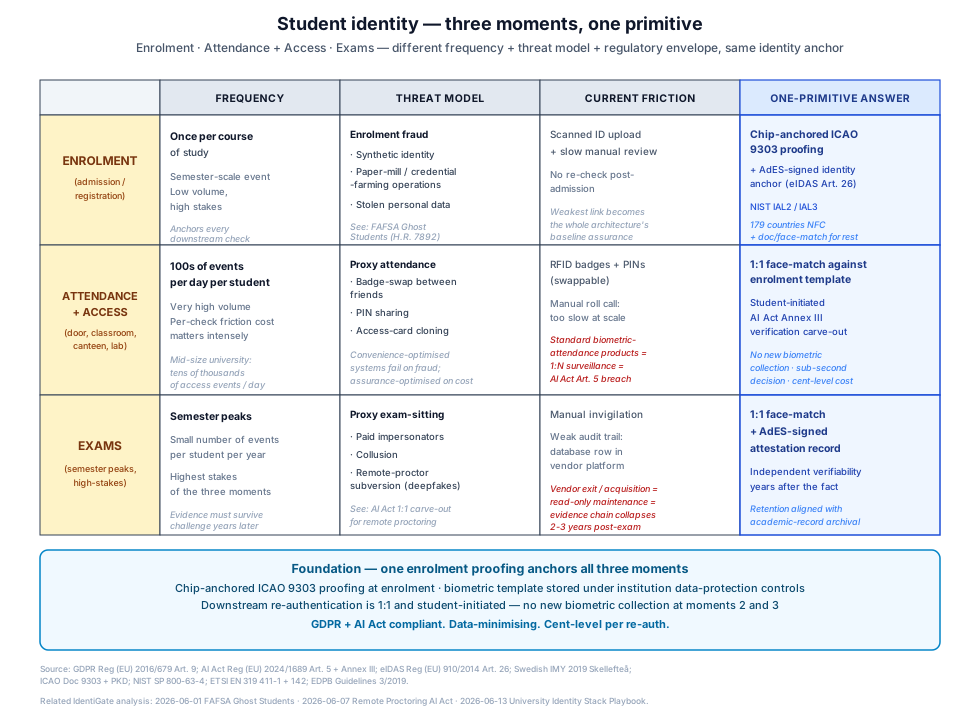
Student identity is not one operational challenge. It is three, arriving at three different frequencies and carrying three different threat models.
Enrolment happens once per course of study — a semester-scale event. The threat here is enrolment fraud: someone else's identity presented at admission, a synthetic identity built from stolen personal data, a paper-mill or credential-farming operation. Volume is low per institution but stakes are high because every downstream identity check inherits whatever assurance was established at enrolment. The US regulatory pressure on this specific moment — H.R. 7892 (No Aid for Ghost Students Act) plus Federal Student Aid's real-time identity-fraud detection deployed against FAFSA applications from April 2026 — walked in FAFSA Fraud + Ghost Students — signals where enforcement is heading globally.
Attendance and physical access happen many times per day — canteens, classrooms, laboratories, dormitories. The threat here is proxy attendance and badge-swapping. Volume is very high (a mid-sized university runs tens of thousands of access events per day) so per-check friction cost matters intensely. Convenience-optimised systems (RFID card badges, PINs) fail on fraud; assurance-optimised systems (in-person invigilation) fail on cost.
Exams and other high-stakes moments happen at semester peaks — a small number of events per student per year, but with the highest stakes of the three moments. Fraud here is proxy exam-sitting (paid impersonators), collusion, and — increasingly — remote-proctoring subversion. The regulatory framing is different from the other two moments because the AI Act Regulation (EU) 2024/1689 governs the biometric-technology profile that can be deployed here.
The way I typically frame this in a first conversation with university operations: treating these three moments as three separate procurement decisions is exactly what creates the fraud gap. Every operational shortcut in any one system compounds against the other two, and the whole architecture ends up being no stronger than the weakest link. A student proxy who gets past a weak enrolment check is validated by strong subsequent systems, which then produce the appearance of a legitimate academic record.
Where does GDPR + AI Act biometric-carve-out actually let you use face-match for students?
This is where most vendor pitches oversimplify. The regulatory envelope in 2026 is narrower than the biometric-attendance industry admits.
Under GDPR Article 9, biometric data is a special category — processing is prohibited by default and requires either explicit consent or a specific legal basis under Article 9(2). The Swedish Data Protection Authority (Datainspektionen, now IMY) fined a municipality roughly €20,000 in 2019 for running a facial-recognition attendance trial at a secondary school, and the reasoning is worth understanding precisely: consent, even parental consent for underage students, was ruled insufficient, because the power imbalance between school and student means consent cannot be freely given, and less intrusive means (a manual roll call) were available. Institutions in EU member states cannot assume that a consent form solves the biometric-attendance compliance question.
Under the AI Act Article 5, real-time remote biometric identification in publicly accessible spaces is prohibited outright for most purposes. Schools and universities are publicly accessible spaces in the AI Act sense. What survives this prohibition is the Annex III + Article 6 high-risk carve-out for 1:1 verification — comparing a live capture to a specific pre-enrolled template to confirm identity, not scanning a crowd to identify one of many. That distinction is architectural, not cosmetic: a face-match system that verifies a specific student against their own enrolled template is a different regulatory beast than a system that watches a corridor to identify students among passers-by. The technical + legal walk-through of the 1:1 verification carve-out and how it survived the AI Act drafting process lives in Remote Proctoring, Deepfakes, and the AI Act 1:1 Verification Carve-Out.
Where I disagree with the loud vendor pitch on this: the standard biometric-attendance product being sold to schools in 2026 — a wall-mounted camera scanning classrooms to identify who is present — is exactly the deployment shape the AI Act is designed to prohibit, regardless of what consent-form language the vendor supplies. The compliant architecture is not "biometric attendance"; it is 1:1 verification at a defined moment of interaction with a specific student, initiated by the student, against a template established during a proofed enrolment. That is a legally defensible product; the other one is a compliance failure waiting for the first DPA audit.
How does one identity primitive serve three moments?
The architecture that survives regulatory scrutiny compresses the three separate systems into one primitive used three ways.
One proofing event at enrolment. During admission, the student's identity is verified once — chip-anchored where possible (ICAO Doc 9303 passport-NFC read + live biometric face-match against the on-chip portrait, covering 179 countries), document + biometric face-match for the rest. That single proofing event produces an Advanced Electronic Signature under eIDAS Article 26 tied to a verified identity, plus a biometric template stored under the institution's data-protection controls. This is a Level 2 or Level 3 identity assurance event under NIST SP 800-63-4 — the same primitive that would be used for a bank onboarding or a cross-border employment verification.
Cheap re-authentication at every subsequent moment. Once the enrolment template exists, attendance checks and door access can be handled by 1:1 verification against that template — student presents themselves at the door reader or the classroom check-in station, live capture is compared against the enrolled template, decision returned in under a second. This is the AI Act-compliant path because the verification is 1:1 (not 1:N surveillance), initiated by the student, and produces no new biometric template that is retained beyond the verification decision. Frequency can be high (hundreds of times per day per student) because the marginal cost per verification is trivial once the enrolment proofing is amortised.
Signed attestation at high-stakes moments. Exam entry produces the same 1:1 face-match — but with an additional artefact: an AdES-level signature on an attestation record ("student X passed 1:1 verification at time T against enrolment template E for exam Y") retained under exam-integrity policy. This gives the exam-integrity committee a cryptographically verifiable record that survives challenge years later, aligned with the retention obligations of academic-record archival. The layered architecture underneath this is walked in University Identity Stack 2027 Playbook.
A German research institute's exam-integrity committee I worked with last quarter had the failure mode inverted: they had strong 1:1 face-match at exam entry, but no cryptographic attestation of the check. When a dispute surfaced two years later over whether a specific graduate had actually sat their qualifying exam, the audit-trail was a database row in the vendor's platform — no signed record, no independent verifiability, and by then the vendor had been acquired and the old system was in read-only maintenance. The face-check had worked at the moment; the evidence had not survived the moment.
The way I usually explain the primitive-reuse advantage: the expensive part of student identity is the enrolment proofing — that is the identity-verification event NIST calls IAL2 or IAL3 and that requires document forensics, liveness detection, and (ideally) chip-anchored reading. Once you have paid that cost once, every subsequent 1:1 verification runs against the enrolment template at cent-level cost. Institutions that treat each of the three moments as needing its own full identity-proofing event are paying for the enrolment-grade check three times per student per semester; institutions that architect for primitive-reuse are paying for it once.
What should university operations check for in a student-identity architecture?
Six questions to put to any student-identity procurement before signing off. The vendor's answers will usually tell you more about actual GDPR + AI Act posture than the marketing document does.
-
What is the GDPR legal basis for biometric processing, and does it survive the Swedish DPA precedent? Consent from students (particularly underage students) is not a safe basis on its own. Institutions need a defensible Article 9(2) basis — usually substantial public interest for accredited-exam integrity, or contract-necessity carefully drafted for adult higher-education flows.
-
Is the architecture 1:1 verification (student-initiated), or 1:N identification (surveillance)? 1:1 with student-initiated capture sits inside the AI Act Annex III carve-out. 1:N corridor-scanning does not, regardless of consent form language.
-
What happens to the biometric template when the student withdraws, graduates, or leaves the institution? Template deletion or cryptographic destruction must be technically enforced, not just contractually promised. Data-minimisation is a GDPR Article 5(1)(c) principle; retention-past-need is a breach.
-
Is the exam-attestation signed, and does the signature survive vendor exit? AdES-level signatures under eIDAS Article 26 embedded in an evidence record — verifiable years later without vendor cooperation. If the exam evidence is a platform-database row, the audit walk-back pattern for signature challenges applies directly and the evidence fails.
-
Which countries can the enrolment proofing actually cover? International-student intake means non-EU document coverage matters — 179 ICAO 9303 countries via passport-NFC + document + face-match for the rest — otherwise your international admissions inherit a weaker identity baseline than your domestic intake.
-
Does the system integrate with the institution's existing identity provider (IdP), or does it fork the student's account? Federating with the institution's SSO + student-record system prevents template proliferation and keeps the enrolment-proofing event as the single canonical identity anchor.
My take on this: a student-identity procurement that treats GDPR compliance as a checkbox and the AI Act as vendor-language boilerplate almost always shows up in a DPA audit or a court challenge two-to-three years later. The retrofit cost when regulation, incident, or contract dispute forces the architecture correction is an order of magnitude above the upfront cost of getting the primitive right at enrolment — and by then the deployed student cohort is the constraint.
Where IdentiGate fits
IdentiGate provides the enrolment-proofing primitive that anchors the whole architecture — chip-anchored passport-NFC reading covering 179 countries, plus document + biometric face-match for every remaining jurisdiction, plus AdES-level signature under eIDAS Article 26. Our authentication layer handles 1:1 verification at every subsequent moment (attendance, door access, exam entry), producing decisions in under a second against the enrolment template without adding new biometric collection. Our signature platform produces the AdES-signed attestation records that make exam integrity independently verifiable years after the fact, and our Unified Digital Identity product is what lets the same student identity federate across enrolment, campus access, and exam-integrity systems without template proliferation.
If your institution is preparing a student-identity procurement that has to satisfy GDPR + AI Act obligations and cover an international admissions intake — or if a DPA audit or exam-integrity dispute has already surfaced the gap — get in touch.
More in this cluster
- International Student Identity 2026: Where Does It Break?
- FAFSA Fraud 2026: How Did $1B+ Almost Reach Ghost Students?
- Diploma Mills 2026: Where Does Cryptographic Verification Hold?
- Remote Proctoring 2026: Can Deepfakes Beat Selfie ID Verification?
- EBSI Verifiable Diplomas 2026: How Is the Holder Actually Bound?
- University Identity Stack 2027: Where Should You Actually Start?
Sources
Legal + regulatory frameworks
- GDPR Regulation (EU) 2016/679 — Article 9 (special category biometric data)
- AI Act Regulation (EU) 2024/1689 — Article 5 + Annex III (biometric verification carve-out)
- eIDAS Regulation (EU) 910/2014 — Article 26 (Advanced Electronic Signatures)
- EDPB Guidelines 3/2019 on video devices
- Swedish IMY (Datainspektionen) decision — Skellefteå school facial recognition (2019)
US education-identity regulatory context
- H.R. 7892 — No Aid for Ghost Students Act
- Federal Student Aid Identity Fraud Detection (April 2026 rollout)
Identity + assurance standards
- NIST SP 800-63-4 (Digital Identity Guidelines)
- ICAO Doc 9303 (Machine Readable Travel Documents)
- ICAO Public Key Directory
Trust service infrastructure
About the author
Mairi Kutberg is a co-founder of IdentiGate, a European identity-verification and digital-signature company building on top of chip-anchored identity-proofing (ICAO 9303 passport NFC), Advanced Electronic Signatures (eIDAS Article 26), and Advanced Electronic Seals. She works with education, healthcare, logistics, fintech, HR-tech, iGaming, defence, and cybersecurity teams where the identity primitive has to serve multiple downstream moments and every one of them has to survive regulatory scrutiny.