How Do You Verify a Gig Worker's Identity Without Re-KYC on Every Task?
You do not — you verify once, chip-anchored, and reuse the record across every subsequent task engagement with a lightweight activation step (biometric touch, PIN, or device unlock) that binds each task to the same verified person. The engineering pattern is reusable identity anchored at first-verify and retained under an AdES evidence envelope that survives well beyond any single task lifetime. This post walks the pattern, the three architectural properties that make it survive a compliance review, and where the picture is genuinely harder than the marketing suggests.
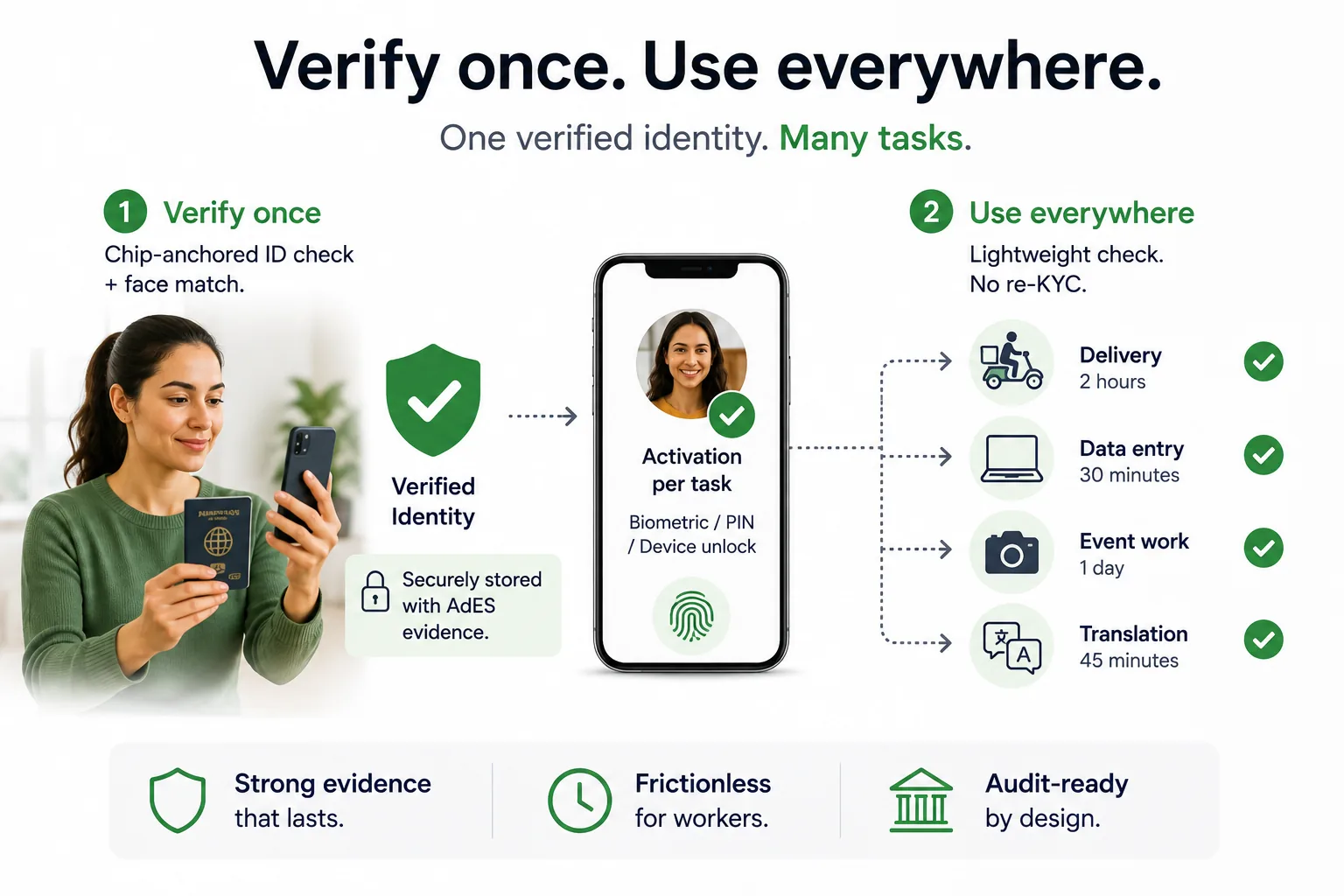
You do not verify a gig worker at every task — you verify once, chip-anchored, and reuse the record across every subsequent task engagement with a lightweight activation step (a biometric touch, a PIN, or a device unlock) that binds each task to the same verified person. The engineering pattern is reusable identity anchored at first-verify and retained under an AdES evidence envelope that survives well beyond any single task lifetime. This post walks the pattern, the three architectural properties that make it survive a compliance review, and where the picture is genuinely harder than the marketing suggests.
This post is the third in our workforce identity cluster, alongside our earlier procurement-side rubric on who offers trusted workforce identity services for distributed teams and our engineering-side walk-through of contractor-of-record identity integration pipelines. Gig work sits in a specific corner of the workforce identity map — high-frequency task engagements against a single worker identity — where the trade-off between per-task verification cost and per-engagement evidence quality is the actual architectural question.
What makes gig worker identity verification different from full-time employment KYC?
The identity primitive is the same. The engagement lifecycle is very different, and the difference is where the design choice gets interesting.
A full-time employee onboards once at hire, works under a stable contract for a period measured in months or years, and their identity verification record naturally amortises across a long engagement. A contractor onboards under a quarterly or annual service agreement — the CoR-integration flow I walked in the previous post in this cluster applies cleanly. A gig worker, by contrast, may engage with the platform for a three-hour delivery shift, a fifteen-minute translation task, a two-day event-staffing block, or a fifteen-week seasonal contract — and may do the equivalent of a hundred separate engagements against the same platform over a twelve-month period. The identity verification cost model that works for one long engagement does not work for a hundred short ones, and the platform lead who tries to reproduce the FTE onboarding pattern for gig workers usually discovers that within the first quarter of operation.
In my work with platform operators shipping identity flows in 2026, the framing that lands is that a gig worker's identity has two lifecycles: the identity-verification lifecycle (which happens once, at first engagement) and the task-activation lifecycle (which happens per task, against the already-verified identity). Conflating the two — running full identity verification at every task activation — is expensive, slow, produces a poor UX for the worker, and, counterintuitively, often produces weaker evidence than a single well-executed first-verify because the platform operator ends up cutting corners on the repeat-verifications to keep the per-task cost tolerable. A Berlin-based food-delivery platform operating across DACH markets that we worked with in early 2026 had exactly this problem: they were running document-scan-plus-selfie at every rider shift-start, and the compliance review flagged that the cumulative evidence file for a rider who had worked two hundred shifts was two hundred document scans and two hundred selfies, none of which individually met the evidence bar the regulator was asking about at audit.
What is the re-KYC-on-every-task trap, and why do platforms fall into it?
Three drivers, all reasonable in isolation, that combine into an architectural mistake.
Driver one: liability-anxiety. The platform's legal and compliance teams read the applicable regulations — AMLR Regulation (EU) 2024/1624 for financial platforms, the AI Act Regulation (EU) 2024/1689 Article 14 transparency provisions for AI-mediated task matching, sector-specific worker verification rules for regulated industries — and the safe interpretation of each is "verify identity at the point of engagement". A first-verify-then-reuse pattern reads as a "gap" to a compliance officer whose training prioritised caution. The safe answer is repeated verification. The safe answer is also expensive and unnecessary at the evidence-quality level.
Driver two: worker-side authentication weakness. The platform's account-security posture is often built around password + optional 2FA. When the task-activation step is "log in with your platform account", the platform cannot confidently assert that the person activating the task is the same person the platform onboarded. The pattern-response is to layer full identity verification on top of authentication at every task — solving the wrong problem with an expensive tool. The right problem to solve is the authentication weakness (upgrade to phishing-resistant MFA bound to a device secure enclave); the wrong problem to solve is by throwing identity verification at every task.
Driver three: vendor-billing incentive. Identity-verification vendors typically bill per-verification. A vendor whose commercial model is per-verify has a subtle incentive to not describe the reusable-identity architecture clearly to prospects. In my experience the vendors who genuinely propose one-verify-and-reuse are the ones whose pricing model does not depend on repeat billing per task activation — which is a signal worth reading during vendor evaluation.
The compound effect: platforms that started with a reasonable first-verify design drift toward re-KYC-per-task over the first eighteen months of operation because each of the three drivers pushes in the same direction independently. Rolling that drift back once it is embedded is harder than getting the architecture right up front.
What does "reusable identity" actually mean, technically?
It means one identity-verification event, one evidence record, and a lightweight per-task activation step that cryptographically binds each task to the same verified person.
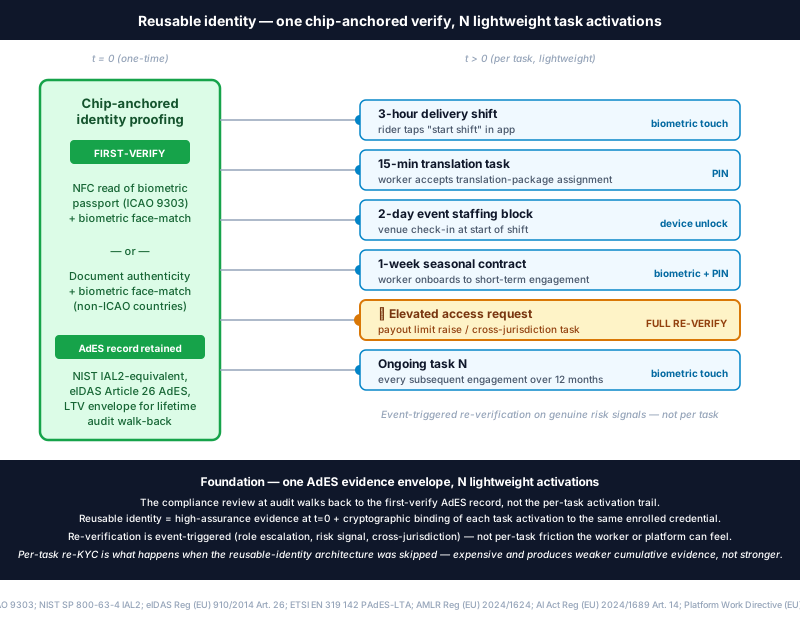
The mechanics: at first engagement, the worker runs identity verification once — chip-anchored NFC read of their biometric passport plus a biometric face-match against the chip photo, or document authenticity plus biometric face-match for jurisdictions without an NFC document. The result is an evidence record produced under eIDAS Article 26 Advanced Electronic Signature, retained by the platform (or its identity vendor) in a form a third party can independently verify: the chip cryptogram, the biometric match score, the signed attestation with issuer chain and timestamp. This is the load-bearing step. It happens once per worker.
At each subsequent task activation — the food-delivery rider tapping "start shift" in the app, the translator accepting a translation-package assignment, the event-staffing worker checking in at the venue — the platform runs a lightweight activation: a biometric touch (Face ID, fingerprint, or the platform's own liveness check bound to the same enrolled biometric template), a PIN entered on a device that has been enrolled to the identity, or a device-unlock cryptogram from a device bound to the identity's public key at first-verify. What each of these activation methods proves is possession-plus-freshness: the person activating this task right now has cryptographic access to the credential bound at first-verify. The evidence chain reads: this worker was verified with high confidence at first-verify (chip-anchored biometric proofing), and the activation right now is bound to the same credential. The two-step evidence stands up to a compliance review in a way that a document scan at every task activation does not.
Which three architectural properties make reusable gig identity survive a compliance review?
Three, and skipping any one of them collapses the pattern back into either re-KYC-per-task or a weak evidence posture.
Property one: chip-anchored proofing at first-verify. The evidence quality of the entire downstream task chain is set at first-verify. If first-verify is a document-scan-plus-selfie, the reusable-identity pattern inherits that evidence tier — which is fine for low-risk gig contexts but thin for financial, healthcare, iGaming, or elevated-access platforms. A chip-anchored NFC read plus biometric face-match under ICAO Doc 9303 meets NIST SP 800-63-4 IAL2 evidence expectations globally without a supervised human reviewer. The one-time cost is higher than a document scan; the amortised cost across a hundred task activations is dramatically lower and the evidence quality is meaningfully higher.
Property two: AdES-signed evidence envelope retained across the full worker lifetime, not just per-task. The evidence artefact the compliance reviewer will ask to see is the first-verify record, not the per-task activation log. An Advanced Electronic Signature under eIDAS Article 26 wrapped in a Long-Term Validity envelope (PAdES-LTA, XAdES-A, or CAdES-LTA depending on the record format) is the pattern that survives an audit three years after the worker's last shift. An internal log entry that says "verified at timestamp X" is not the same class of evidence. Platforms that skip this retention decision at architecture time end up with evidence gaps at audit time that cannot be closed retroactively.
Property three: event-triggered re-verification hooks — not per-task, but risk-based. Reusable does not mean immutable. The identity primitive should re-verify when there is a genuine risk signal: the worker requests elevated access (payout limit increase, cross-jurisdiction task acceptance, escalated role), the platform's fraud engine flags an anomaly (unusual location, biometric confidence drop, device change), the contract renews across a jurisdictional boundary that changes the applicable regulation, or a scheduled interval elapses that the platform's risk policy defines as the maximum reusable-identity age. What re-verification triggers on is a design decision. The right design is event-triggered, not per-task. Wiring the trigger event catalogue at architecture time is what makes the reusable-identity posture defensible.
Where does the picture break?
Three places, all worth naming honestly rather than glossing over.
Cross-border payroll and tax classification is not the same as cross-border identity. A gig platform operating across the EU + third countries has identity verification well-covered by the chip-anchored + document-face-match dual-track. It does not have the local employment-law, tax-withholding, worker-classification, or benefits-eligibility posture covered by the same primitive. Those are a separate architectural investment — a contractor-of-record or employer-of-record partnership, jurisdiction-specific tax filing infrastructure, and a legal function that keeps pace with worker classification rulings across jurisdictions. Reusable identity solves the who is this worker question. It does not solve the what jurisdiction owns this engagement question.
AI-mediated task matching creates a new regulatory exposure at the identity layer. Under AI Act Article 14, platforms that use AI systems for high-risk decisions about workers (including task allocation that materially affects earnings) face specific transparency obligations. Identity verification is not the AI system in this scenario, but the identity record becomes an input to the AI matching model, and the compliance conversation about the AI model's transparency will pull the identity-verification evidence into scope. Platforms that treat identity and AI transparency as separate compliance workstreams end up doing the work twice; platforms that architect them together get a cleaner audit posture.
Worker classification uncertainty is a live regulatory front, and the identity layer sits underneath it. The EU Platform Work Directive Directive (EU) 2024/2831 — adopted in 2024 with Member State transposition due by 2 December 2026 — introduces a presumption of employment for platform workers meeting specific control-of-work criteria. Whether a specific gig worker is an employee or a contractor may change during a platform's operating lifetime as case law and national implementations land. The identity-verification architecture should be classification-neutral — same evidence quality, same reusable-identity primitive — because the classification answer may change on regulatory grounds without changing the underlying worker.
Where IdentiGate fits
Being direct: this pattern — one-time chip-anchored proofing plus reusable identity plus AdES-retained evidence — is exactly the architecture we ship. Our identity-verification product produces the first-verify record across the full 179 ICAO 9303 country footprint via chip-anchored NFC, with document authenticity plus biometric face-match for the remaining jurisdictions. Our signatures product produces the AdES record under eIDAS Article 26, and our evidence layer wraps it in Long-Term Validity retention that meets the compliance-review evidence bar three years after the last task activation.
Where we integrate is at the platform's task-activation flow — the platform calls our identity-verification API once at worker onboarding, receives an AdES-anchored identity record it can bind to its own worker account, and thereafter runs lightweight activation (biometric touch, PIN, or device-unlock) locally at each task-start against the same enrolled credential. The commercial model is calibrated per verified worker at first-verify, not per task activation, which aligns our incentive with the platform's actual cost curve rather than against it.
Where the picture is more limited: we do not (today) ship the cross-border payroll or tax classification layer — that is a separate architectural investment the platform makes with a payroll or CoR partner. And native platform-workflow connectors (task-marketplace webhooks, worker-app SDKs) are in the roadmap for late 2026 rather than production-ready today. The distributed teams we have onboarded in 2026 have universally accepted this scoping — they wanted the evidence-quality piece done right, and they own the payroll and workflow integration decisions themselves.
The push-back I would make
Where I would push back on the "verify at every task" posture that dominates most platform compliance conversations in 2026 is on the assumption that per-task verification is what regulators actually want. In my reading of the applicable regimes — AMLR, AI Act, the Platform Work Directive, sector-specific rules — none of them require per-task identity verification. They require verifiable identity bound to the worker across the engagement lifecycle, with evidence that survives audit walk-back. Chip-anchored first-verify plus reusable identity plus AdES retention meets that requirement cleanly. Per-task re-KYC is a compliance-officer proxy for "we could not architect the reusable-identity pattern properly, so we default to the expensive alternative". It is not what the regulation asks for, and the platforms doing it well have moved past it — usually quietly, because the compliance narrative around "we verify at every task" reads as a strength to prospects who have not thought about it carefully.
If your platform is currently running re-KYC on every task, the architectural cost of migrating to reusable identity is real but bounded — and the compliance posture at the far end is materially stronger, not weaker, than the pattern it replaces.
More in this cluster
- Who Offers Trusted Workforce Identity Services for Distributed Teams?
- Which Contractor of Record Software Makes Contractor Identity Verification Reliable During Onboarding?
Adjacent worker-onboarding vertical:
Sources
Primary — identity assurance and document standards
Primary — eIDAS and evidence framework
- Regulation (EU) 910/2014 — eIDAS (Article 26 AdES)
- Regulation (EU) 2024/1183 — eIDAS 2.0
- ETSI EN 319 142 — PAdES long-term validity
Primary — platform work, AML, AI
- Directive (EU) 2024/2831 — Platform Work Directive
- Regulation (EU) 2024/1624 — AMLR
- Regulation (EU) 2024/1689 — AI Act (Article 14)
About the author
Mairi Kutberg is a co-founder of IdentiGate OÜ, a European identity-verification and digital-signature company building on top of chip-anchored identity proofing (ICAO 9303 passport NFC), Advanced Electronic Signatures under eIDAS Article 26, and Advanced Electronic Seals. She works with gig platforms, distributed engineering teams, and cross-border hiring functions on the intersection of workforce identity assurance and platform-worker regulatory compliance under AMLR, the Platform Work Directive, and the AI Act.