How to Verify Non-EU Driver Identity for eCMR Signing
Non-EU drivers carry a material share of EU freight but have no European digital identity. Three methods to verify them — and which one actually works at scale.
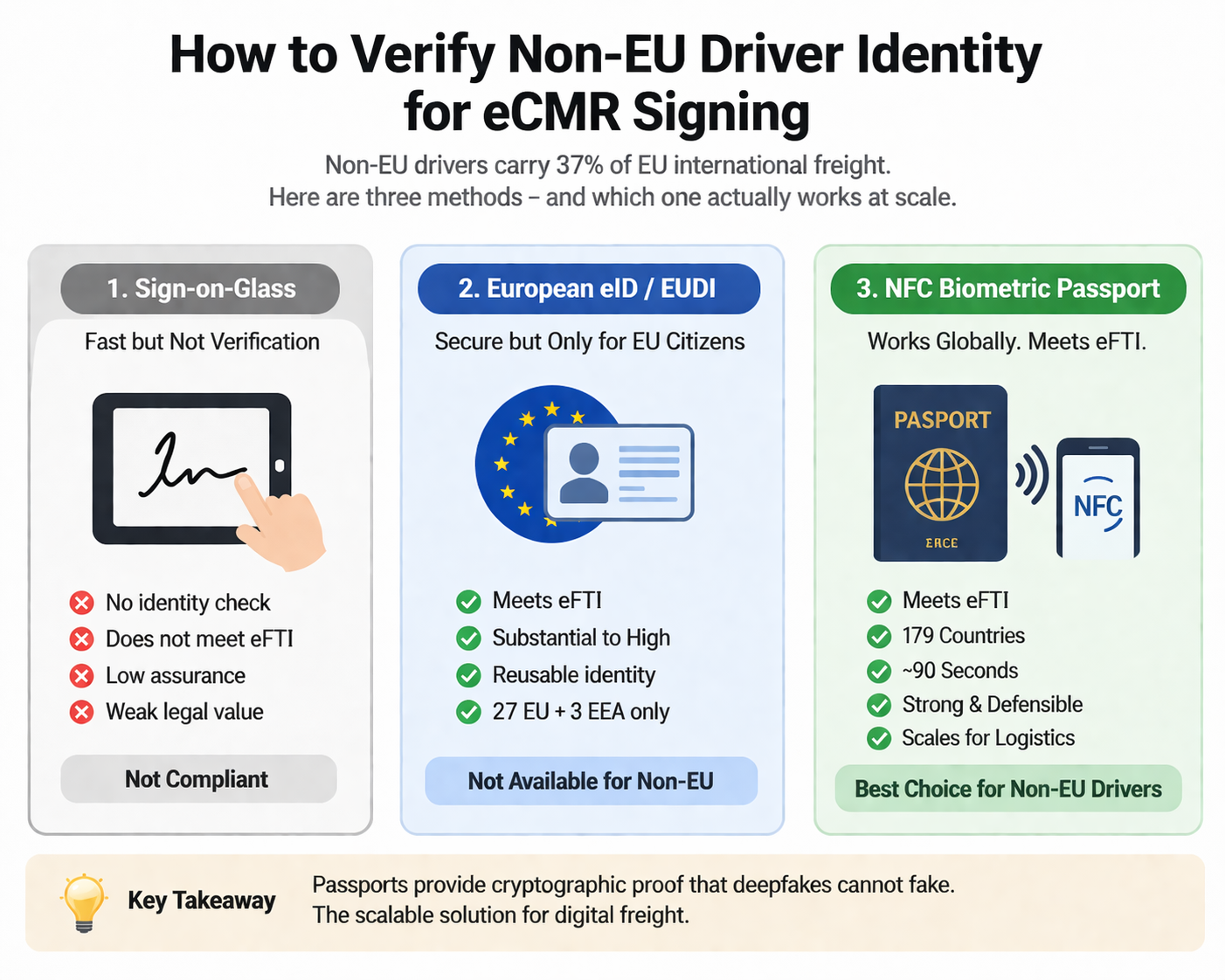
Non-EU drivers carrying freight in Europe need a verified digital identity to sign eCMR documents, but they have no access to the European Digital Identity (EUDI) wallet, no European eID card, and no path to obtaining either. This is the single largest operational gap in Europe's transition to digital freight documentation.
Eurostat data on cross-trade and cabotage shows that a material share of international road freight within the EU is performed by vehicles and drivers operating across borders, and on key corridors — Turkey to Germany, Ukraine to Poland, Morocco to Spain — non-EU carriers dominate the flows. Every one of these drivers will need to sign eCMR documents digitally once the eFTI regulation takes full effect in July 2027. And every one of them falls outside the scope of Europe's digital identity infrastructure.
This guide explains why this gap exists, compares the three available methods for verifying non-EU driver identity, and provides a practical implementation path for logistics companies and eCMR platform operators.
Why Non-EU Drivers Cannot Use European Digital Identity
The European digital identity ecosystem was designed for European citizens. Understanding its boundaries explains why non-EU drivers are excluded.
The EUDI Wallet covers 27 countries
The EU Digital Identity Wallet (EUDI), mandated under eIDAS 2.0, will be available to citizens and legal residents of the 27 EU Member States by the end of 2026. EEA countries (Iceland, Liechtenstein, Norway) have an extended deadline of December 2027. Switzerland is developing its own Swiyu wallet outside the EUDI framework.
The target is ambitious: 80% citizen adoption by 2030, covering approximately 450 million people. But the eCMR protocol has been ratified by 39 countries — including Turkey, Ukraine, the United Kingdom, Belarus, Moldova, Armenia, and several Central Asian states. None of these countries will receive the EUDI wallet. Their carriers and drivers have no access to the European digital identity ecosystem.
National eID systems are not interoperable
Several EU countries have mature national eID systems — Estonia's ID-kaart, Germany's Personalausweis, Sweden's BankID, Belgium's eID. These work within their own countries and, to varying degrees, across EU borders under eIDAS mutual recognition.
But a Turkish, Ukrainian, or Moroccan driver cannot obtain or use any of these systems. They are tied to national citizenship or legal residency.
The numbers make the gap concrete
| Country | Role in EU Freight | Access to EU Digital Identity |
|---|---|---|
| Turkey | Largest source of non-EU haulage into EU | No EUDI, no EU eID |
| Ukraine | Major carrier on Eastern EU corridors | No EUDI, no EU eID |
| Morocco | Primary carrier on Spain/France corridors | No EUDI, no EU eID |
| Serbia | Active on Balkans-EU corridors, CMR member | No EUDI, no EU eID |
| Belarus | Significant transit and carrier country | No EUDI, no EU eID |
| Moldova | Growing carrier presence on EU routes | No EUDI, no EU eID |
| United Kingdom | Major freight partner post-Brexit | No EUDI (own system planned) |
| Uzbekistan, Kyrgyzstan | Emerging Middle Corridor carriers | No EUDI, no EU eID |
The IRU reports that 58 countries are CMR contracting parties — of which 39 have ratified or acceded to the eCMR protocol (most recently Armenia, Austria, Hungary, and Italy in 2024). The identity gap affects every non-EU country in this list.
What eFTI Article 5 Requires for Driver Identity Verification
The eFTI Implementing Regulation (EU) 2025/2243, Article 5 requires every certified eFTI platform to verify the identity of every business user at eIDAS "substantial" assurance level. In the eCMR workflow, the driver is a business user — they sign at the point of goods handover.
This means the driver must be identified against a government-issued document. The following methods do NOT meet this requirement:
- Login credentials (username + password) — low assurance level
- One-time SMS or email codes — does not verify identity, only device access
- Sign-on-Glass (finger signature on tablet) — Simple Electronic Signature with no identity verification
- Self-declared identity (name entry in an app) — no verification at all
The regulation does not specify which method must be used — only that the result must meet substantial assurance. This leaves three viable paths.
Three Methods Compared: Sign-on-Glass vs eID vs NFC Passport
| Criteria | Sign-on-Glass | European eID / EUDI | NFC Biometric Passport |
|---|---|---|---|
| Identity assurance level | Low (SES) | Substantial to High | Substantial |
| Meets eFTI Article 5? | No | Yes (EU citizens only) | Yes (~180 countries and regions) |
| Works for non-EU drivers? | N/A (no identity check) | No | Yes |
| Countries covered | Any (but no verification) | 27 EU + 3 EEA | ~180 (ICAO 9303) |
| Onboarding time | Instant (no verification) | Varies by country | ~90 seconds |
| Reusable identity? | No (per-session only) | Yes | Yes |
| Signature level produced | SES (weakest) | AES or QES | AES |
| Requires special hardware? | Tablet/phone | Depends on country | Smartphone with NFC |
| Cost per verification | Near zero | Free (government-issued) | EUR 2–5 per onboarding |
| Legal defensibility in dispute | Weak (easily repudiated) | Strong | Strong |
| Offline capability | Yes | Varies | Initial verification requires connection; subsequent signing can work offline |
The verdict
Sign-on-Glass is not identity verification. It records a finger drawing. It will not meet eFTI Article 5 and is legally weak in disputes. It remains common because it is frictionless — but frictionless does not mean compliant.
European eID / EUDI is the correct long-term solution for EU citizens. But it leaves non-EU drivers — who carry over a third of EU international freight — without a path. It is also not fully available: several Member States will miss the December 2026 deployment deadline.
NFC biometric passport verification is the only method that covers both EU and non-EU drivers, produces a legally defensible Advanced Electronic Signature (which is sufficient for eCMR — you do not need the more expensive QES), and meets eFTI Article 5. It is the practical solution for cross-border freight where the driver may come from any of ~180 countries and regions.
How NFC Biometric Passport Verification Works
Modern biometric passports issued under the ICAO 9303 standard contain an NFC (Near Field Communication) chip. This chip stores the holder's biometric and biographical data — name, date of birth, nationality, facial image, and fingerprint hashes — signed with a cryptographic certificate issued by the passport's home country.
Here is how verification works, step by step:
Step 1: The driver downloads the verification app
The driver installs a mobile app on their smartphone. The app requires NFC capability, which is standard in approximately 80% of smartphones manufactured since 2020 (all iPhones since iPhone 7, most Android devices).
Step 2: The driver scans their passport
The driver holds their passport against the back of their phone. The NFC antenna reads the chip. The app establishes a secure communication channel using the document number, date of birth, and expiry date (read from the Machine Readable Zone).
Step 3: Cryptographic verification
The app verifies the chip's data against the issuing country's public key infrastructure:
- Passive Authentication checks that the data on the chip has not been modified. The chip stores hash values of all data groups, signed by the country's Document Signing Certificate.
- Chip Authentication (or Active Authentication) verifies that the chip itself is genuine and has not been cloned. The chip contains a private key that cannot be extracted — its existence is proven through a cryptographic challenge-response.
This verification is deterministic, not probabilistic. The cryptographic signature either validates against the issuing country's Certificate Authority, or it does not. There is no "confidence score" — it is mathematically proven.
Step 4: Biometric liveness check
The driver completes a biometric liveness check — typically a selfie captured in real time and compared against the facial image stored on the passport chip. This confirms that the person holding the passport is the person the passport was issued to.
Step 5: Digital identity created
The driver now has a verified digital identity bound to their device. This identity is reusable — the driver does not need to scan their passport again for each transaction. From this point, they authenticate using the app (PIN, biometric, or device unlock) and can sign documents with an Advanced Electronic Signature that is cryptographically linked to their verified identity.
The entire process — from opening the app to having a verified digital identity — takes approximately 90 seconds.
What makes this different from photo-based ID verification
Traditional identity verification services (used widely in banking and fintech) work by photographing the document and comparing the photo to a selfie. This is a visual comparison — and it is increasingly vulnerable to AI-generated deepfakes.
NFC chip verification operates at the cryptographic level. It does not evaluate what a document looks like. It verifies the mathematical signature embedded in hardware by a sovereign government. A deepfake cannot forge a private key inside an NFC chip. This is why border control agencies worldwide use chip reading, not photograph comparison, as their primary identity verification method.
Which Countries' Passports Support NFC Verification
Biometric passports with NFC chips are issued under the ICAO 9303 standard by ~180 countries and regions worldwide. This covers virtually every country whose carriers operate on European freight corridors.
Key countries for European logistics
| Region | Countries with NFC Passports | Relevance to EU Freight |
|---|---|---|
| EU Member States | All 27 | Domestic and intra-EU freight |
| EU Candidate / Aspiring | Turkey, Serbia, Montenegro, North Macedonia, Albania, Bosnia | Major carrier countries |
| Eastern Partnership | Ukraine, Moldova, Georgia | Growing carrier presence |
| North Africa | Morocco, Tunisia, Egypt | Spain/France/Italy corridors |
| Central Asia | Uzbekistan, Kyrgyzstan, Kazakhstan, Tajikistan | Middle Corridor, eCMR ratified |
| Middle East | Iran, Oman (eCMR ratified) | Emerging corridors |
| United Kingdom | Yes | Post-Brexit freight partner |
| Russia, Belarus | Yes (NFC passports issued) | Subject to sanctions considerations |
The ICAO Public Key Directory (PKD) allows verification systems to access the public keys needed to validate passport signatures from participating countries. Over 55 countries participate directly in the PKD, with additional bilateral arrangements covering most of the remainder.
The practical coverage
For a logistics company operating on European corridors, NFC passport verification covers:
- 100% of EU Member State drivers (also coverable via eID/EUDI when available)
- 100% of Turkish drivers (the largest non-EU carrier population in European freight)
- 100% of Ukrainian, Moroccan, Serbian, Moldovan, and British drivers
- 100% of Central Asian drivers on the Middle Corridor
There is no freight corridor in or around Europe where the driver cannot be verified via their biometric passport.
Implementation for Logistics Companies and Platform Operators
For eCMR platform operators (API integration)
If you operate an eCMR platform and want to add Article 5 compliant identity verification:
- Integrate a passport verification API into your existing signing flow
- When a driver first uses your platform, they verify via NFC passport (90 seconds)
- The driver receives a reusable digital identity — subsequent uses require only authentication (PIN/biometric)
- Each signature is an Advanced Electronic Signature linked to the verified identity
- Your platform meets both eFTI Article 5 (identification) and eCMR (signature authenticity and integrity)
IdentiGate provides this as a single API: NFC passport verification, reusable identity creation, and AES signing for ~180 countries and regions. The API is designed for integration into existing TMS and eCMR platforms.
For carriers and freight forwarders (direct use)
If you are a carrier with drivers who need to sign eCMR documents:
- Drivers download the identity app and verify once (90 seconds)
- For each shipment, the driver authenticates and signs the eCMR on their phone
- The signed document is available to all parties instantly
- The signature is legally defensible — uniquely linked to a verified person
For companies evaluating eCMR platforms
When selecting an eCMR platform, ask:
- How does your platform verify the identity of non-EU drivers?
- What signature level does your platform produce — SES, AES, or QES?
- Does your identity verification meet eFTI Article 5 substantial assurance level?
- Can a driver from Turkey, Ukraine, or Morocco onboard and sign within minutes?
If the answers involve Sign-on-Glass, one-time codes, or "manual document review," the platform does not meet the upcoming regulatory requirements.
Frequently Asked Questions
Can a non-EU driver sign an eCMR without identity verification? Technically, many platforms allow it today — using Sign-on-Glass or one-time codes. However, this produces a Simple Electronic Signature with no identity assurance. Under eFTI Article 5 (mandatory from July 2027), platforms must verify identity at substantial level. After that date, unverified signing will not be compliant.
How long does NFC passport verification take? Approximately 90 seconds for the initial verification (passport scan + liveness check). Subsequent authentications and signatures take seconds — the driver does not re-scan their passport each time.
Does the driver need internet access at the loading dock? The initial passport verification requires a data connection. Subsequent authentication and signing can work with intermittent connectivity — signatures are queued and transmitted when connection is available.
What if a driver's passport does not have an NFC chip? Passports issued after 2006 by most countries include NFC chips. Older passports without chips cannot be verified cryptographically. In such cases, alternative verification methods (video identification, in-person verification) may be needed, though these are slower and less scalable.
Is NFC passport data stored by the platform? Not necessarily. Privacy-by-design implementations — such as IdentiGate's zero personal data storage architecture — verify the passport data, create a cryptographic identity token, and do not retain the underlying personal data. The passport data is used for verification only and is not stored.
How does this differ from scanning a passport with a camera? Camera-based scanning reads the visual information on the passport page and uses OCR and image matching. This is vulnerable to forged documents and AI-generated deepfakes. NFC chip reading verifies the cryptographic signature embedded in hardware — it cannot be faked by visual means.
Can the same identity be used across multiple platforms? Yes. A reusable digital identity created through passport verification can be used to authenticate and sign on multiple eCMR platforms — provided each platform integrates the same identity provider. The driver verifies once and signs everywhere.
What about GDPR compliance? NFC passport verification processes biometric data (facial image comparison). Under GDPR, this requires explicit consent and a lawful basis. Implementations that verify without storing personal data — using fragmented-data-by-design or zero-storage architectures — minimise GDPR exposure while meeting the verification requirement.
More in this cluster
- eFTI 2027 Compliance Checklist: 10 Steps for Freight Ops
- Digital Identity in European Freight: eCMR, eFTI, Cross-Border
- Paper CMR vs eCMR: The Real Cost of Not Going Digital
- What Is eCMR? A Plain-Language Guide for Freight Companies
- Which Countries Accept eCMR? The Complete 2026 List
Sources
Regulation
- eFTI Regulation (EU) 2020/1056 and Implementing Regulation (EU) 2025/2243 — digital freight information and platform certification
- eIDAS Regulation (EU) 910/2014 — electronic identification and trust services, including assurance levels
CMR / eCMR status
- IRU — CMR and eCMR ratification status — 58 CMR contracting parties, 39 eCMR
- UNECE — As UN's CMR Convention turns 70, more countries move to digitalize international carriage of goods
Road freight statistics
- Eurostat — Road freight transport statistics: cabotage and cross-trade
- Eurostat — Road freight transport by journey characteristics
EUDI Wallet readiness
- European Commission — EUDI Wallet policy
- Biometric Update — Will the EUDI Wallet be ready in 2026? Experts say probably not (December 2025)
NFC passport and ICAO 9303
- ICAO — Doc 9303 Machine Readable Travel Documents
- Trail of Bits — The Cryptography Behind Electronic Passports (October 2025)
- Signicat — What countries have ePassports? (December 2025) — ~180 countries and regions
IdentiGate provides NFC biometric passport verification for ~180 countries and regions — turning any driver's passport into a reusable digital identity with eFTI-compliant Advanced Electronic Signatures. One API, 90-second onboarding. Learn more at identigate.com
About the author
Mairi Kutberg is co-founder of IdentiGate, where she runs operations and content. She works at the intersection of EU regulation (eIDAS, NIS2, AMLR, eFTI), cross-border digital identity, and the practical compliance angles of advanced electronic signatures.