Deepfakes Can Fool Any Camera. They Can't Fool a Passport Chip.
Deepfake fraud attempts surged 2,137% since 2022. Synthetic identities cost $20–40B. But one piece of hardware remains immune — and it's already in your pocket.
A finance employee at engineering firm Arup transferred $25 million after receiving instructions from senior management on a video call. The executives looked real. They sounded real. They were deepfakes. Every person on that call was a synthetic creation, and the money was gone before anyone realised.
That incident, documented in Sumsub's 2025–2026 Identity Fraud Report, is no longer an outlier. It is a preview of how fraud works now. The question facing every organisation that verifies identity — banks, logistics companies, HR departments, government agencies — is no longer "can we detect deepfakes?" It is: "what do we trust when we can no longer trust what we see?"
The Numbers Are Not Subtle
Deepfake-powered fraud is not a theoretical risk. It is an operational crisis that is accelerating faster than most defences can adapt.
According to Signicat's "Battle Against AI-Driven Identity Fraud" report, fraud attempts involving deepfakes grew 2,137% over three years at financial institutions — rising from roughly 0.1% of fraud attempts to around 6.5%. Keepnet Labs' 2026 analysis reports that Q1 2025 already saw more deepfake incidents than all of 2024. The UK government predicted that 8 million deepfakes would be shared in 2025, up from 500,000 just two years earlier.
The financial damage is staggering. US consumers lost $47 billion to identity fraud in 2024, according to Javelin Strategy & Research. Global losses from identity fraud exceeded $50 billion in 2025. Synthetic identity fraud — where criminals combine real and fabricated data to create entirely new personas — costs businesses an estimated $20 to $40 billion annually and was used in one in five first-party frauds detected in 2025.
The identity verification industry itself is under direct assault. Veriff's Identity Fraud Report 2026 found that 1 in 20 identity verification failures is now linked to deepfakes, while digitally presented media is 300% more likely to be entirely AI-generated or altered compared to the previous year. Group-IB documented over 8,000 attempts to bypass a single financial institution's liveness checks in eight months using AI-generated deepfake images.
And the barrier to entry has collapsed. A synthetic identity now sells for as little as $15. A deepfake image service costs $10 to $50. The Deepfake-as-a-Service industry has made identity fraud a commodity — as Group-IB's research noted, legitimate tools are being repurposed so that anyone with basic AI access can become a threat actor.
Gartner's prediction is blunt: by 2026, 30% of enterprises will no longer consider face-biometric identity verification and authentication solutions reliable in isolation due to AI-generated deepfakes.
Why Cameras and Screens Are Losing the Arms Race
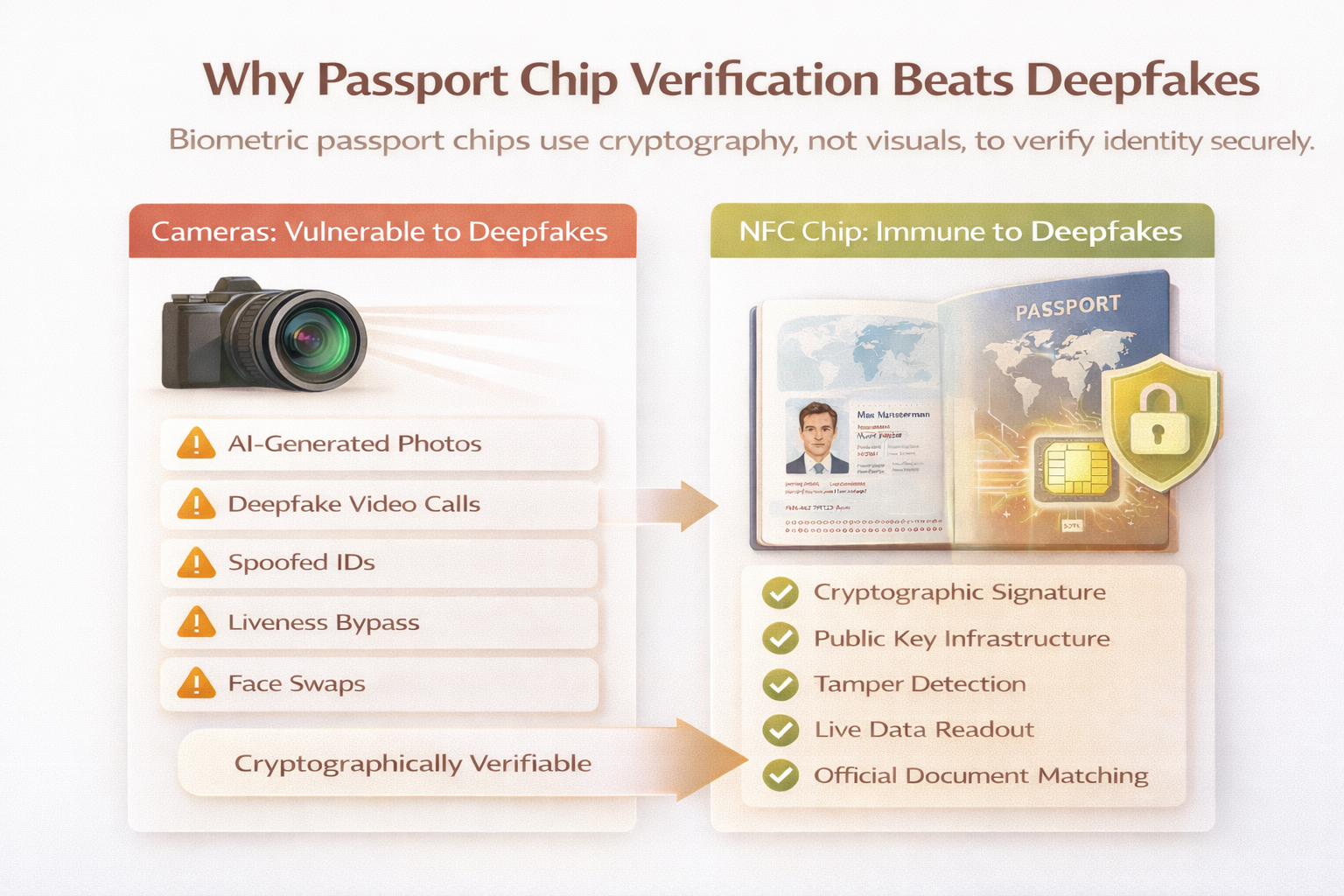
The core problem is architectural. Most identity verification today relies on what a camera can see: a face, a document image, a liveness video. The system asks: does this face match this document? Does this person appear to be alive?
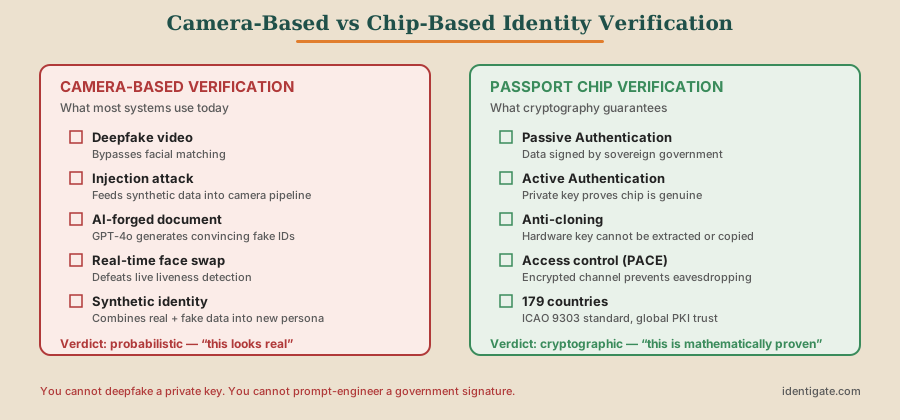
Deepfakes attack exactly this chain. AI-generated faces can pass facial matching. Injection attacks feed synthetic video directly into the camera pipeline, bypassing liveness detection entirely. Forged documents generated by GPT-4o and similar tools are sophisticated enough to fool automated checks — Veriff noted that creating convincing fake government IDs is now as easy as typing a prompt.
The defenders are not standing still. AI-powered deepfake detection has reached 98% accuracy in controlled settings. Behavioural biometrics can detect anomalies within 220 milliseconds. Liveness detection combined with AI achieves 99.1% accuracy on legitimate documents.
But the attackers are evolving faster. Real-time deepfakes — where a fraudster manipulates live video during a verification session — have increased 46% year-over-year according to Veriff. Sumsub's report warns that in 2026, autonomous AI fraud agents will begin conducting multi-step attacks at scale, combining deepfaked video with synthetic documents and device tampering in coordinated sequences.
As Regula Forensics observed in their 2026 identity verification trends analysis: defending against deepfakes requires a mindset shift — from asking "what does this look like?" to asking "where did this come from, and how do we know it's real?"
The Thing That Cannot Be Deepfaked
Inside every modern biometric passport is an NFC chip. That chip contains something no AI model can generate: a cryptographic signature issued by a sovereign government.
The ICAO Doc 9303 standard — maintained by the International Civil Aviation Organization, a UN agency — defines how these chips work. The architecture is built on three layers of cryptographic protection.
Passive Authentication verifies that the data on the chip has not been modified. The chip stores hash values of all its files — facial image, fingerprints, personal data — along with a digital signature of those hashes, created using the issuing country's document signing key. That key is itself signed by a country signing certificate. If a single byte of data is changed, the signature becomes invalid.
Active Authentication (or Chip Authentication) verifies that the chip itself is genuine and has not been cloned. The chip contains a private key that cannot be read or extracted, but its existence can be cryptographically proven. This means you cannot copy a chip's data to another chip and have it pass verification — the clone would lack the original private key.
Access control mechanisms — Basic Access Control (BAC) and Password Authenticated Connection Establishment (PACE) — prevent unauthorised reading of the chip's contents. You need the document number, date of birth, and expiry date to establish a secure communication channel.
This is fundamentally different from what a camera sees. A deepfake video is an image-level attack — it manipulates pixels. A passport chip operates at the cryptographic level — it proves provenance through mathematics. You cannot deepfake a private key. You cannot prompt-engineer a government-signed certificate. You cannot inject a synthetic data structure into a hardware-protected chip.
As Trail of Bits noted in their technical analysis of passport cryptography: the chip contains a private key that cannot be read or copied, but its existence can easily be proven. This is the foundation that makes passport chips resistant to the categories of attack that are dismantling camera-based verification.
~180 Countries, One Standard
The practical reach of this technology is vast. Biometric passports with NFC chips are issued in around 180 countries and territories under the ICAO 9303 standard. This is not a regional solution — it is a global identity infrastructure that already exists.
The ICAO Public Key Directory (PKD) allows verification systems worldwide to access the public keys needed to validate passport signatures. As of 2025, more than 100 participants contribute to the PKD, with additional bilateral certificate-sharing arrangements covering most of the remainder.
This means that a passport chip from Turkey can be cryptographically verified in Germany. A Nigerian passport can be verified in Estonia. A Brazilian passport can be verified in Japan. The trust infrastructure is already built, standardised, and operational — it has been running at scale across international borders for over a decade.
For organisations that need to verify identity across borders — financial institutions onboarding global customers, logistics companies verifying drivers from multiple countries, enterprises authenticating employees and contractors worldwide — the passport chip represents the strongest available anchor of identity. Not because it is new, but because it is cryptographically fundamental in a way that AI cannot subvert.
From Passport Chip to Digital Identity
The passport chip proves who someone is at a point in time. The challenge is turning that proof into a reusable digital identity that can be used for ongoing transactions — signing documents, authenticating to systems, authorising AI agents — without requiring the person to scan their passport every time.
At IdentiGate, this is the problem we solve. A person scans their biometric passport with a smartphone via NFC. Our system verifies the chip's cryptographic signatures against the issuing country's public key. Liveness detection confirms the person is physically present. In 90 seconds, they have a device-bound digital identity — cryptographically anchored to a government-issued document that cannot be deepfaked.
That identity can then be used to sign documents with Advanced Electronic Signatures under eIDAS, authenticate to platforms and systems, serve as the human anchor in AI agent delegation chains, and verify identity for KYC, onboarding, or access control — all without storing or transmitting the underlying passport data.
The principle is consistent with what Regula, Veriff, and the broader identity industry are converging toward: the future of identity verification must be rooted in cryptographic proof of origin, not in what a camera can see. The passport chip is the most widely deployed, most standardised, and most cryptographically robust form of that proof available today. In NIST terms, this is identity assurance at the highest level — see our comparison of AAL and IAL under SP 800-63B-4.
What Organisations Should Do Now
The deepfake threat is not going away — it is industrialising. Here is what that means for identity strategy.
Accept that camera-based verification alone is no longer sufficient for high-risk scenarios. Liveness detection and facial matching are still valuable as one layer of a multi-layer approach. But for financial transactions, contract signing, regulatory compliance, and any scenario where identity must be legally defensible, you need a cryptographic anchor.
Evaluate NFC passport verification for your highest-risk identity workflows. KYC onboarding, employee verification, contractor authentication, and cross-border identity are all scenarios where adding passport chip verification transforms the assurance level from probabilistic (this face probably matches) to cryptographic (this chip is mathematically proven genuine).
Prepare for the regulatory shift. The EU AI Act, eIDAS 2.0, and emerging NIST guidance are all moving toward requirements for stronger identity proofing. Organisations that build cryptographic identity verification into their systems now will be ahead of what is coming — not scrambling to retrofit when regulations tighten.
Think beyond detection, toward provenance. The deepfake arms race — better fakes versus better detectors — has no stable endpoint. The more sustainable approach is to anchor identity in something that is provably genuine by construction, not something that appears genuine under inspection. That is the difference between analysing pixels and verifying cryptography.
A deepfake can replicate a face. It can clone a voice. It can forge a document image. It can fool a camera, a human, and — increasingly — an AI-powered detection system.
It cannot forge a private key embedded in hardware by a sovereign government.
That is not a feature of today's detection technology. It is a law of mathematics.
Sources
- Sumsub 2025–2026 Identity Fraud Report — deepfake democratisation, synthetic identity trends, Arup incident
- Signicat — Fraud attempts with deepfakes have increased by 2,137% — origin of the 2,137% three-year figure, 0.1% → 6.5% shift
- Keepnet Labs Deepfake Statistics 2026 — Q1 2025 already exceeded all of 2024 in deepfake incidents
- Gartner press release, Feb 2024 — 30% of enterprises prediction for 2026
- Signicat — Which countries have ePassports? — ~180 countries issuing biometric passports (Dec 2025)
- ICAO PKD participants — current list of Public Key Directory members
- Veriff Identity Fraud Report 2026 — 1 in 20 IDV failures linked to deepfakes, 300% more AI-generated media
- Veriff — Real-time deepfake fraud 2025 — AI-forged government IDs, 46% increase in adversary-in-the-middle attacks
- Group-IB — Deepfake-as-a-Service — $5–$50 per synthetic identity, 8,000+ liveness bypass attempts
- AiPrise / Fintech Global — AI and deepfakes reshaping identity fraud 2026 — $50B+ global losses, $20–40B synthetic identity fraud
- BIIA — Synthetic Identity Fraud Statistics 2026 — 311% surge in North America Q1 2025, 67% of banks saw rising fraud
- Regula Forensics — Identity Verification Trends 2026 — "where did this come from?" mindset shift
- Trail of Bits — Cryptography behind electronic passports — technical analysis of ICAO 9303 security
- Inverid / Signicat — ePassport security mechanisms — AA, CA, BAC, PACE
IdentiGate turns passport chips into reusable digital identities. Cryptographic verification from around 180 countries, 90-second onboarding, zero personal data storage. Learn more at identigate.com
About the author
Mairi Kutberg is co-founder of IdentiGate, where she runs operations and content. She works at the intersection of EU regulation (eIDAS, NIS2, AMLR, eFTI), cross-border digital identity, and the practical compliance angles of advanced electronic signatures.