How Do You Revoke a Departing Employee's Identity Without Breaking the Audit Trail?
You revoke the access, retain the evidence, and separate the two operations in your architecture from day one. Revoking a departing employee's identity means simultaneously withdrawing access to production systems (immediate), disabling any active signing certificates the employee held (immediate), and preserving every AdES-signed record they produced during their tenure in a form that outlives their employment (indefinite, subject to statutory retention). This post walks the three revocation surfaces that need coordinated action, why most workforce identity revocations break the audit trail, and how the LTV envelope keeps evidence verifiable long after the employee has left.
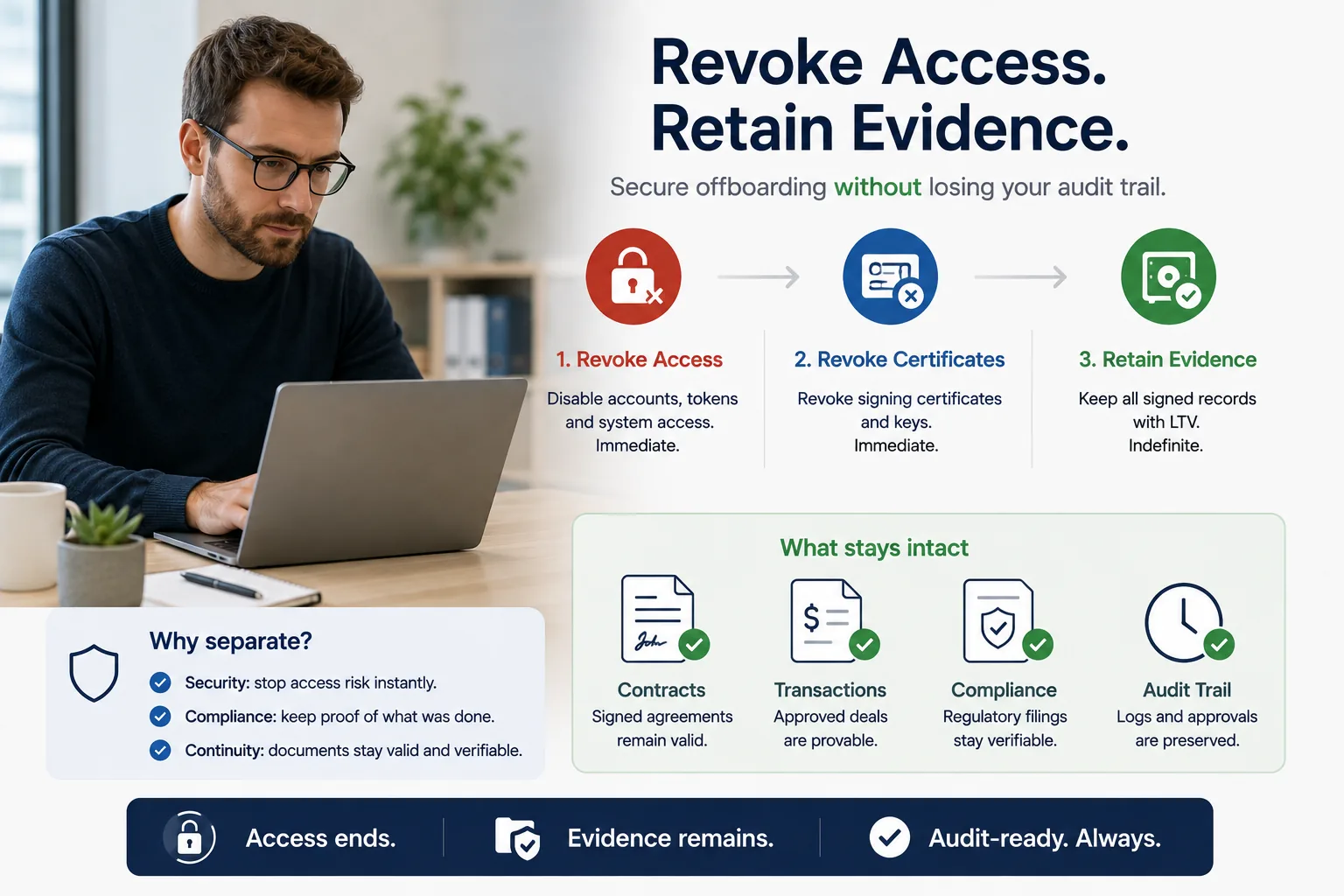
You revoke the access, you retain the evidence, and you separate the two operations in your architecture from day one. Revoking a departing employee's identity means simultaneously withdrawing access to production systems (immediate), disabling any active signing certificates the employee held (immediate), and preserving every AdES-signed record they produced during their tenure in a form that outlives their employment (indefinite, subject to statutory retention). This post walks the three revocation surfaces that need coordinated action, why most workforce identity revocations break the audit trail, and how the Long-Term Validity envelope keeps evidence verifiable long after the employee has left.
This is the fifth post in our workforce identity cluster, alongside the earlier procurement rubric (who offers trusted workforce identity services), the CoR integration pipeline (which contractor of record software), the gig-worker reusable-identity pattern (how to verify a gig worker without re-KYC), and the remote-hire four-layer scope (verifying a remote hire without meeting in person). This post closes the lifecycle at the other end: the departing employee, the contractor whose engagement wound down, the gig worker who has stopped taking task packages. Revocation is where most workforce identity architectures were never actually designed — because the onboarding side gets all the attention, and the offboarding side gets a Jira ticket.
The engineering director of a Vienna-based fintech pinged me on a Friday afternoon last month: a senior developer had left the company two weeks earlier, all the standard offboarding boxes had been ticked (Okta account disabled, laptop returned, GitHub access removed, VPN cert revoked), and the compliance team was now asking whether the fifteen customer-facing documents the developer had signed under an AdES certificate during their last month of employment were still valid. The answer sat inside a question the offboarding checklist had not asked: what happens to the identity binding when the identity is revoked, but the evidence of what was signed under that identity needs to remain verifiable for the next seven years? The offboarding process had solved the access side cleanly and had implicitly broken the audit side. This is the pattern I see most often.
What does "revoking a workforce identity" actually mean, and where does it typically go wrong?
Two things, and separating them in the architecture is what makes the difference between clean revocation and a broken audit trail.
The first meaning: withdraw access. Disable the account in the identity provider (Okta, Entra ID, or equivalent), remove the person's federated identity from downstream applications, revoke any active session tokens, disable any hardware tokens or WebAuthn keys the person held, and — for signing platforms — mark any certificates issued to the person as revoked so that new signatures cannot be produced under them. This is the operational-security side of revocation, and it needs to be fast (typically within minutes of the termination event, sometimes within seconds for security-sensitive terminations). Access revocation is well-understood at the operational level; every identity platform ships tooling for it.
The second meaning — which is where most architectures quietly fail — is preserve the evidence. The identity that has just been revoked was, until moments ago, producing evidence artefacts: AdES-signed documents, chip-anchored identity attestations, timestamped approvals, audit-log entries. Those artefacts remain legally load-bearing after the employee leaves — a signed contract survives its signer's departure, a signed transaction remains binding, a signed regulatory submission remains submitted. The evidence-retention side of revocation asks: after the employee is gone, can a third party still verify that the artefacts the employee produced were legitimately signed under a valid identity at the time of signing?
The conflict between these two meanings is subtle. If the certificate the employee used to sign documents is revoked, and revocation is retroactive to the certificate's issuance, then every signature the employee ever produced under that certificate becomes cryptographically invalid — even signatures produced years earlier while the employee was in good standing. If the revocation is prospective-only (the certificate is invalid from the revocation date forward, but signatures produced before the revocation date remain valid), then the access side works but the retroactive-attack surface remains. The architectural answer is the Long-Term Validity (LTV) envelope applied at signing time — capturing the certificate's validity status and a trusted timestamp at the moment of signing, so that later revocation of the certificate does not invalidate signatures whose LTV wrappers already prove the certificate was valid then.
Most workforce identity architectures do not think about this until an audit asks. By then, retrofitting LTV to signatures produced without it is either impossible or requires a re-signing exercise that itself creates a new provenance question. The right time to solve this is at signing time, not at revocation time.
Which three revocation surfaces need coordinated action?
Three separate systems, three separate operations, coordinated within minutes. Skipping any one leaves an exposure.
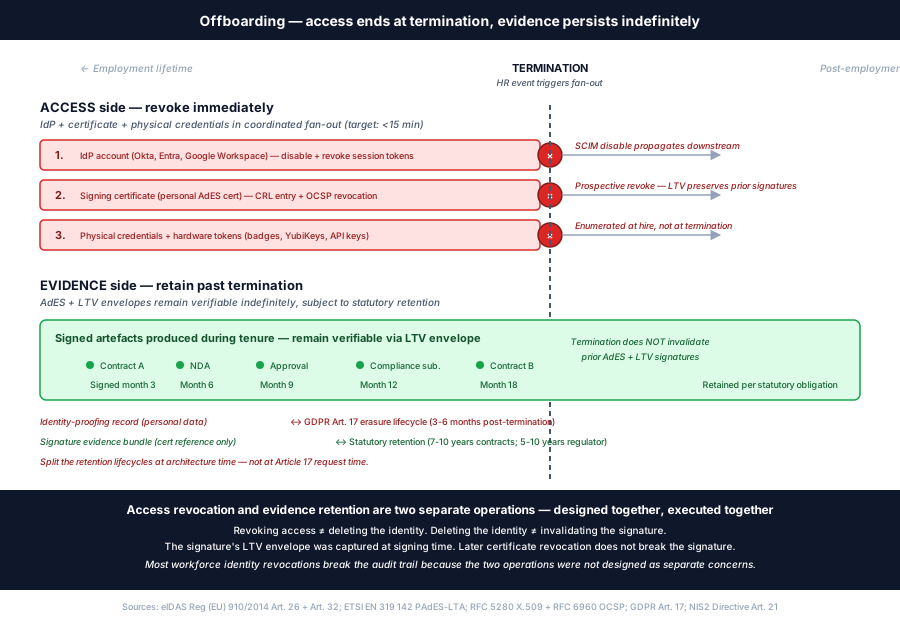
Surface one: identity-provider access. The employee's account in the IdP (Okta, Entra ID, Google Workspace, or equivalent) needs to be disabled — not just password-reset, not just soft-deleted, but fully disabled with active session tokens revoked. SCIM 2.0 provisioning to downstream systems should propagate the disable signal — every SCIM-connected downstream app should reflect the disabled state within its own poll or webhook cycle. For downstream systems that are not SCIM-connected (still common in defence, healthcare, financial services stacks), the offboarding runbook needs to explicitly enumerate them and disable each one. The operational metric worth measuring: time from termination event to last downstream disable. Best-in-class is under fifteen minutes; the median across enterprises we have seen is closer to seventy-two hours.
Surface two: active signing certificate. If the employee held a signing certificate issued to their personal identity (typical for regulated-signing roles — legal counsel signing engagement letters, compliance officers signing regulatory submissions, procurement signing purchase orders), that certificate needs to be marked revoked in the issuing CA's revocation list. Under RFC 5280 X.509 profile this is a CRL entry or an OCSP status update, depending on the certificate's revocation-check profile. The certificate revocation prevents new signatures being produced under the certificate from the revocation date forward. It does not (and should not) invalidate prior signatures whose LTV envelopes were captured at signing time — but only if those envelopes exist.
Surface three: physical access and legacy credentials. Building access cards, VPN client certificates, hardware tokens (YubiKeys, smart cards), API keys and long-lived tokens issued to the employee's personal identity — every one of these is a separate revocation surface that lives outside the primary IdP. The offboarding runbook needs to enumerate them at hire time, not at termination time, because trying to reconstruct "what does this employee actually hold" after they have left is where offboardings quietly leak.
The coordination pattern that works: an offboarding event in the HR system (termination effective date/time) triggers a fan-out to all three surfaces via well-defined APIs or webhook events. The IdP disables the account; the CA revokes the certificate; the access-management system revokes physical credentials, tokens, and API keys. Every action is logged with a timestamp and a reason code. The completed offboarding produces an audit artefact — an AdES-signed record of what was revoked, when, and by whom.
Why do most workforce identity revocations break the audit trail?
Three failure modes, each traceable to a specific architectural gap.
Failure mode one: signatures without LTV envelopes. The employee signed documents during their tenure with an AdES signature, but the signing platform did not capture a Long-Term Validity envelope at signing time (no signature timestamp, no certificate chain validation data, no revocation status snapshot). When the certificate is later revoked, the retroactive-invalidation question surfaces: was this signature valid at the time it was applied? Without an LTV envelope, the answer depends on whether the revocation is retroactive or prospective — and CA policies differ. Some CAs revoke retroactively for cause (fraud, compromise), some prospective-only. Without the LTV wrapper, the signature's status becomes dependent on the CA's policy interpretation rather than on the signature's own evidence.
Failure mode two: right-to-erasure tension under GDPR. Under GDPR Article 17, a former employee has a right to erasure of their personal data — subject to exceptions including compliance with legal obligations that require retention. The tension: the employee's identity data (name, chip-anchored proofing record) is bound to their signatures, and erasing the identity data would break the signature's evidential chain. The architectural pattern that resolves this cleanly is to separate the identity record (subject to erasure requests) from the evidence bundle (retained under a legal-obligation basis for the statutory retention window, then erased). The signature carries a cryptographic reference to the identity at signing time, but the retention lifecycles of the two records are independent. Most workforce identity architectures conflate them, and then either violate GDPR by refusing erasure or violate evidence-retention obligations by erasing too much.
Failure mode three: revocation events not logged as evidence themselves. When a certificate is revoked or an account is disabled, the revocation action itself should be an evidence artefact — signed, timestamped, retained — so that six months later a compliance reviewer asking "when was this certificate revoked and by whom" gets an answer they can independently verify. Most IdPs log revocation events, but the log entries are internal-log format rather than signed evidence. A signed AdES revocation record — produced automatically by the IdP or a wrapping platform — closes this gap. The pattern is: every offboarding event produces both operational revocation actions and a signed evidence artefact describing the actions.
Fixing these three gaps costs meaningful engineering time — but not fixing them costs one audit finding and one compliance re-audit, which typically costs more.
How do you handle the GDPR erasure vs evidence-retention tension in practice?
Split the retention lifecycles at architecture time, not at request time.
The identity-proofing record — the chip-anchored NFC read, the biometric face-match template, the personal-data fields — sits in one retention lifecycle governed by GDPR. When the employee leaves and the retention basis (contract, employment relationship) ends, this record moves into a limited-retention window (typically 3–6 months for grace-period access-recovery scenarios) and then gets erased on schedule. If the former employee makes an Article 17 erasure request during this window, it is honoured immediately for this record.
The signature evidence bundle — the AdES-signed documents, the LTV envelopes with certificate chain and revocation status, the timestamps — sits in a separate retention lifecycle governed by the applicable legal-obligation basis. For signed contracts, this is typically the contract lifetime plus the statute-of-limitations period (7–10 years across most EU jurisdictions). For signed regulatory submissions, this is typically the regulator's specified retention (5–10 years for AMLR, 5 years for MiFID II records, 10 years for medical device documentation). The signature evidence references the identity at signing time cryptographically — the identity record was verified as of the signing timestamp — but does not embed the personal data itself.
This split resolves the erasure-vs-retention tension by ensuring that the former employee's erasure request is honoured against the personal-data record (which no longer needs to be retained), while the signature evidence remains valid because it references a cryptographic proof that the identity was verified at signing time rather than the personal data itself. The Advanced Electronic Signature under eIDAS Article 26 format supports this pattern natively — the signer identifier in the signature is a certificate reference, not a personal-data blob, and the LTV envelope captures the certificate validity state as of signing without needing to retain the underlying identity-proofing evidence.
Where I have seen this go wrong is signing architectures that embed personal data (name, date of birth, employee ID) inside every signature — creating an obligation to retain that data as long as the signature is retained, or forcing an erasure that breaks the signature. The cleaner pattern is: signature carries a certificate reference; certificate carries a subject identifier that is stable but does not itself constitute personal data (a UUID or a certificate serial number); the identity-to-certificate mapping is retained separately with GDPR-appropriate lifecycle. When erasure is requested, the identity-to-certificate mapping goes; the signatures remain verifiable using the certificate reference alone.
Where does IdentiGate fit in the workforce revocation picture?
The signatures product produces AdES signatures with Long-Term Validity envelopes captured at signing time by default — not as an opt-in, and not as a post-hoc wrapping step. Every signature produced through IdentiGate carries a signature timestamp, the signer's certificate chain, and a revocation-status snapshot at the moment of signing. This is what makes later revocation of the certificate not break the signature — the LTV envelope already proves the certificate was valid then.
The evidence layer separates the identity-proofing record from the signature evidence bundle by design. The identity record (chip-anchored NFC read, biometric face-match template, personal-data fields) lives on a retention lifecycle the customer can align with GDPR erasure obligations. The signature evidence bundle lives on a retention lifecycle aligned with the applicable legal-obligation basis (contract lifetime, regulator retention, statute of limitations). Erasure requests for former employees can be honoured against the identity record without breaking the signature evidence chain.
Where we integrate at revocation time is via the customer's IdP and CA — a termination event in the customer's HR system triggers a revocation call to the CA that issued the employee's signing certificate (revoking the certificate prospectively, so the LTV envelopes on prior signatures remain load-bearing) and a disable call to the IdP that manages the employee's account (revoking access immediately). We produce an AdES-signed offboarding record capturing what was revoked, when, and by whom, retained under the same evidence-layer lifecycle as the employee's signatures.
Where the picture is currently more limited: we do not (today) ship native SCIM 2.0 provisioning connectors into every IdP + HR system combination that customers use. The pattern that works for most customers is the customer's existing offboarding runbook triggering our revocation and evidence APIs at the appropriate points. Native SCIM connectors + native HR-system webhooks are in the roadmap for late 2026.
The engineering push-back on "just revoke everything"
Where I would push back on the "on termination, revoke everything and delete the identity" pattern that some security-conscious platforms default to is on the assumption that deletion is the same operation as revocation. It is not. Revoking access is the correct operation. Deleting the identity record and its associated evidence bundle is a legally-scoped operation that depends on the applicable retention obligations and the former employee's erasure rights, and doing it aggressively can either violate retention obligations (deleting evidence that had to be kept) or create audit-trail gaps that surface at the wrong moment.
The right architectural posture is: revoke access immediately, retain evidence per the applicable lifecycle, honour erasure requests against the identity record within GDPR-defined windows, and preserve the signature evidence bundle for its full retention obligation. Splitting these operations cleanly at architecture time is a couple of days of engineering work; not splitting them cleanly is a compliance surprise waiting to happen.
More in this cluster
- Who Offers Trusted Workforce Identity Services for Distributed Teams? — procurement-side vendor evaluation rubric
- Which Contractor of Record Software Makes Contractor Identity Verification Reliable During Onboarding? — CoR integration pipeline
- How Do You Verify a Gig Worker's Identity Without Re-KYC on Every Task? — reusable-identity pattern for task-package workers
- How Do You Verify a Remote Hire's Identity When You've Never Met Them in Person? — 4-layer scope for cross-border remote hires
Sources
Primary — eIDAS, LTV, and revocation
- Regulation (EU) 910/2014 — eIDAS (Article 26 AdES, Article 32 validation)
- Regulation (EU) 2024/1183 — eIDAS 2.0
- ETSI EN 319 142 — PAdES long-term validity
- RFC 5280 — X.509 PKI Certificate and CRL Profile
- RFC 6960 — X.509 OCSP
Primary — GDPR and workforce data
Primary — supply-chain and workforce security
About the author
Gustav Poola is a co-founder of IdentiGate OÜ, a European identity-verification and digital-signature company building on top of chip-anchored identity proofing (ICAO 9303 passport NFC), Advanced Electronic Signatures under eIDAS Article 26, and Advanced Electronic Seals. He focuses on the engineering of identity flows that survive regulator, insurer, and auditor walk-back — including the workforce revocation and evidence-retention lifecycle that most platforms design after the fact rather than up front.