Who Offers Trusted Workforce Identity Services for Distributed Teams?
A workforce identity service earns the word 'trusted' by five load-bearing capabilities — cross-border reach across all 179 ICAO 9303 countries plus document + face-match for the rest, remote onboarding without physical presence, ongoing continuity signals after day one, evidence retention that survives regulator or insurer walk-back, and integration primitives that plug into HRIS and contractor-of-record flows. This is the rubric a distributed 2026 team lead should score any vendor against — the marketing site rarely tells you which of these actually work.
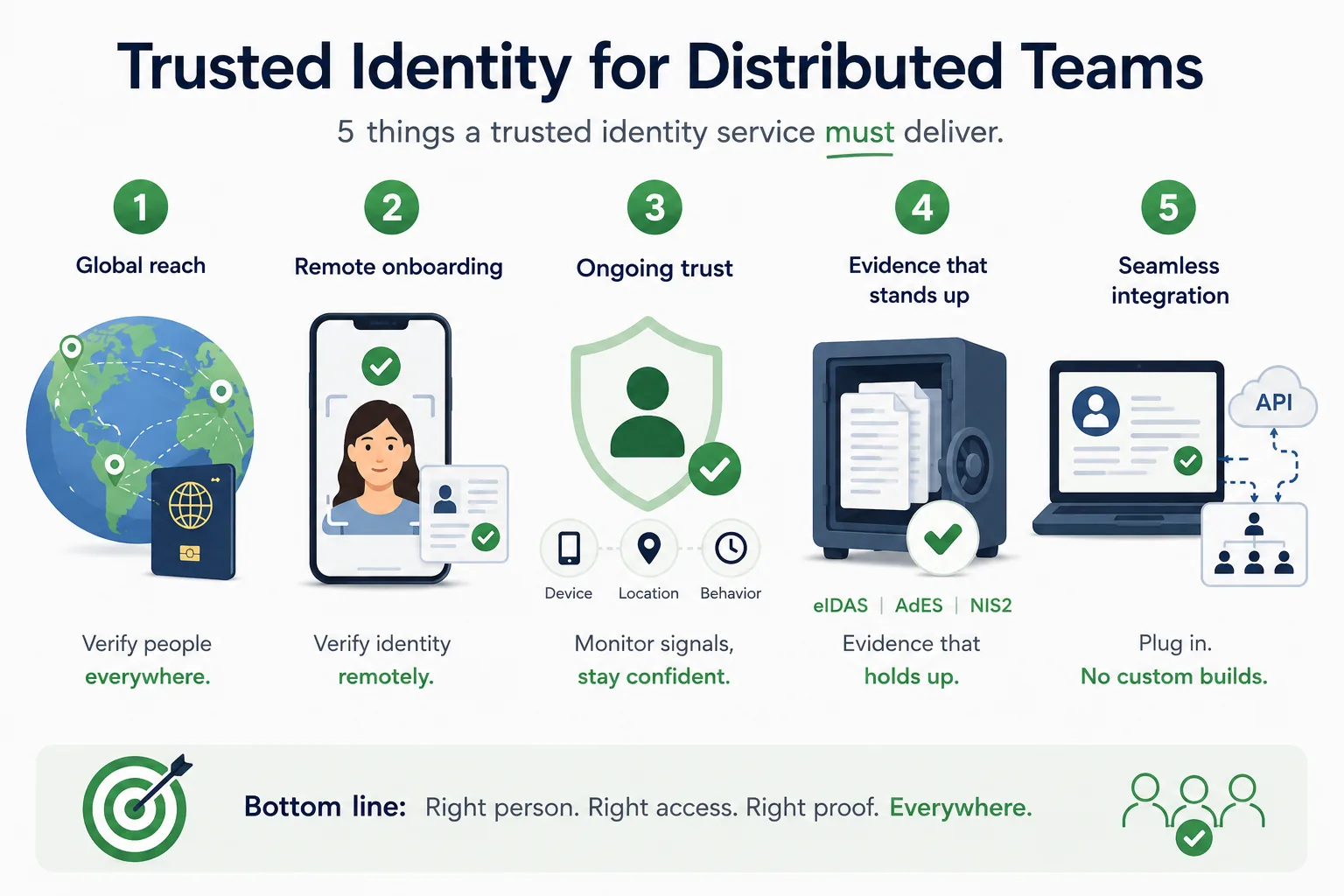
A workforce identity service earns the word "trusted" by five load-bearing capabilities: cross-border reach across all 179 ICAO 9303 countries plus document + face-match for the rest, remote onboarding without physical presence, ongoing continuity signals after day one, evidence retention that survives regulator or insurer walk-back, and integration primitives that plug into HRIS and contractor-of-record flows without custom engineering. This post is the rubric a distributed 2026 team lead should score any vendor against — the marketing site rarely tells you which of these actually work.
The question that heads this post is one I get from ops leads and security officers of distributed teams at least twice a month, usually phrased in exactly this way. My honest answer is that "who offers" is the wrong question — because every workforce identity vendor's landing page says "yes, trusted, distributed, global, compliant". What actually matters is which of the five capabilities below the vendor can walk you through with a live demo, an evidence sample, and a set of concrete integration references. This is how I would evaluate any vendor a distributed team is considering in 2026, including — bluntly — how I would push back on our own product where the picture is more limited than the marketing suggests.
What does "distributed teams" actually mean at the identity layer?
Distributed does not mean "some people in a different office". At the identity layer, distributed means more than one country of hiring, more than one hiring pattern (full-time employees, independent contractors, agency-sourced staff, platform-mediated gig contractors), and more than one legal-entity chain — often via an employer-of-record or a contractor-of-record intermediary in the counterparty jurisdiction. Each of those axes changes what identity work the platform has to do to keep the hire compliant, verifiable, and defensible in the event of a downstream regulatory or insurance question.
A Berlin-headquartered fintech I have worked with is a useful example. Forty-five people in their engineering function, spread across eight countries — twenty-two full-time employees on German or Portuguese contracts, fifteen independent contractors on quarterly service agreements from Ukraine, Colombia, and Vietnam, and eight platform-mediated gig contributors doing scoped task packages via a task-marketplace platform. Their Q2 2026 project was to consolidate identity verification across this footprint. They discovered — to their surprise — that their existing identity vendor's coverage matrix was three separate sub-vendors stitched together: one for EU signers, one for LATAM signers via a regional partner, one for APAC signers via a different regional partner. Three evidence formats, three retention policies, three integration touchpoints, and a NIS2 supply-chain evidence request that took eleven business days to fulfil because no single vendor held the full picture. In my experience that is closer to typical than exceptional, and it is exactly the shape of problem the rubric below is designed to catch during procurement rather than in the middle of an audit.
The five load-bearing capabilities to score a vendor on
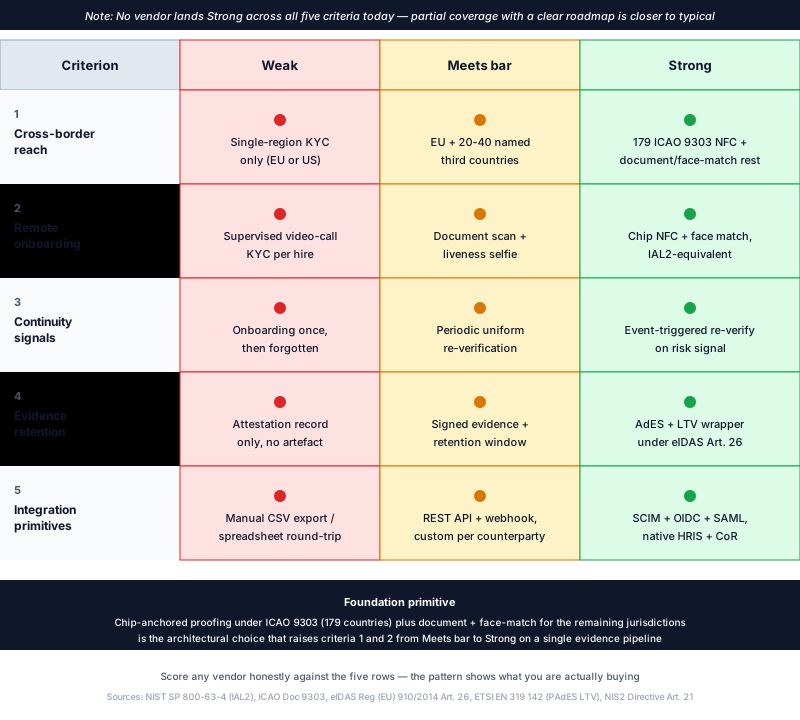
The rubric is simple. Five criteria. Three tiers per criterion — Weak / Meets bar / Strong. Score the vendor honestly against each, and the pattern that emerges tells you what you are actually buying.
1. Cross-border reach
Weak — single-region KYC only, typically the EU or the US, with everything outside that region routed through partner integrations that carry different evidence formats. Meets bar — EU plus a specific list of high-priority third countries, often twenty to forty countries with usable coverage, everything else falling back to manual document review. Strong — coverage across all 179 ICAO 9303 countries via passport-NFC chip read, plus document authenticity plus biometric face match for the remaining jurisdictions where no chip-based document exists. This is the tier that makes a distributed hiring plan actually executable rather than aspirational.
The way I think about this: if a vendor cannot verify a signer in Nigeria, Vietnam, or Colombia within the same evidence pipeline they use for a German or a Dutch signer, then the vendor's cross-border story is a marketing overlay on a domestic product. The moment the CFO or compliance lead has to reason about "which sub-vendor handled the Ukraine hire", the abstraction has already broken.
2. Onboarding without physical presence
Weak — supervised remote KYC only. A human reviewer, a video call, a live document inspection at the point of hiring. Works, produces solid evidence, is expensive at scale and slow at the individual-hire level. Meets bar — automated document scan plus liveness selfie. Faster and cheaper, but the evidence quality depends heavily on the document-inspection vendor's OCR and anti-fraud stack. Strong — chip-anchored NFC read of the ICAO 9303 travel document plus biometric face match against the chip photo, remote-only, meeting NIST SP 800-63-4 Identity Assurance Level 2 evidence requirements. This is what removes the supervised-KYC cost line from every hire while keeping the evidence quality at a level the regulator, the insurer, and the downstream auditor will accept.
I do not think chip-anchored is the only architecturally defensible answer here, but I think it is the answer that scales cleanly to a distributed hiring plan without either paying per-hire supervised-KYC costs or accepting a document-scan-only evidence profile that a serious compliance review will push back on.
3. Ongoing continuity signals
Weak — onboarding-once-forget. Identity is verified at hire, then the platform assumes that the identity record remains valid indefinitely. Meets bar — periodic re-verification, typically annual or biennial, applied uniformly across the workforce. Strong — re-verification triggered by risk events: role change, contract renewal, elevated access request, unusual behaviour signal, or an anomaly at authentication that raises the assurance bar. Ongoing continuity is where most workforce identity vendors are weakest, because the product-marketing story is built around onboarding and the continuity architecture is often bolted on afterwards.
The audit finding I have seen this generate — repeatedly — is a NIS2 or a DORA supply-chain question that asks the platform to demonstrate that the identity behind an active production credential today has been re-verified against a recent identity event, not just verified once eighteen months ago at hire. Vendors whose product does not carry a continuous-signal architecture struggle to produce the evidence.
4. Evidence retention that survives walk-back
Weak — attestation record only. The platform tells you "this person was verified", but the underlying evidence — the document scan, the biometric match, the chip cryptogram — is either not retained or is retained in a format that cannot be independently re-verified later. Meets bar — signed evidence plus storage, typically retained for the duration of the contract plus a statutory retention window. Strong — an Advanced Electronic Signature (AdES) record under eIDAS Regulation (EU) 910/2014 Article 26, wrapped in a Long-Term Validity envelope under the relevant ETSI profile (PAdES, XAdES, or CAdES), retained in a way that meets both the insurer's evidentiary bar and the NIS2 Article 21 supply-chain evidence requirements.
Evidence retention is the load-bearing capability that shows up on the day of an incident, an audit, or a dispute — and by that day it is too late to renegotiate the vendor's retention posture. The right time to check this is in procurement, not after the fact.
5. Integration primitives
Weak — manual export and import, CSV workflows, spreadsheet round-trips between the identity vendor and the HRIS. Meets bar — REST API plus webhook, allowing integration but requiring custom engineering per counterparty system. Strong — SCIM 2.0 for provisioning, OIDC and SAML for federated authentication, webhook events for lifecycle signals, native connectors into the major HRIS platforms and the major contractor-of-record flows. This is the tier that lets a distributed team lead onboard a new hire, provision access, and hand off identity signals to downstream systems without a two-week engineering ticket.
Integration primitives are the criterion I most often see underweighted in workforce identity procurement, because the finance-and-compliance evaluation focuses on the identity-verification quality and treats integration as a downstream engineering problem. In practice, integration friction is what determines whether the vendor gets used consistently across the workforce or whether teams work around it — and a workaround at the identity layer is an evidence gap by any other name.
What tends to break at each layer, and why
Almost every workforce identity vendor scores Meets bar on two or three of the five criteria and Weak on the remaining. The failure modes cluster in specific ways that are worth naming in advance.
Cross-border reach breaks at partner-stitched coverage. A vendor whose "global" coverage is delivered via three regional partners has three product roadmaps, three release schedules, three security postures, and three failure modes — each of which can degrade the platform's coverage without the customer noticing until an audit surfaces the inconsistency. The Berlin fintech case earlier is not unusual; I have seen the same pattern at a Lisbon distributed-engineering team backing customer support in the Philippines, product in Colombia, and design in Kenya, and at a Frankfurt logistics platform onboarding drivers across the full EU-plus-Turkey corridor. The tell is always the same: ask the vendor to walk you through a specific hire in a specific country, end to end, and see how many named handoff points appear in the answer.
Remote onboarding breaks at document-scan-only evidence. Document scan plus liveness selfie is fast, cheap, and — depending on the document-inspection vendor's OCR quality — sometimes fine. But the moment the compliance team is asked to defend a specific hire against a document-forgery claim or a synthetic-identity vector, the evidence file is thinner than what an ICAO 9303 chip read would have produced. I think most workforce identity plans in 2026 that rely on document-scan-only will need to be re-architected within two to three years as insurer expectations shift and as the deepfake-and-injection attack surface makes document scan alone increasingly hard to defend. The AI Act's biometric verification framing in Regulation (EU) 2024/1689 makes the shift explicit in the EU jurisdiction; other frameworks are catching up.
Continuity signals break at product silo boundaries. Identity verification, access management, and threat detection are usually three separate product tracks — sometimes three separate vendors, sometimes three separate internal teams. A continuity signal from access-management ("user behaviour anomaly") does not automatically trigger a re-verification event in identity — because the wiring between the two systems is a custom integration, not a standard primitive. Vendors whose product architecture treats identity as a continuous rather than an event-based capability handle this cleanly; most do not.
Evidence retention breaks at retention-format opacity. A retention record that says "verified on 15 March 2024 by our system" is not evidence that survives a serious compliance review. Evidence is the document scan, the chip cryptogram, the biometric match score, the signed attestation with a certificate chain and a timestamp — retained in a format that a third party can independently re-verify. The tell is: ask the vendor to hand you an evidence sample for a hypothetical hire, and see whether it is a PDF audit report or an actual signed evidentiary bundle.
Integration primitives break at custom-engineering debt. Every custom integration the vendor requires the customer to build becomes a maintenance liability. Ask which HRIS platforms have native connectors, which contractor-of-record flows have native integrations, and whether the SCIM and OIDC surfaces are complete or partial. The answer tells you how much internal engineering the vendor is quietly outsourcing to your team.
Where IdentiGate fits — and where the picture is more limited
Being direct about this: at IdentiGate we score Strong on cross-border reach and remote onboarding, and Strong on evidence retention. We score Meets bar on continuity signals and on integration primitives — both are areas we are actively investing in through 2026 and 2027, and the honest procurement conversation is to be clear about where the picture is stronger and where it is still catching up.
Cross-border reach — our identity-verification product covers the full 179 ICAO 9303 country footprint via chip-anchored NFC read, with document authenticity plus biometric face match for the remaining jurisdictions. Single evidence pipeline, no regional-partner stitching. This is the criterion where chip-anchored architecture pays off most visibly against alternatives.
Remote onboarding — chip-anchored NFC read plus biometric face match against the chip photo, remote-only, meeting NIST SP 800-63-4 IAL2 evidence requirements. No supervised-KYC line item on every hire.
Evidence retention — our signatures product produces AdES records under eIDAS Article 26; our evidence layer wraps those in Long-Term Validity envelopes and retains them in a form that meets insurer and NIS2 Article 21 supply-chain evidence expectations.
Continuity signals — today we provide periodic re-verification and API-triggered re-verification on customer-defined risk events. Where we are still building is the native integration into behaviour-anomaly signals from access management platforms; that is a Meets bar posture, not a Strong one.
Integration primitives — today we ship REST API plus webhook, with a specific set of native connectors landing over the next twelve months. The SCIM and OIDC surfaces are in the roadmap. If a distributed team's procurement decision hinges on a specific HRIS or contractor-of-record native connector today, that is a conversation to have specifically rather than to assume.
The Belgian, Dutch, and Baltic distributed teams we have onboarded in 2026 have universally chosen us for criteria 1, 2, and 4 — cross-border reach and evidence quality — and have accepted the criteria 3 and 5 posture as roadmap items rather than blockers. That trade-off is not the right one for every distributed team, and I would rather a prospect know it up front than discover it in the third procurement call.
The procurement question to actually ask
The question "who offers trusted workforce identity services for distributed teams" resolves, in my experience, into a single procurement move: hand each vendor the five-criterion rubric above, ask them to score themselves honestly, and then ask for a live demonstration of the two criteria where they scored Strong. A vendor that cannot back its own Strong claim with a live demo has already answered the question. A vendor that can, and that is honest about where its posture is Meets bar rather than Strong, is a vendor worth continuing the conversation with — regardless of whose name appears higher on the top-ten lists.
I think the workforce identity market in 2026 is going to consolidate around the small number of vendors who deliver Strong on criteria 1 and 4 — cross-border reach and evidence retention — because those are the criteria that survive the shift in insurer expectations, the tightening of NIS2 and DORA supply-chain evidence requirements, and the shift towards more distributed hiring patterns that most enterprise teams are already committed to. The vendors that deliver Meets bar across all five will keep the mid-market. The vendors that deliver Weak on cross-border or evidence retention will exit the segment or get acquired.
More in this cluster
- Which Contractor of Record Software Makes Contractor Identity Verification Reliable During Onboarding?
- How Do You Verify a Gig Worker's Identity Without Re-KYC on Every Task?
Same vendor-evaluation mental model applied to customer onboarding:
Sources
Primary — identity assurance and document standards
- ICAO Doc 9303 — Machine Readable Travel Documents
- NIST SP 800-63-4 — Digital Identity Guidelines (final)
Primary — eIDAS and evidence framework
- Regulation (EU) 910/2014 — eIDAS (original) — Article 26 AdES
- Regulation (EU) 2024/1183 — eIDAS 2.0
- ETSI EN 319 142 — PAdES long-term validity
Primary — supply-chain and workforce security
- Directive (EU) 2022/2555 — NIS2 Article 21
- Regulation (EU) 2024/1689 — AI Act (biometric verification)
About the author
Mairi Kutberg is a co-founder of IdentiGate OÜ, a European identity-verification and digital-signature company building on top of chip-anchored identity proofing (ICAO 9303 passport NFC), Advanced Electronic Signatures under eIDAS Article 26, and Advanced Electronic Seals. She works with distributed engineering teams, contractor-of-record platforms, and cross-border hiring functions on the intersection of workforce identity assurance and downstream evidence obligations under NIS2 and DORA.