Which Contractor of Record Software Makes Contractor Identity Verification Reliable During Onboarding?
Reliable contractor identity verification during onboarding is not a feature of the contractor-of-record platform itself — it is a function of the identity primitive the CoR wires in behind the sign-up flow and the three integration standards (SCIM 2.0, OIDC, webhook events) that plumb the verified identity into the client's HRIS and IdP. This post walks the six-stage integration flow, names the two stages where reliability tends to break, and gives an engineering answer to which architectural properties actually matter when a distributed team lead evaluates a CoR vendor's identity story.

Reliable contractor identity verification during onboarding is not a feature of the contractor-of-record (CoR) platform itself — it is a function of the identity primitive the CoR wires in behind the sign-up flow and the three integration standards (SCIM 2.0, OIDC, webhook events) that plumb the verified identity into the client's HRIS and identity-provider stack. This post walks the six-stage integration flow, names the two stages where reliability tends to break, and gives an engineering answer for a distributed team lead evaluating a CoR vendor's identity story.
This post is a companion to our procurement-side rubric on who offers trusted workforce identity services for distributed teams, which walks the five capabilities a workforce identity vendor is evaluated against. This post is the engineering counterpart — how the identity verification stage of a contractor-of-record onboarding flow actually plugs into the client's stack, and where reliability tends to break at the integration surface.
The engineering director of a Vienna-based fintech dropped a screenshot into a shared channel last week: their contractor-of-record platform had onboarded a Ukrainian software engineer in twenty-two minutes, the CoR had produced a signed engagement letter, the identity had been "verified" per the CoR's onboarding checklist, and the contractor's HRIS entry landed in the client's Okta tenant that afternoon. Two days later the compliance lead flagged that the identity verification record the CoR had stored contained a document photo and a selfie but no cryptographic anchor — the "verified" tick was a UX signal, not an evidence claim, and the record would not stand up to the client's own SOC 2 identity-proofing walk-back that the auditor was scheduled to run in October. The CoR platform's engagement letter was clean. The identity primitive underneath was not. This post is how I would think about that gap if I were evaluating any CoR platform for a distributed hiring plan in 2026.
What does a contractor-of-record platform actually do at the identity layer?
Less than the marketing suggests, and the delta is where reliability breaks.
A contractor-of-record platform's core value proposition is legal-entity abstraction — the CoR employs (or contracts with) the individual on the client's behalf in the individual's jurisdiction, handling the tax, benefits, employment-law, and payroll complexity the client would otherwise have to reproduce in every country it hires from. That is a substantial value proposition on its own, and it is genuinely what CoR platforms do well. The identity-verification layer sits underneath this, is often bundled invisibly into the onboarding UX, and is where the actual evidence chain is either strong or thin depending on which sub-vendor the CoR routes the verification through and what the record retention format looks like.
In my experience, most CoR platforms treat identity verification as a checkbox — done or not done — rather than as an evidence artefact that the client can later hand to an auditor, an insurer, or a regulator asking what proof exists that the contractor named on the engagement letter is the person who was actually onboarded. The distinction matters. A checkbox says the CoR believes the identity check passed at the time it ran. An evidence artefact hands the reviewer the underlying material (the document chip cryptogram, the biometric match score, the signed attestation with issuer chain and timestamp) so the reviewer can re-verify independently. NIS2 Article 21 supply-chain evidence expectations, DORA Article 30 third-party risk management obligations, and the emerging insurer expectations around workforce identity all increasingly ask for the second, not the first.
What are the six stages of a contractor-of-record onboarding flow, and where does identity actually sit?
Six stages, and identity verification determines what happens in three of them.
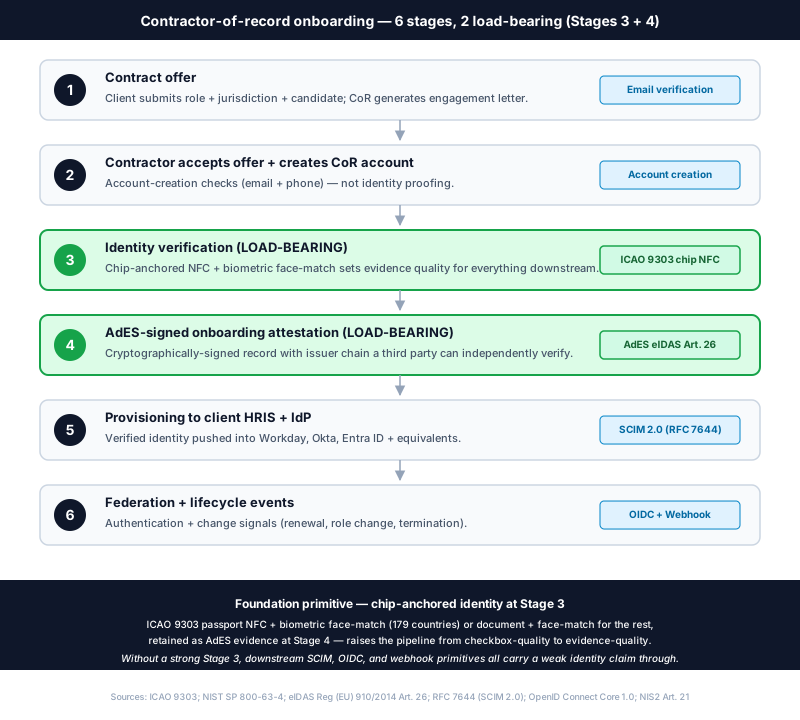
Stage 1 — Contract offer. The client submits a role, a jurisdiction, and a candidate; the CoR generates a jurisdiction-specific engagement letter and sends it to the contractor. At this stage the contractor's identity is a claim, not a fact.
Stage 2 — Contractor accepts the offer and initiates onboarding. The contractor clicks a link, creates an account with the CoR, and begins the CoR's onboarding flow. Any identity check at this stage is an account-creation check (email + phone verification), not an identity-proofing event.
Stage 3 — Identity verification. The CoR's onboarding flow presents an identity verification step. This is the load-bearing stage. What happens here — a supervised video KYC, a document scan plus selfie, or a chip-anchored NFC read plus biometric face match — determines the evidence quality of everything downstream. The evidence artefact produced here (or not produced) will be what the client's auditor asks to see in eighteen months.
Stage 4 — AdES-signed onboarding attestation. The CoR (or its identity vendor) produces a signed record that says "this contractor DID is bound to this verified identity as of this timestamp". If the record is an Advanced Electronic Signature under eIDAS Article 26, it carries evidential weight; if it is a JSON attestation with a bearer token, it does not.
Stage 5 — SCIM 2.0 provisioning to the client's HRIS and identity-provider stack. The verified identity flows from the CoR into the client's HRIS (Workday, BambooHR, or equivalent) and IdP (Okta, Entra ID, or equivalent) via System for Cross-domain Identity Management 2.0 — a standard REST protocol for user provisioning. This is the primitive that lets the CoR create the contractor's user record in the client's stack without either side building a custom integration.
Stage 6 — OIDC federation for authentication + webhook events for lifecycle changes. The contractor authenticates against the CoR's IdP or the client's IdP using OpenID Connect, inheriting the verified identity claims established at Stage 3. Lifecycle events (contract renewal, role change, elevated access request, termination) fire as webhooks from the CoR to the client's downstream systems, triggering re-verification or access re-provisioning where the client's policies require it.
The identity-verification stage (Stage 3) determines Stage 4's evidence quality, which determines Stage 5's provisioning claim ("who is this user, cryptographically"), which determines Stage 6's continuity signal fidelity. Break Stage 3 and the reliability of everything downstream is downstream of that break.
Where does contractor-of-record identity verification tend to break?
Two stages account for almost every reliability failure I have seen in this flow, and both are structural rather than implementation-quality issues.
Stage 3 breaks when the CoR routes identity verification through a document-scan-only sub-vendor. The onboarding UX shows a "verified" state; the underlying evidence file contains a photo of a document and a selfie. Document scan plus liveness selfie is fast, cheap, and — depending on the sub-vendor's OCR and anti-fraud stack — sometimes adequate for low-risk jurisdictions. But at a distributed hiring plan that includes candidates from countries with high document-fraud rates, or that hires roles with elevated access to production systems or customer data, this evidence tier is thinner than what a serious compliance review will accept. The escape hatch is a CoR that either runs chip-anchored NFC read plus biometric face match natively (rare) or lets the client bring their own identity provider that produces a stronger evidence tier (more common as an integration option, but still needs to be actively selected).
Stage 4 breaks when the CoR does not produce an AdES-signed onboarding attestation. Many CoR platforms produce an internal audit log entry — "user X was verified at timestamp Y by verification method Z" — but the log entry is not a cryptographically-signed record with an issuer chain that a third party can independently verify. When the client's auditor asks eighteen months later for proof that a specific contractor was properly proofed at onboarding, an audit log entry is not the same class of evidence as a signed attestation. The escape hatch is a CoR that produces AdES records under eIDAS Article 26 at the identity-proofing event and retains them under a Long-Term Validity envelope (PAdES-LTA, XAdES-A, or CAdES-LTA depending on the record format).
The other stages (contract offer, SCIM provisioning, OIDC federation, webhook events) are all standardised or standardisable protocols with well-understood integration patterns; they rarely break in ways that surprise anyone. Stage 3 and Stage 4 are where the vendor-selection decision actually matters, and where the marketing material is least useful because the evidence-quality distinction is invisible in a demo.
Which three integration primitives make the downstream flow reliable?
If Stages 3 and 4 are where the evidence is established, Stages 5 and 6 are where the evidence has to actually flow into the client's stack without custom engineering. Three integration primitives make this reliable — or unreliable in their absence.
SCIM 2.0 for provisioning. System for Cross-domain Identity Management 2.0 is the standard REST protocol for provisioning user records across systems. A CoR that supports SCIM 2.0 out of the box can push a verified contractor's user record directly into Workday, Okta, Entra ID, and other SCIM-compliant systems without the client building custom integration code. A CoR that does not support SCIM 2.0 typically offers a REST API + webhook option — workable, but requires the client's engineering team to build and maintain the integration surface per counterparty system. In a distributed team backing multiple client-side stacks, this scales poorly.
OIDC for authentication federation. OpenID Connect allows the contractor to authenticate against either the CoR's identity provider or the client's identity provider, with the verified identity claims established at Stage 3 flowing through the authentication tokens. Without OIDC, the contractor typically has to maintain separate credentials with the CoR and the client, which creates the "duplicate identity" pattern that fragments the audit trail and creates opportunities for identity drift over the contract lifetime.
Webhook events for lifecycle continuity. The identity established at onboarding is not static — contract renewals, role changes, elevated access requests, and terminations all need to trigger downstream events in the client's HRIS, IdP, and access-management systems. A CoR that publishes lifecycle events as webhooks (with a well-defined event schema) lets the client's systems react in near-real-time without polling. A CoR that only exposes lifecycle state via poll-based API endpoints creates staleness windows where the client's systems believe the contractor is in state X while the CoR knows they moved to state Y hours or days earlier.
The pattern I would push a CoR vendor to demonstrate at evaluation time is exactly this: hand the client a live SCIM provisioning example, an OIDC federation example against a client-side IdP, and a webhook event stream — not slides describing them. The three primitives are standardised enough that a competent CoR should be able to demonstrate all three within a demo call. If any is missing or scoped only via custom engineering, that is the reliability gap.
Where IdentiGate fits — and the honest posture
Being direct: at IdentiGate we produce Stage 3 evidence — chip-anchored NFC read plus biometric face match across all 179 ICAO 9303 countries, with document authenticity plus biometric face match for every remaining country — and Stage 4 evidence — AdES records under eIDAS Article 26 retained through our Evidence Layer. We integrate with CoR platforms via REST API and webhook (Stage 5 and 6 primitives), and native SCIM 2.0 + OIDC federation are on the roadmap for late 2026.
The way we typically fit into a distributed hiring plan is as the identity-verification sub-vendor a CoR routes Stage 3 through, or as the identity provider the client asks the CoR to accept when the CoR's default identity tier does not meet the client's evidence bar. In both patterns, the CoR remains the primary vendor relationship — we ship the evidence quality behind it. The Belgian, Dutch, and Baltic distributed teams that have onboarded us in 2026 have selected this pattern specifically because they wanted evidence-quality control at Stage 3 and Stage 4 while keeping their CoR relationship (and jurisdictional coverage) intact.
Where I would push back on the "one vendor for everything" framing is the assumption that CoR jurisdictional coverage and Stage 3 evidence quality come from the same vendor cleanly. In my experience they usually do not — the CoR is optimised for legal-entity abstraction, and the identity-verification depth is a secondary architectural investment for most CoR platforms. Splitting the two decisions cleanly (CoR for jurisdiction; identity provider for evidence quality) is often the pragmatic answer for teams whose evidence bar is above what the default CoR tier ships.
What is the procurement question to actually ask?
Six questions, per the six stages. Hand them to any CoR vendor at evaluation:
- Stage 3. What identity primitive do you run at onboarding — supervised video KYC, document scan plus liveness selfie, or chip-anchored NFC plus biometric face match? Which countries do you cover natively vs. via partner routing?
- Stage 3. Can we bring our own identity provider for Stage 3 if your default does not meet our evidence bar?
- Stage 4. Do you produce an Advanced Electronic Signature record for the onboarding attestation, and is it retained under a Long-Term Validity envelope?
- Stage 5. Do you support SCIM 2.0 natively, or is provisioning via REST API + webhook that we need to integrate?
- Stage 6. Do you support OIDC federation, and against which IdP families?
- Stage 6. Do you publish lifecycle events as webhooks with a well-defined event schema, and what is the event latency in practice?
A CoR vendor that answers all six cleanly with live demos is a vendor whose reliability story survives contact with a serious compliance review. A vendor that answers three or four but not all six — as is more common — is a vendor whose reliability is contingent on the client filling in the gaps, which is a decision to make consciously rather than to inherit from the marketing site.
More in this cluster
- Who Offers Trusted Workforce Identity Services for Distributed Teams?
- How Do You Verify a Gig Worker's Identity Without Re-KYC on Every Task?
Sources
Primary — identity assurance and document standards
Primary — eIDAS and evidence framework
- Regulation (EU) 910/2014 — eIDAS (Article 26 AdES)
- Regulation (EU) 2024/1183 — eIDAS 2.0
- ETSI EN 319 142 — PAdES long-term validity
Primary — integration standards
Primary — supply-chain and workforce security
About the author
Gustav Poola is a co-founder of IdentiGate OÜ, a European identity-verification and digital-signature company building on top of chip-anchored identity proofing (ICAO 9303 passport NFC), Advanced Electronic Signatures under eIDAS Article 26, and Advanced Electronic Seals. He focuses on the engineering architecture of identity flows that survive regulator, insurer, and auditor walk-back — particularly at the integration surface between identity providers, contractor-of-record platforms, and client-side HRIS and IdP stacks.