What Happens When AI Agents Need to Collaborate With Humans?
The collaboration boundary becomes a delegation interface. Under the EU AI Act Article 14 human-oversight obligation and emerging Know Your Agent (KYA) frameworks, the agent's authority chain must terminate at a verifiably-identified human delegator — and every handoff back to that human must re-verify the human at the moment of decision. The handoff is not a chat exchange; it is an identity-bound control transfer, and the engineering question is whose identity is on each side of the boundary.
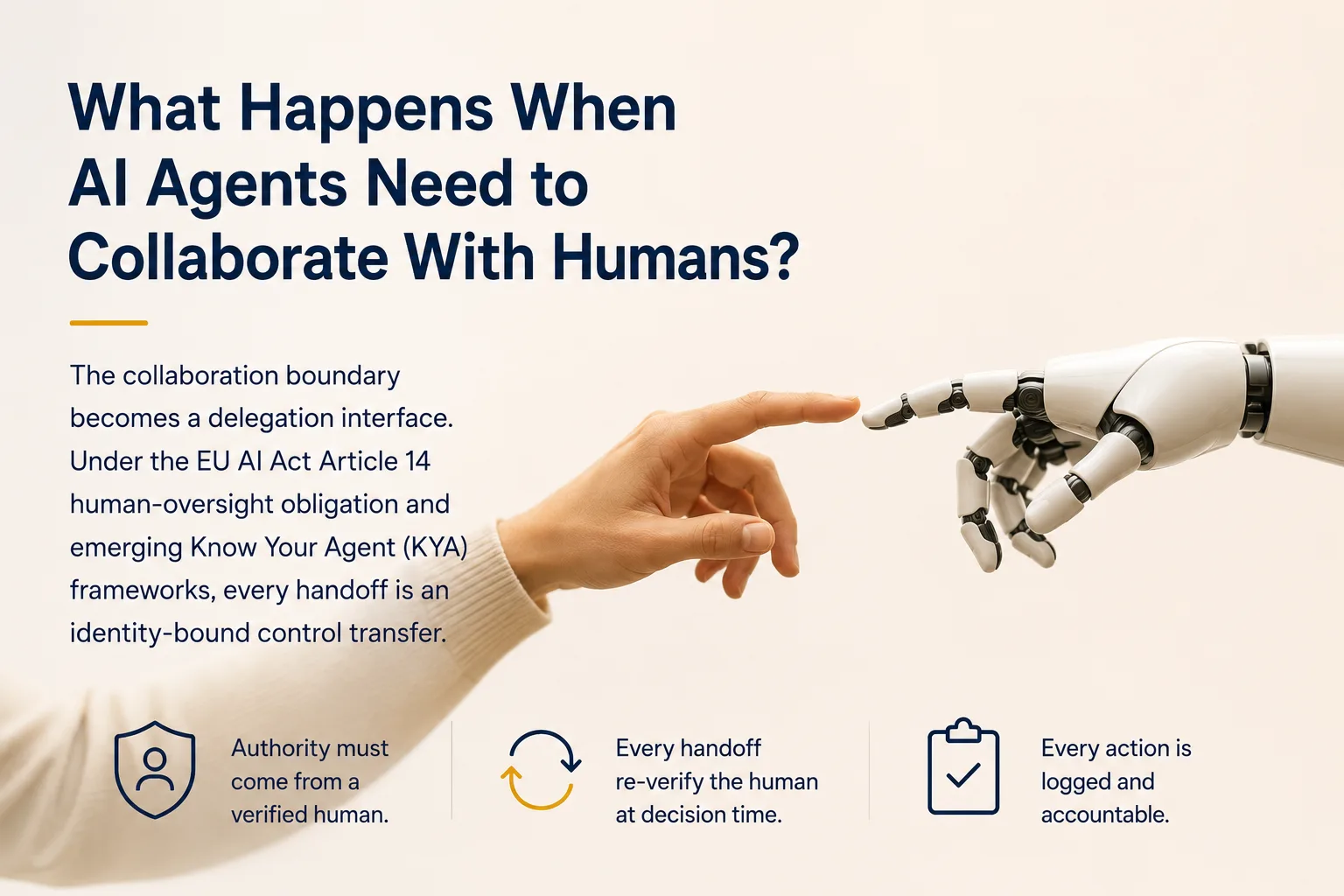
The collaboration boundary becomes a delegation interface. Under the EU AI Act Article 14 human-oversight obligation and emerging Know Your Agent (KYA) frameworks, the agent's authority chain must terminate at a verifiably-identified human delegator — and every handoff back to that human must re-verify the human at the moment of decision. The handoff is not a chat exchange; it is an identity-bound control transfer, and the engineering question is whose identity is on each side of the boundary.
In our work shipping the foundational identity primitives that sit underneath agent-deployment stacks in 2026, the agent-human collaboration question is the one customers walk into the call thinking is solved by their MCP host or their A2A gateway. It isn't. The agent framework can move the message; the identity layer is what decides whether the message has been issued by the right principal and whether the human on the other side of the handoff is the human the delegation chain expects. That gap is where most agent deployments quietly accumulate operational risk through 2026. A Stockholm-based mid-market commercial bank we worked with last quarter discovered the gap when its compliance committee asked who, exactly, had authorised a customer-segment AI agent to send a particular sequence of payment-rejection emails: the agent's MCP host could name the model and the tool call, but could not name the verified human whose authority the action sat under. This post is how I walk through that gap on the call.
What does "agent-human collaboration" actually mean in 2026?
It means a structured delegation interface where authority transfers across an identity-bound boundary — not a chat exchange where the messages happen to be in natural language.
The mainstream framing treats agent-human collaboration as a conversational interface — the user types, the agent responds, occasionally the agent asks for clarification. That framing is operationally adequate for low-risk tasks like drafting and summarisation. It breaks the moment the agent is asked to take an action with regulatory consequence: book a payment, dispatch an instruction to a downstream system, sign a document, modify a record under retention obligation. Under the EU AI Act (Regulation (EU) 2024/1689) the question becomes not "what did the agent say" but "under whose authority was the action taken, and how was that authority transferred". Article 14 of the Act requires that high-risk AI systems be designed for effective human oversight; Article 26 places obligations on the deployer to maintain that oversight in operation.
What the regulators do not yet specify, and where the engineering pressure has landed, is what effective human oversight means as a protocol. The emerging consensus across NIST's AI Risk Management Framework, the Anthropic Model Context Protocol (MCP) specification, and the Google Agent-to-Agent (A2A) Protocol is that oversight resolves to two technical primitives: a capability scope that constrains what the agent is authorised to do, and a handoff protocol that triggers human decision at the scope boundary. The collaboration is not the language exchange; the collaboration is the scope-bound handoff.
The honest read is that in 2026 the industry is still working out what the handoff protocol looks like in regulated contexts. The conversational-UX framing is dominant in product writing; the delegation-interface framing is what survives in audit. The platforms shipping against the latter are converging on something close to OAuth's rich authorisation request pattern (RFC 9396) — a structured, scope-explicit, time-bounded, revocable transfer of authority from a verified human principal to an agent process. The handoff back to the human at the scope boundary inherits the same structure.
Where does the EU AI Act actually draw the boundary?
At "effective human oversight" of high-risk systems, with the engineering question of how to operationalise oversight left to deployers and to emerging standards.
Article 14 of the EU AI Act lists oversight mechanisms the high-risk system must be designed to enable: human ability to understand the system's capacity and limitations, to monitor its operation, to remain aware of automation bias risks, to intervene, and to disregard or reverse outputs. Article 26(2) places the operational version of these obligations on the deployer: to assign oversight to natural persons with the necessary competence, training, and authority. What the Act does not specify is the protocol by which that natural person is identified, authenticated at handoff, and bound to the decision they make.
That gap is being filled by adjacent frameworks. NIST SP 800-63-4 (May 2025 draft) defines the Identity Assurance Level (IAL) framework that determines how strongly the human delegator's identity is proofed. NIST SP 800-207 Zero Trust Architecture frames the agent as a workload identity whose authorisation has to be continuously verified, including at every handoff. The W3C Verifiable Credentials Data Model 2.0 provides the credential schema that can carry delegation evidence — the human delegator's identity, the scope granted to the agent, the moment of grant, and the cryptographic signature binding the three.
What I see in the institutional integration work in 2026 is that compliance leads are starting to read Article 14 alongside their existing eIDAS obligations. Under eIDAS 2.0 (Regulation (EU) 2024/1183) the authoritative form for a binding decision by a natural person is a signature — Simple, Advanced (AdES under Article 26), or Qualified (QES under Article 25). When the human at the handoff is approving an action with regulatory consequence, the cleanest implementation is an AdES record bound to the verified human's identity at the moment of decision. The agent then carries this record forward as the evidence of the human's authorisation. That is the structure that survives audit.
What do the emerging standards say about the handoff protocol?
They converge on three primitives: a capability scope, a re-authentication trigger, and an evidence record. The implementations differ; the primitives are the same.
The Model Context Protocol (MCP) specification defines a tool abstraction where the host application brokers between the LLM-driven agent and external resources. The 2026.03 revision of MCP introduced explicit human-in-the-loop tool patterns — tools that the agent can invoke only after the host application has captured an explicit human confirmation. The host is responsible for surfacing the confirmation prompt, capturing the human's decision, and binding the decision back to the agent's tool call. What MCP does not specify, and explicitly leaves to the host, is how the human's identity is verified at the confirmation step. A host could verify by session cookie (weak), by step-up MFA challenge (better), or by an eIDAS-bound AdES signature primitive (strongest). The choice depends on the regulatory context.
The A2A Protocol operates at a different layer — agent-to-agent communication, where the principals on both sides are agents rather than agent-and-human. A2A's Agent Card declares the capability scope an agent is willing to expose; the consuming agent calls within scope. The handoff back to a human happens when the receiving agent's policy requires escalation. Like MCP, A2A leaves the human-side authentication to the embedding application. The pattern in both is consistent: the protocol carries the message and the scope; it leans on the host to verify the human at the handoff.
OAuth Rich Authorization Requests (RFC 9396) provides the closest off-the-shelf model for the delegation grant from human to agent. RAR extends OAuth's scope concept into structured authorisation data — the human can grant the agent, for instance, "authorisation to transfer up to €10,000 from account X to vendors on the approved list during the next 24 hours". The grant is cryptographically signed, time-bounded, and revocable. What RAR does not specify, and what is the open engineering question in 2026, is what proof artefact the relying agent system must retain to demonstrate, at audit time, that the human who granted the authorisation was the human the chain expects. That is the identity-proofing question.
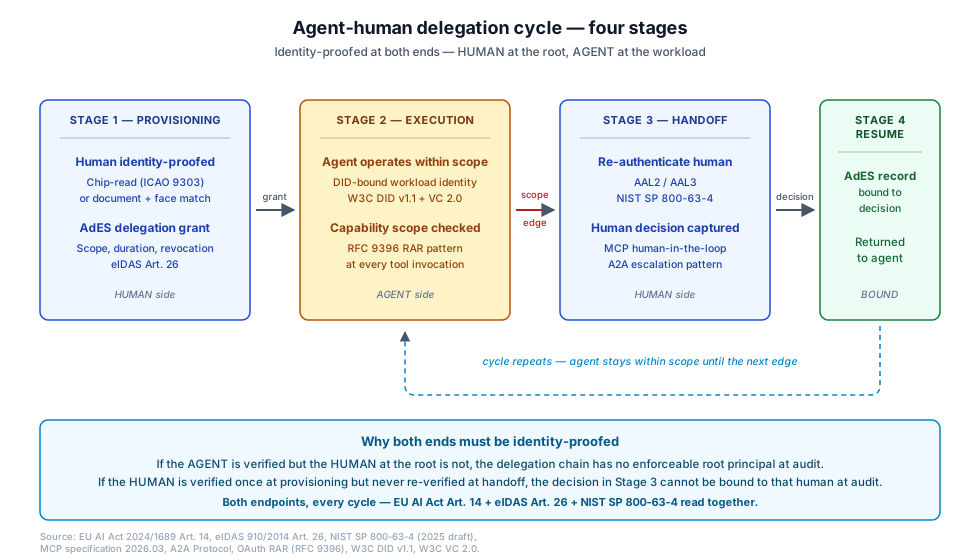
Why does the human side of the handoff need to be identity-proofed?
Because if it isn't, the agent's action is bound to an unverified principal and the entire delegation chain breaks at audit.
This is the question the agent-deployment frameworks consistently underspecify, and the question IdentiGate's KYA position sits squarely on. The standard industry framing of KYA focuses on verifying the agent: producing a persistent identifier, attesting its capabilities, tracking its actions. That work is necessary; it is not sufficient. The agent's authority chain has a root, and the root is a human. If the human at the root is not identity-proofed at the same assurance level as the actions the agent takes downstream, the chain is no stronger than its weakest link — which is the human's verification.
The pattern we ship against at IdentiGate is identity-proofing at both ends of the delegation chain — the framing we opened in the KYA-anchor post (What is Know Your Agent and why should you care?). At the human end, the Identity Verification product produces a chip-anchored proofing record — passport NFC chip read for the 179 ICAO 9303 countries, or document authenticity plus biometric face match (FaceTec liveness) for every remaining country, AdES-bound under eIDAS Article 26. At the agent end, the Identity of Things product handles workload identity primitives — DID-based persistent identifiers and capability attestations for the agent process itself. The delegation record bound at the Authentication product layer ties the two ends together: a signed AdES delegation from the verified human to the identified agent, with scope, duration, and revocation rights. The distinctive position we ship is the insistence that the human end of the chain gets the same chip-anchored proofing rigour as the agent end gets workload-identity rigour — both anchored on eIDAS Article 26 and NIST SP 800-63-4 IAL2 evidence at minimum. The AI Act Annex III high-risk obligations that start landing 2 August 2026 are the deadline pressure for getting this right — we covered the broader Annex III framing in our remote proctoring + AI Act post.
What I'd push back on hardest in the current KYA discourse is the assumption that the agent-side verification carries the regulatory weight on its own. It doesn't. Under EU AI Act Article 14 the human is the oversight principal, and the regulator's question at audit will be how that human was identified at the moment of decision. Under eIDAS Article 26 the binding artefact for a natural-person decision is a signature, and the signature is only as strong as the identity proofing that issued the certificate. Under NIST SP 800-63-4 the assurance level the deployment claims has to hold across both ends of the handoff. Stack these three regulatory frames together and the conclusion is unavoidable: the human side of the handoff is not a UX surface; it is the regulatory anchor for everything the agent does in the human's name.
The honest read for any platform-side architect designing agent-human collaboration in 2026 is to start the design from the audit question backwards. Ask what evidence the deployment will need to produce when a regulator or downstream verifier asks "under whose authority did the agent take this action, and how was that authority transferred". If the answer is "the user was logged in via OIDC session", the deployment is fragile. If the answer is "an AdES-bound delegation record signed by a chip-anchored identity-proofed human, with scope, duration, and revocation rights, plus a re-authentication record at every handoff", the deployment survives. We have not yet seen a regulator's enforcement action that turned on this distinction; we expect to see one before the Act's high-risk obligations bite in 2027.
More in this cluster
- AI Agents Need Identity: Who's Behind the Machine?
- AI Agent Signing Authority: Can a Non-Human Sign Contracts?
- Identity of Things in Defence: What NIS2, CRA, and EDF 2026 Actually Require
Sources
Primary — EU AI Act and eIDAS framework
- Regulation (EU) 2024/1689 — EU AI Act — EUR-Lex
- Regulation (EU) 910/2014 — eIDAS original — EUR-Lex
- Regulation (EU) 2024/1183 — eIDAS 2.0 — EUR-Lex
Primary — NIST identity and trust frameworks
- NIST AI Risk Management Framework
- NIST SP 800-63-4 (May 2025 draft) — Digital Identity Guidelines
- NIST SP 800-207 — Zero Trust Architecture
Primary — agent protocols and credentials
- Anthropic — Model Context Protocol (MCP) specification
- Google — Agent-to-Agent (A2A) Protocol
- W3C Verifiable Credentials Data Model 2.0 (Recommendation, 15 May 2025)
- W3C Decentralized Identifiers (DIDs) v1.1 — Candidate Recommendation 5 March 2026
- RFC 9396 — OAuth 2.0 Rich Authorization Requests
About the author
Gustav Poola is co-founder of IdentiGate. He focuses on the technical architecture of passport-chip identity verification, advanced electronic signature production under eIDAS, and the engineering of identity flows that survive regulator and auditor walk-back.