Are Digital Signatures Accepted in Court?
Yes — digital signatures are legally admissible in every major jurisdiction and cannot be denied legal effect solely because they are electronic. What varies dramatically is the evidentiary weight the signature carries and which party has to prove what. A Qualified Electronic Signature reverses the burden of proof onto the challenger under eIDAS Article 25(2). An Advanced Electronic Signature is admissible and independently verifiable but the relying party still has to produce the evidence. A Simple Electronic Signature is admissible but the relying party carries almost the entire attribution burden.
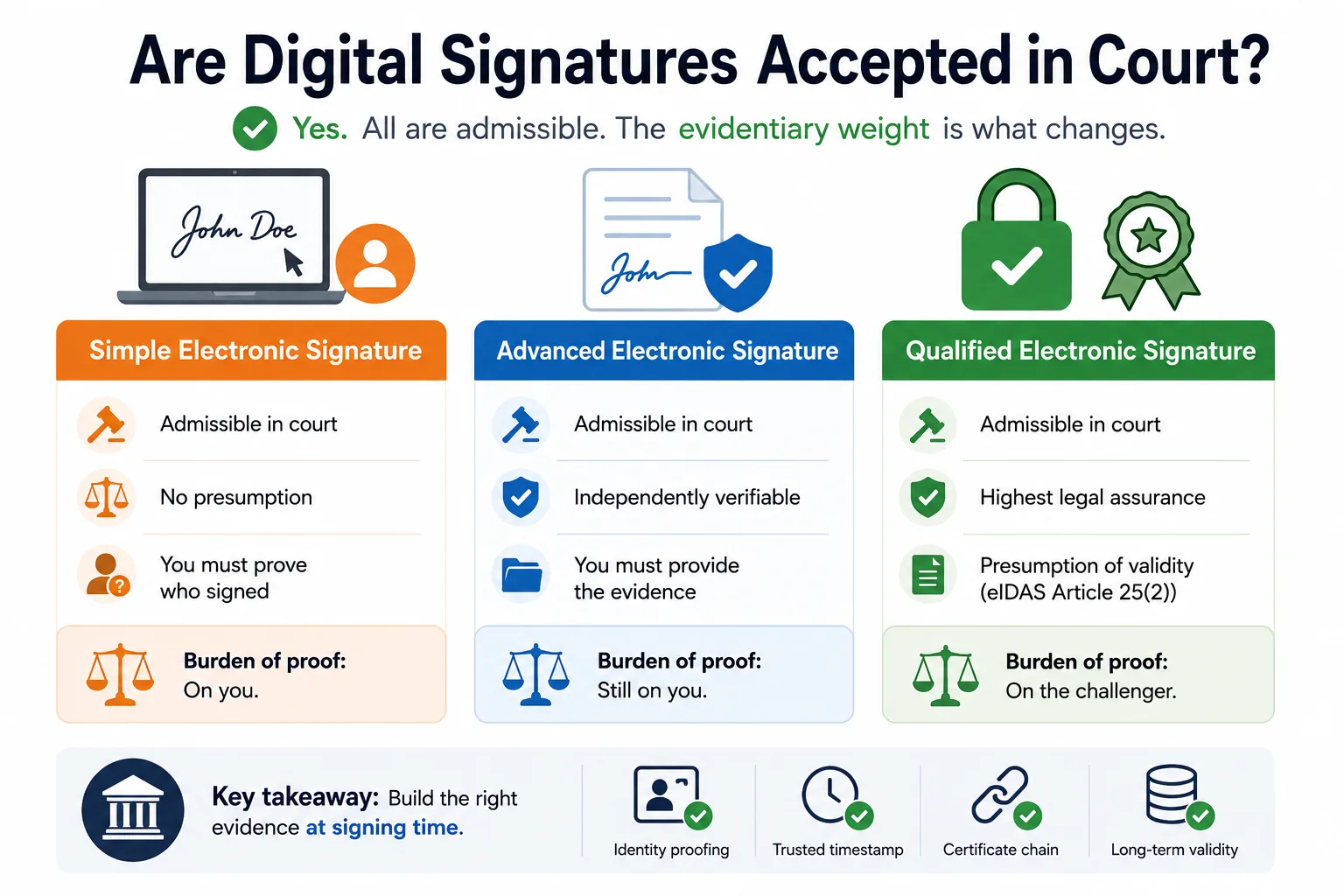
Yes — digital signatures are legally admissible in every major jurisdiction and cannot be denied legal effect solely because they are electronic. What varies dramatically is the evidentiary weight the signature carries and which party has to prove what. A Qualified Electronic Signature reverses the burden of proof onto the challenger under eIDAS Article 25(2). An Advanced Electronic Signature is admissible and independently verifiable but the relying party still has to produce the evidence. A Simple Electronic Signature is admissible but the relying party carries almost the entire attribution burden.
A German commercial court's clerk sent us a follow-up question at a recent conversation, after a dispute the court had handled the week before. Two mid-sized industrial companies had contracted electronically for a €600,000 machine-parts order; the buyer refused delivery, claiming the CEO had never signed the accepting-quote document. Both parties agreed the signature was "electronic." Both agreed the signing platform was reputable. What neither party could produce, at the discovery stage, was clear evidence of who had held the signing keys, what tier the signature actually was under eIDAS, or what independent verification path the court could use to resolve the attribution question. The case settled on unfavourable terms because neither side had the evidence to win. This post is that pattern — how digital signatures are actually treated in court, and where the load-bearing evidence has to be embedded at signing time to survive challenge.
What does "accepted in court" actually mean legally?
Two questions are collapsed in the everyday phrase "accepted in court." The first is admissibility — can the signature be entered into evidence at all? The second is evidentiary weight — once admitted, how much does it prove? The two are completely different questions and the answer to the first is usually "yes" while the answer to the second is "it depends."
Admissibility is nearly universal. eIDAS Regulation (EU) 910/2014 Article 25(1) states that "an electronic signature shall not be denied legal effect and admissibility as evidence in legal proceedings solely on the grounds that it is in an electronic form or that it does not meet the requirements for qualified electronic signatures." The US ESIGN Act (15 U.S.C. §7001) uses the same non-discrimination construction. The UNCITRAL Model Law on Electronic Signatures (2001), which every downstream framework I know of traces to, was drafted specifically to make the admissibility question a settled matter. If your signature is a click, a typed name, a scanned image, or a full AdES with chip-anchored identity behind it — the court will admit it as evidence.
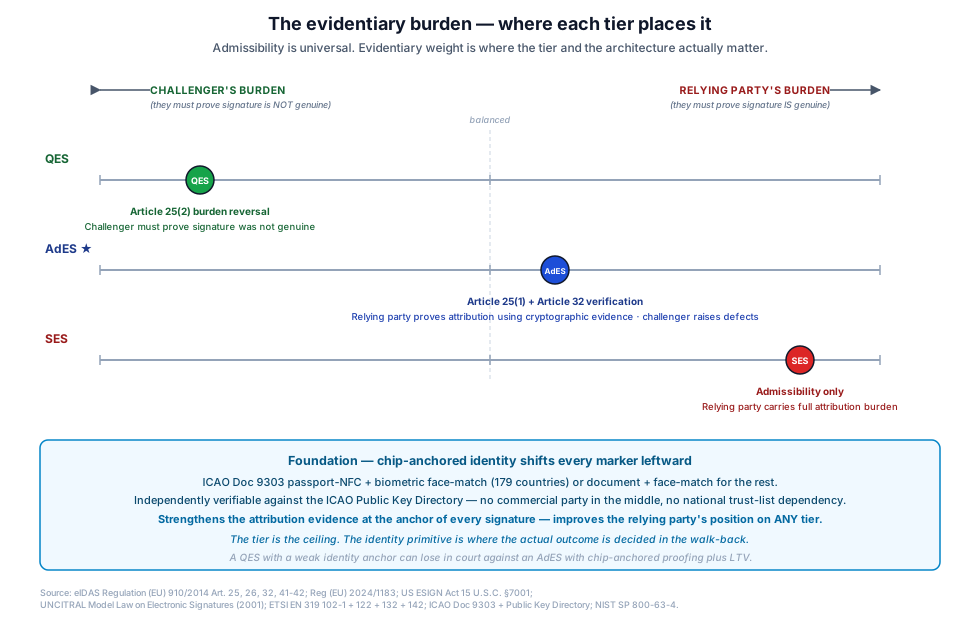
Evidentiary weight is where the tier and the architecture actually matter. Once the signature is in evidence, the court has to decide how much weight to give it. That decision turns on three things: the signature's tier (SES, AdES, QES), the independent verification path available to the court (certificate chain, timestamp, LTV embedding), and the strength of the identity-proofing event that anchors the private key to a specific person. The first is a legal-classification question. The second and third are architectural questions decided at signing time — long before the dispute exists.
The way I typically frame this in a first conversation with legal counsel: "admissible in court" is the low bar. "Wins in court" is the high bar. The gap between them is exactly the evidence you either embedded per signature at production time or did not — and by the time you are in front of a judge, that decision is already made.
How does the signature tier change the evidentiary posture?
Under eIDAS Article 25 plus Article 32 validation procedures, the three tiers carry three different starting positions in a dispute.
Simple Electronic Signature (SES). Admissible under Article 25(1). No presumption of attribution. The party relying on the signature has to prove — from scratch, using whatever evidence they can produce — that the specific person actually signed the specific document at the specific moment. In practice this means session logs, IP addresses, authentication records, device fingerprints, and the surrounding audit trail. That evidence can succeed, but the burden sits fully on the relying party throughout the proceeding.
Advanced Electronic Signature (AdES). Admissible + independently verifiable if produced under ETSI EN 319 122 / 132 / 142 with a properly-anchored certificate. The cryptographic signature itself proves that whoever held the private key signed the specific document — a stronger starting position than SES. The relying party still has to prove attribution (who held the key, and was the key holder authorised to sign this specific document), but the cryptographic evidence moves the argument forward substantially.
Qualified Electronic Signature (QES). Admissible + Article 25(2) burden reversal. This is the load-bearing legal effect of QES: the signature has "the equivalent legal effect of a handwritten signature," and — crucially — the party challenging the signature must prove it was not genuine, rather than the party relying on it having to prove it was. That reversal is what makes QES an expensive commercial choice worthwhile in high-stakes document classes. A more detailed walk-through of the three tiers and the specific Articles 25/26/32 verification chain lives in What Makes a Digital Signature Legally Valid?.
Where I disagree with the loud commercial-law position on this: the tier-choice is often presented as a legal-preference decision — "use QES for high-value contracts, AdES for standard ones." That framing misses the real question. What actually determines whether a signature wins in court is not the tier itself but whether the independent verification path — certificate chain, revocation status, timestamp, LTV embedding, identity-proofing evidence — was preserved at production time. An AdES with all four preserved is stronger evidence than a QES whose certificate chain has been lost. Tier is the ceiling; the architecture is the actual outcome.
What actually happens in a real challenge, step-by-step?
When a signature is disputed in court, the court walks the evidence chain in reverse — from the challenged signature all the way back to the identity-proofing event that anchored the signing key. Each link in that chain has to hold under adversarial scrutiny.
Step 1 — cryptographic verification. The court's technical expert (or an appointed forensic examiner) computes the hash of the disputed document and verifies the signature against the associated public certificate. If this step fails, the signature is not valid on its face and the dispute is over. If it succeeds, the argument moves to the identity chain.
Step 2 — certificate validity at signing time. The certificate has to have been valid at the moment of signing — not revoked, not expired. Under ETSI EN 319 102-1 validation procedures, this requires an independent timestamp (typically qualified under eIDAS Articles 41-42) plus a snapshot of the certificate revocation status at that moment. This is where LTV embedding under PAdES-LTV becomes decisive — if the revocation-status snapshot is captured inside the signed record, the court does not need any external source to complete the check.
Step 3 — key-holder identification. The certificate binds the private key to a subject identity. The court needs evidence that the person the certificate was issued to is the same person who is being held to the signature. This is the identity-proofing walk-back — and it is where most disputes actually get won or lost. The same pattern applies directly to key-compromise scenarios walked in What If My Private Key Gets Stolen?.
Step 4 — authorisation and intent. Even if the key holder is proven, the party challenging can argue that the key was compromised, that the signing operation was performed by someone else with access to the credential, or that the signer did not have the corporate authority to bind the entity to the document. This is where the walk-back extends into the platform's authentication logs and the corporate authorisation records. The general pattern of denial-of-signing challenges — and how they collapse or succeed at each link of the chain — is walked in more detail in What Happens if Someone Denies They Signed Digitally?.
A UK Companies Act signature challenge I reviewed briefs on last year had exactly this pattern: the AdES cryptographic verification held clean; the certificate chain was intact; the timestamp was verified; but the key-holder identity-proofing at onboarding had been a self-uploaded ID photo with no chip anchoring and no biometric match. The challenger's counsel focused the entire attack on Step 3, and the court accepted the argument that the onboarding evidence was not sufficient to establish attribution beyond reasonable doubt for the specific director being held to the signature. The signature was admissible; it did not win. That is the difference the identity-proofing primitive makes at the far end of the evidence chain.
How does cross-border enforcement work?
A signature produced in one jurisdiction and litigated in another adds a layer to the analysis. The signature has to be admissible under the receiving court's rules, and its evidentiary weight has to be reconstructable from artefacts the receiving jurisdiction's technical experts can verify.
Inside the EU + EEA + EFTA, QES produced against a QTSP on the EU Trusted List enjoys automatic mutual recognition — Article 25(2) burden reversal applies in every member-state court. AdES and SES are also universally admissible but the specific evidentiary weight can vary by national procedural rules.
Outside the EU, recognition depends on the receiving country's domestic law. Common-law jurisdictions (US, UK, Australia, Canada) admit foreign electronic signatures under their own non-discrimination statutes but do not typically apply eIDAS's burden-reversal effect — a QES in Germany is admitted in a US court but does not automatically reverse the burden of proof there. Civil-law jurisdictions outside the EU vary considerably. The full three-pattern framework — tier-based, party-autonomy, hybrid — is walked in Digital Signature Laws by Country: What's Legal Where?.
Where chip-anchored identity proofing becomes decisive is precisely in cross-border enforcement. A signature that carries an ICAO 9303 passport-NFC + biometric face-match record at its identity-anchor produces evidence that any court in any jurisdiction can independently verify against the ICAO Public Key Directory — 179 issuing countries, no single commercial party in the middle, no national trust-list dependency. Everything above that anchor — the specific tier, the certificate authority, the timestamp source — is jurisdictional. The identity-proofing evidence is not. That is the reason IdentiGate architects on chip-anchored proofing rather than on any national identity scheme, and it is what makes our signature platform and evidence layer carry defensible evidentiary weight regardless of which jurisdiction the dispute ends up in.
My take on this: organisations that plan for cross-border enforcement at signing time have a dramatically different position in dispute than organisations that assume domestic-jurisdiction enforcement will always apply. The architectural cost of building for cross-border evidence — LTV embedding, chip-anchored identity, qualified timestamps — is meaningful but bounded. The cost of losing a cross-border case because the evidence chain cannot be reconstructed in the receiving jurisdiction is unbounded, because it includes the value of every other cross-border contract that inherits the same evidence architecture.
Where IdentiGate fits
IdentiGate anchors every signature to a chip-anchored ICAO 9303 identity-proofing event that survives cross-border challenge without depending on any national trust framework. Our signature platform produces AdES-level signatures with qualified timestamps and Long-Term Validity embedded by default — the four artefacts a court's Article 32 verification chain actually needs, captured at signing time and preserved with the signed record. Our evidence layer keeps that chain independently verifiable across the retention periods commercial contracts, healthcare records, and long-tail liability actually require.
If you are structuring a cross-border contract architecture and the courts you might end up in are not the courts your platform was designed for — or if you have a signature-challenge exposure sitting in your legal-risk register that has never been stress-tested against a live walk-back — get in touch.
More in this cluster
- AdES vs QES: Which eSignature Level Does Logistics Need?
- EU Defence Tenders 2026: Do EDIP and EDF Need QES?
- How Long Do Digital Signatures Remain Valid?
- How Do I Verify Someone's Digital Signature Is Authentic?
- Do Digital Signatures Require Proof of Identity?
- What's the Difference Between a Digital Signature and an Electronic Signature?
- How Much Does a Digital Signature Cost?
- What's the Difference Between Hash and Digital Signature? — the crypto primitive courts actually inspect at the evidence layer
Sources
Legal frameworks — signature admissibility and evidentiary weight
- eIDAS Regulation (EU) 910/2014 — Articles 25, 26, 32, 41-42
- Regulation (EU) 2024/1183 (eIDAS 2.0)
- US ESIGN Act (15 U.S.C. §7001)
- Uniform Electronic Transactions Act (1999)
- UK Electronic Communications Act 2000
- UNCITRAL Model Law on Electronic Signatures (2001)
Technical validation standards
- ETSI EN 319 102-1 (Signature Validation Procedures)
- ETSI EN 319 142 (PAdES — long-term validity)
- ETSI EN 319 132 (XAdES)
- ETSI EN 319 122 (CAdES)
- EU Trusted List (QTSP registry)
Identity standards
- ICAO Doc 9303 (Machine Readable Travel Documents)
- ICAO Public Key Directory
- NIST SP 800-63-4 (Digital Identity Guidelines)
About the author
Mairi Kutberg is a co-founder of IdentiGate, a European identity-verification and digital-signature company building on top of chip-anchored identity-proofing (ICAO 9303 passport NFC), Advanced Electronic Signatures (eIDAS Article 26), and Advanced Electronic Seals. She works with logistics, healthcare, fintech, HR-tech, iGaming, defence, and cybersecurity teams where the evidentiary posture of every signature has to survive cross-border challenge — and where the identity-proofing primitive at the anchor is the load-bearing decision.