Digital Signature Laws by Country: What's Legal Where?
Digital signature laws fall into three global patterns. Tier-based frameworks ascribe different legal weight to different signature classes (EU eIDAS, UK, most APAC). Party-autonomy frameworks let contracting parties decide what counts (US ESIGN + UETA). Hybrid frameworks combine the two (India IT Act, Brazil MP 2200-2, most LATAM). Every cross-border deployment I have seen either respects those three patterns or breaks against them.

Digital signature laws fall into three global patterns. Tier-based frameworks ascribe different legal weight to different signature classes (EU eIDAS, UK, most APAC). Party-autonomy frameworks let contracting parties decide what counts (US ESIGN + UETA). Hybrid frameworks combine the two (India IT Act, Brazil MP 2200-2, most LATAM). Every cross-border deployment I have seen either respects those three patterns or breaks against them.
A Lagos-headquartered fintech expanding into Frankfurt banking called us last month. Their internal legal counsel had sent them the question every founder eventually gets: will the signing platform we've built hold up across all forty-seven countries in our expansion plan? The honest answer, once we walked through the target markets, was that it wasn't a single legal question at all. It was three different questions dressed as one, each mapped to a different pattern of law, each with its own failure mode. This post is the map — the three patterns, where each one dominates, where they collide, and what the load-bearing layer is that works underneath all of them.
What is the shared foundation across every major digital-signature law?
Every serious framework in force in 2026 traces back — directly or indirectly — to two UNCITRAL Model Laws: the Model Law on Electronic Commerce (1996) and the Model Law on Electronic Signatures (2001). Between them, these two documents established the two principles every downstream framework I have worked with actually inherits: non-discrimination (an electronic signature cannot be denied legal effect solely because it is electronic) and technology neutrality (the law cannot pre-select which cryptographic technique constitutes a valid signature).
The reason those two principles matter is that they are the reason cross-border e-signing works at all. If every country's law had ended up specifying which algorithm counted as a signature, we would have wound up with a hundred incompatible national cryptographic monopolies. Instead we got a hundred national laws that all recognise, at minimum, that a signature produced by cryptographic means using a private key controlled by the signer, capable of detecting subsequent alteration, is a legally admissible signature. Beyond that minimum, the tiering and the party-autonomy questions diverge — and that divergence is what the next section is about.
My take on why this matters for a founder building today: if you architect on top of the UNCITRAL floor rather than on top of any single national framework, you inherit portability into every country that ratified. If you architect on top of eIDAS specifically, you inherit portability into the EU and painful re-engineering everywhere else. Build to the shared foundation first, then layer national-tier features on top for the markets where they materially move the needle. That is the sequence I keep having to argue for in early-stage architecture reviews.
How do the two dominant frameworks — eIDAS and ESIGN + UETA — actually differ in a live deployment?
The EU eIDAS Regulation (EU) 910/2014 — and its 2024 successor Regulation (EU) 2024/1183 — is a tier-based framework. There are three named classes: Simple Electronic Signature (Article 3(10)), Advanced Electronic Signature (Article 26), Qualified Electronic Signature (Article 25(2)). Each class carries a specific evidentiary weight. Qualified reverses the burden of proof onto the challenger; advanced does not. Cross-border recognition inside the EU/EEA/EFTA is automatic for signatures produced against a Qualified Trust Service Provider on the EU Trusted List. Which class you deploy determines what happens in court.
The US ESIGN Act (15 U.S.C. §7001) and the Uniform Electronic Transactions Act (1999), adopted by 49 states plus DC, are party-autonomy frameworks. There are no tiers. The statutory test is that both parties intended the electronic record to serve as a signature and that the signature is attributable to the person by any evidence available. That includes cryptographic evidence, but it also includes an IP address, a clickstream, an authentication event, or an audit log. The evidentiary weight of a US electronic signature is a function of the totality of the evidence a party can produce at dispute — not a function of which named class the signature belongs to.
My take, from watching this go wrong more times than I would like to count: the failure mode is a US-headquartered SaaS assuming that because their US contracts hold up on ESIGN + UETA-style click-signing, the same thing will hold up in a Frankfurt or Milan court. It won't. In the EU, if a signature is challenged on a document class that requires QES (many public-sector filings, notarial acts, some employment contracts under national law), a US-style attributable click-signature can be admissible but carries no evidentiary burden reversal — meaning the party trying to rely on it, not the party denying it, has to prove it in court. That is the reverse of what most US founders assume. If your target market is the EU, you deploy AdES at minimum. If it is the US, ESIGN + UETA holds. If it is both, you architect the platform to produce both.
Where do most cross-border signature deployments actually break?
Three patterns account for essentially every cross-border break I have watched play out. First — non-EU jurisdictions with idiosyncratic tier requirements. India's IT Act 2000 (as amended in 2008 and by the Digital Personal Data Protection Act 2023) recognises two classes: electronic signatures (open-ended, includes eSign via Aadhaar) and digital signatures (specifically PKI-based, tied to Controller of Certifying Authorities-licensed CAs). If you want to sign in India for tax filings, corporate returns, or MCA submissions, you need a CCA-licensed Digital Signature Certificate — not just any AdES equivalent. China's Electronic Signature Law (2005, revised 2015 and 2019) requires reliable electronic signatures produced against Chinese Certification Authority infrastructure for legal effect on state and financial documents. Both regimes accept UNCITRAL-tier signatures for private commercial contracts but escalate for regulated document classes.
Second — evidence carry-over gaps. A signature that is Qualified in the EU does not automatically remain Qualified when the document crosses into Singapore, Brazil, or the UAE, because Qualified status is a function of the QTSP being on the EU Trusted List, not an intrinsic property of the signature. Third countries recognise the signature under their own domestic law — usually as an Advanced Electronic Signature equivalent, sometimes as a plain Simple Electronic Signature — but the specific evidentiary burden reversal that Article 25(2) grants inside the EU does not travel with the document. This is the piece founders almost always miss until an audit surfaces it.
Third — signer-identity jurisdictional overlap. A Turkish national signing an employment contract for a Barcelona operating subsidiary generates a document that has a signer subject to Turkish law, a beneficiary subject to Spanish employment law, and a signature framework governed by whichever jurisdiction the signing platform sits in. That triple can fall apart in dispute unless the identity-proofing event underneath the signature is itself verifiable in all three jurisdictions — which is the pivot into the fourth question. A related walk-through of what happens when this evidence chain is challenged and the burden is on the platform to reconstruct it lives in What Happens if Someone Denies They Signed Digitally? and the underlying legal-validity chain (Articles 25, 26, 32) is walked in What Makes a Digital Signature Legally Valid?.
Where I disagree with the loud engineering position on this: the answer to cross-border complexity is not "pick one strong framework and lock into it." The answer is that identity-proofing is the load-bearing layer under every framework, and it is the one part of the stack you can standardise globally without picking a national side. Everything above that layer — tier, class, format — is jurisdictional. Everything below it is a chip and a face.
What does chip-anchored identity buy you across all these regimes?
Every framework I have named — eIDAS, ESIGN + UETA, UK Electronic Communications Act, India IT Act, China Electronic Signature Law, Brazil MP 2200-2, Singapore's Electronic Transactions Act, Australia's Electronic Transactions Act, Japan's Act on Electronic Signatures, South Africa's ECT Act 25 of 2002 — carries an implicit identity-proofing requirement underneath its signature class. The specific language varies. eIDAS calls it "reliable methods for identity verification." ESIGN calls it "attribution by any means available." India's IT Act calls it "identity of the subscriber verified by the Certifying Authority." China's Electronic Signature Law calls it "reliable identity verification of the electronic signatory." The common substance is that if a challenge is mounted, the party seeking to rely on the signature has to walk back — under whichever framework applies — to the moment identity was proofed and produce the evidence of that proofing.
ICAO Doc 9303 — the specification for machine-readable travel documents — is the piece that operates below every one of those framework layers. The active passport chip carries a signed data structure verifiable against the ICAO Public Key Directory. 179 countries are currently issuing ICAO 9303 chip-anchored travel documents in 2026. If your identity-proofing terminates at a passport-NFC read and a live biometric face match against the on-chip portrait, you have a proofing event that is independently verifiable in every framework I have named — not because the framework endorses ICAO 9303 specifically, but because the framework's own identity-verification requirement is satisfied by an evidence source that no commercial party controls and no single national CA gatekeeps. That is the reason IdentiGate architects on top of chip-anchored proofing rather than on top of any national identity scheme, and that is the layer that makes our signature products and evidence layer carry across all three law patterns without re-engineering. A deeper walk-through of the specific evidence retention that makes this walk-back defensible lives in What Happens if Someone Denies They Signed Digitally?.
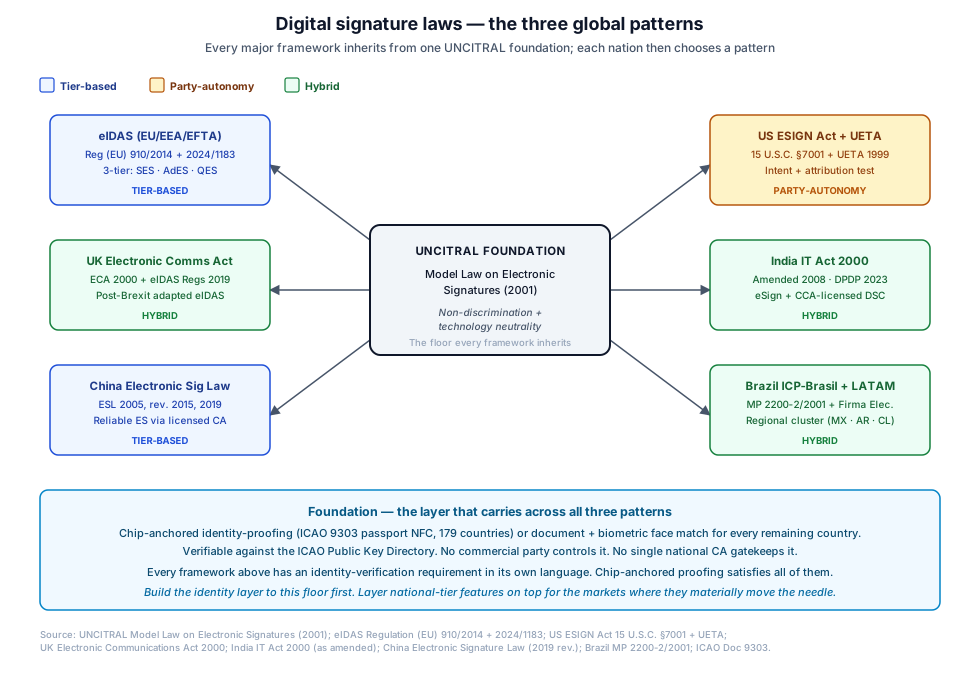
The founder call that opened this post ended with the same answer we usually reach. The Lagos-Frankfurt fintech did not need forty-seven different signing integrations. They needed one signature layer producing AdES-strength cryptographic evidence, one identity-proofing primitive terminating at chip-anchored ICAO 9303 evidence, and a legal position statement documenting which class the signature satisfies in each target jurisdiction. That is a three-line answer to what looked like a forty-seven-line question. And it is the answer I keep having to walk founders back to, once they realise the alternative is a national-framework matrix that will be technically obsolete before they finish onboarding the second country.
More in this cluster
- AdES vs QES: Which eSignature Level Does Logistics Need?
- EU Defence Tenders 2026: Do EDIP and EDF Need QES?
- How Long Do Digital Signatures Remain Valid?
- How Do I Verify Someone's Digital Signature Is Authentic?
- Do Digital Signatures Require Proof of Identity?
- What's the Difference Between a Digital Signature and an Electronic Signature?
- How Much Does a Digital Signature Cost?
- Are Digital Signatures Accepted in Court?
- What's the Difference Between Hash and Digital Signature? — the shared crypto primitive across every jurisdiction listed
Sources
EU frameworks
UNCITRAL foundations
Common-law jurisdictions
- US ESIGN Act (15 U.S.C. §7001)
- Uniform Electronic Transactions Act (1999)
- UK Electronic Communications Act 2000
- Australia Electronic Transactions Act 1999
Asia-Pacific frameworks
- India IT Act 2000 (as amended)
- China Electronic Signature Law (2019 revision)
- Singapore Electronic Transactions Act (Cap 88)
- Japan Act on Electronic Signatures 2001
LATAM + Africa
Technical + identity standards
- ETSI EN 319 102-1 (Signature Validation Procedures)
- ETSI EN 319 411-1 (TSP General Requirements)
- ICAO Doc 9303 (Machine Readable Travel Documents)
- ICAO Public Key Directory
- NIST SP 800-63-4 (Digital Identity Guidelines)
About the author
Mairi Kutberg is a co-founder of IdentiGate, a European identity-verification and digital-signature company building on top of chip-anchored identity-proofing (ICAO 9303 passport NFC), Advanced Electronic Signatures (eIDAS Article 26), and Advanced Electronic Seals. She works with logistics, healthcare, fintech, HR-tech, defence, and cybersecurity teams deploying across jurisdictions where cross-border legal recognition is the load-bearing constraint. Her writing focuses on the intersection of regulation, cryptographic evidence, and the practical architecture decisions founders and legal counsel have to make together.