What If My Private Key Gets Stolen?
A stolen private key can produce signatures indistinguishable from legitimate ones until it is revoked. Revocation via CRL or OCSP invalidates every signature produced after the compromise timestamp. Signatures produced before the compromise remain valid if the platform can prove exactly when each one was produced — which is where Long-Term Validity, qualified timestamps, and chip-anchored identity proofing become the load-bearing evidence.

A stolen private key can produce signatures indistinguishable from legitimate ones until it is revoked. Revocation via CRL or OCSP invalidates every signature produced after the compromise timestamp. Signatures produced before the compromise remain valid if the platform can prove exactly when each one was produced — which is where Long-Term Validity, qualified timestamps, and chip-anchored identity proofing become the load-bearing evidence.
A German fintech's CISO forwarded us an incident-response brief at a recent conversation. Their internal red team had simulated a private-key extraction from a signing service and demonstrated that a determined attacker with API access could have produced fraudulent AdES-level signatures against the customer's public certificate for a rolling 48-hour window before detection. The uncomfortable part of the brief was not the compromise scenario — that was expected. It was that the incident-response team could not confidently answer two questions the audit committee then put to them: how many legitimate signatures were produced in that 48-hour window, and could they defensibly separate those from the fraudulent ones after revocation. The answer, when we drew the architecture, was "not without the timestamp + LTV evidence layer we had not yet embedded." This post is that architecture, walked through in the shape a CISO, incident-response lead, or compliance officer actually needs.
What happens the moment a private key is stolen?
Cryptographically, nothing changes. The stolen key produces mathematically valid signatures indistinguishable from legitimate ones — the same hash-and-key transformation, the same output, the same verification path against the associated public certificate. The moment of compromise is not a technical event; it is an information event. The system does not know it has happened until something else — a red-team exercise, an anomaly-detection alert, a leak on a criminal forum, or an incident report from a downstream verifier — surfaces the fact.
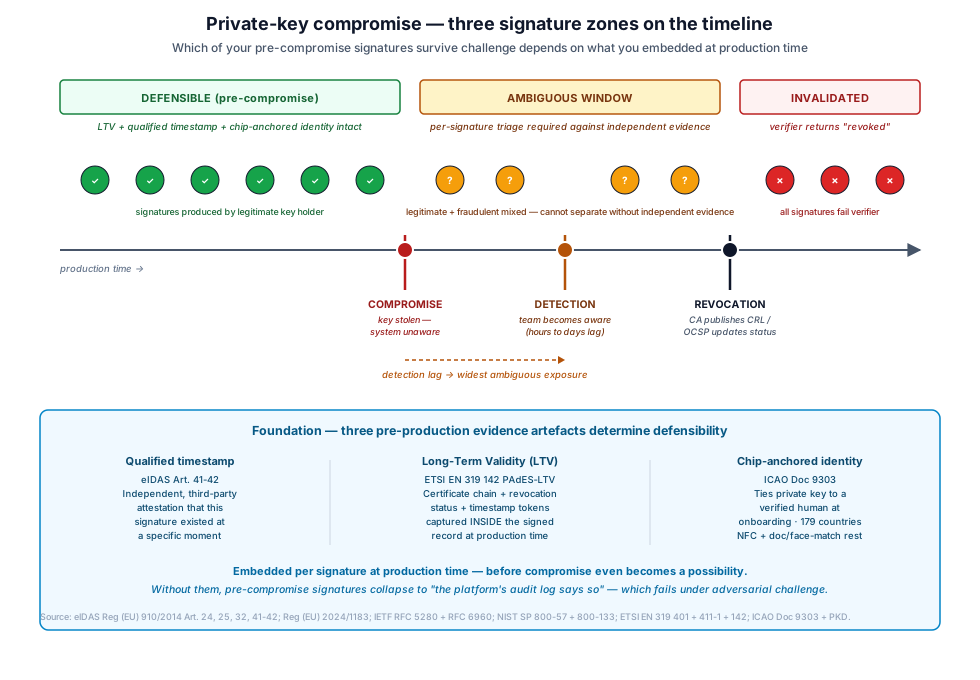
That detection lag is the load-bearing variable in every private-key-compromise scenario I have watched play out. The forgery capability starts at compromise; the invalidation capability starts at detection. Every signature produced in between falls into an ambiguous zone that the incident-response team has to reconstruct after the fact — usually with less evidence than they need. Certificate revocation, once fired, is retroactive-effective only from the revocation timestamp forward under standard X.509 revocation semantics; everything produced during the detection-lag window has to be triaged individually.
Where I most often see incident-response plans fall short: they treat key-compromise as "revoke the certificate and move on" without a corresponding pre-invested evidence architecture that can defend legitimate signatures produced during the lag window. Once revocation fires, every signature in that window is presumed compromised unless independently proved otherwise — and if the platform did not embed Long-Term Validity + qualified timestamps + strong identity proofing at the moment of signing, that independent proof does not exist to be produced.
How does revocation actually work, and what does it invalidate?
Two standard mechanisms handle revocation propagation. Certificate Revocation List (CRL) under RFC 5280 publishes revoked certificate serial numbers on a periodic schedule — verifiers download the list and cross-check every certificate they see. Online Certificate Status Protocol (OCSP) under RFC 6960 lets a verifier query a live responder for a specific certificate's status at verification time. Both are supported under eIDAS Article 24(2)(f) obligations for trust service providers, and both are required for Qualified certificates.
The revocation event carries a specific timestamp: the moment the certificate authority marks the certificate revoked. Every signature verification the platform performs after that point returns "revoked" — regardless of when the signature was originally produced. This is where the two-timestamps distinction matters most: a signature carries its own production timestamp (when the signature happened) and the verifier separately checks the revocation timestamp (when the certificate was marked revoked). If the production timestamp is verifiable and predates the revocation timestamp, the signature remains valid under Article 32 verification semantics. If the production timestamp is unverifiable or contested, the signature fails.
The two revocation-model traps I have watched trip incident-response teams: first, propagation lag — CRLs are typically published on 24-hour or longer cycles, so a verifier using cached CRL data may accept a revoked certificate for hours after revocation, opening a second forgery window that is often overlooked in the incident brief. OCSP fixes this but adds availability dependency on the CA's OCSP responder. Second, backdating the revocation timestamp is not permitted under standard PKI semantics — the CA marks revocation at the moment of the CA operation, not at the moment of compromise. So if compromise happened 48 hours before detection, no amount of subsequent CA activity can retroactively revoke signatures produced in that 48-hour window. Only independent evidence per signature can do that. The legal framework for what counts as "independent evidence" is walked in What Makes a Digital Signature Legally Valid?.
How do you prove signatures produced BEFORE compromise are still valid?
This is the question that determines whether a private-key compromise is a manageable incident or an existential business-continuity event.
Three evidence artefacts, embedded per signature at the moment of production, are what separates "defensible pre-compromise signature" from "presumed-compromised signature":
Qualified timestamp under eIDAS Article 41-42 from a QTSP — an independent, third-party attestation that this specific signature existed at a specific moment. If the timestamp predates the revocation timestamp, the signature's production time is not something the incident-response team has to argue for — it is a mathematically-verifiable claim from an entity that has no stake in the compromise.
Long-Term Validity (LTV) embedding in the AdES record under ETSI EN 319 142 (PAdES-LTV) or equivalent XAdES-LTV / CAdES-LTV profiles — the certificate chain, revocation status snapshot, and timestamp tokens are captured inside the signed record at production time. When a verifier checks the signature years later, all the trust-list evidence needed to validate it is right there in the record, not fetched from a live source that may or may not still be operating.
Chip-anchored identity proofing at the moment the key holder was originally onboarded — a passport-NFC + biometric face-match record that ties the private key to a verified human, produced under ICAO Doc 9303 verifiable against the ICAO Public Key Directory. Even if the private key is stolen, the audit walk-back can independently confirm which person controlled the key at the moment the compromised certificate was issued — the same walk-back pattern that defends against denial-of-signing challenges, walked in What Happens if Someone Denies They Signed Digitally?.
Together those three artefacts let the incident-response team, months or years after compromise, produce evidence that a specific signature was produced by the legitimate key holder at a specific moment before compromise, without depending on the compromised platform's own cooperation. Without them, the position collapses to "the platform's audit log says this signature was legitimate" — which is exactly the story-versus-evidence distinction that fails under adversarial challenge.
A UK legal-tech platform I reviewed an incident-response drill with last quarter had exactly this problem inverted: strong LTV embedding in every signature, but the identity-proofing at key-holder onboarding was a self-uploaded ID photo with no chip anchoring. When the drill posited a hypothetical private-key compromise, the drill team could defend when each pre-compromise signature had been produced — but could not defend who had produced it against a challenge from the audit committee that the key-holder's initial onboarding had been fraudulent to begin with. The evidence chain was strong at the production moment and weak at the anchor moment.
What should incident-response playbooks include for signature-key compromise?
Six items to build into any signature-service incident-response playbook. If the answer to any of them is "we'd figure it out during the incident," the playbook is not ready.
-
What is the detection surface? Anomaly-detection rules on signing volume, geographic distribution, off-hours activity, downstream-verifier reports. The narrower the detection lag, the smaller the ambiguous-signature window.
-
What is the revocation path, end-to-end? From compromise-declaration by the internal team → CA operation to publish revocation → OCSP + CRL propagation timeline → downstream verifier cache expiry. Every hour in that chain is signatures the platform cannot defend without independent evidence.
-
Is qualified timestamp embedded per signature? Under eIDAS Article 41-42, from a QTSP the platform does not control. If timestamps are internal-only or missing, pre-compromise defensibility is severely weakened.
-
Is LTV embedded per signature? Under ETSI EN 319 142 or equivalent — the trust-list snapshot captured at production time inside the signed record. Without it, verification years later depends on external sources that may be unavailable.
-
Is the key holder's initial identity proofing retrievable and independently verifiable? Chip-anchored ICAO 9303 proofing (179 countries) or document + biometric face-match for the rest, retained per data-protection policy. Weak proofing at onboarding propagates through to weak defensibility at incident-response time.
-
Does the incident-response plan cover the pre-compromise signature-triage step explicitly? The plan should specify exactly how the team will separate legitimate signatures from fraudulent ones in the ambiguous window — which evidence gets produced, in what order, to which counter-party. If this is left to figure out during the incident, the ambiguous window becomes a legal-defensibility hole.
My take on this: private-key compromise is a foreseeable event. HSMs get exploited, insider threats materialise, key-management pipelines have gaps. Treating compromise as unthinkable — and therefore not investing in the pre-production evidence architecture that survives it — is the mistake I have watched cost organisations orders of magnitude more at incident-response time than the upfront investment in LTV + qualified timestamps + chip-anchored proofing would have cost. The incident is going to happen eventually. The only question is whether the platform's pre-compromise signatures survive it defensibly.
Where IdentiGate fits — and why the compromise scenario looks different
Everything above assumes the standard PKI model: one private key, held by one party, at risk of being stolen. IdentiGate's signature platform uses a fundamentally different architectural choice for personnel signing: Dual Key. The private key is split between two custodians — the user's own credential and a server-side hardware security module (HSM) — and neither party can produce a signature alone. A theft of one half is not a viable compromise, because the other half lives under different custody and is required for every signature. That changes the incident-response burden of "private key stolen" from "reconstruct signature legitimacy across an ambiguous window" to "invalidate one custody half, re-provision it — the other half was never at risk." The same Dual Key vs single-key distinction between personnel signing (split) and device signing (hardware non-extractable) is walked in Identity of Things in Defence.
Dual Key does not eliminate the need for the three pre-production evidence artefacts — qualified timestamp + LTV + chip-anchored identity proofing are still what makes signatures defensible in dispute, whatever the key model. But it does reduce the probability that the standard-PKI compromise scenario walked in this post ever fires against a Dual Key deployment, because the single-point-of-failure that "private key gets stolen" implies is not the shape our architecture presents to an attacker in the first place.
Our signature platform produces AdES with qualified timestamp + Long-Term Validity embedded by default. Our evidence layer keeps the full audit chain independently verifiable at retention periods that survive both signature challenges and platform-side incidents. Our identity verification layer anchors every key holder to a chip-anchored ICAO 9303 proofing event that survives audit walk-back regardless of what happens to the signing infrastructure later.
If your incident-response playbook has a signature-key-compromise section and either the Dual Key alternative or the pre-production evidence architecture is the missing piece — or if you have run a red-team drill and want to compare the resulting ambiguous-window exposure against a Dual Key + chip-anchored + LTV baseline — get in touch.
More in this cluster
- What's the Difference Between Hash and Digital Signature?
- Post-Quantum eIDAS Signatures: 7 Questions for Your TSP
- Do Digital Signatures Require Proof of Identity?
- What Encryption Does a Digital Signature Use?
- What's the Difference Between a Digital Signature and an Electronic Signature?
- Mobile Digital Signing: How Safe Is It Really?
- Can You Sign Multiple Documents with One Digital Signature?
Sources
Legal + regulatory frameworks
PKI + revocation standards
- IETF RFC 5280 (X.509 PKI Certificate Profile + CRL)
- IETF RFC 6960 (OCSP)
- NIST SP 800-57 Part 1 (Key Management Recommendations)
- NIST SP 800-133 (Recommendation for Cryptographic Key Generation)
Trust service + LTV standards
- ETSI EN 319 401 (TSP General Requirements)
- ETSI EN 319 411-1 (TSP Certificate Policies)
- ETSI EN 319 142 (PAdES — long-term validity)
- ETSI EN 319 132 (XAdES)
Identity standards
About the author
Gustav Poola is a co-founder of IdentiGate, a European identity-verification and digital-signature company building on top of chip-anchored identity-proofing (ICAO 9303 passport NFC), Advanced Electronic Signatures (eIDAS Article 26), Advanced Electronic Seals, and hardware-anchored Identity of Things. He works on the architecture side — deployment patterns for cross-border defence, logistics, healthcare, fintech, and cybersecurity teams — and writes about the intersection of cryptographic primitives, standards, and the practical decisions engineering and incident-response teams have to make together.