How Much Does a Digital Signature Cost?
The unit price on a signature quote is almost never the interesting number. What actually drives cost is signature class (SES / AdES / QES), the identity-verification architecture the platform runs, and the volume bracket the quote sits in. This post is a procurement-side walk-through of what determines the price behind the headline, why cross-border international signatures cost more than domestic ones, and the six questions to put to any vendor quote before you sign.
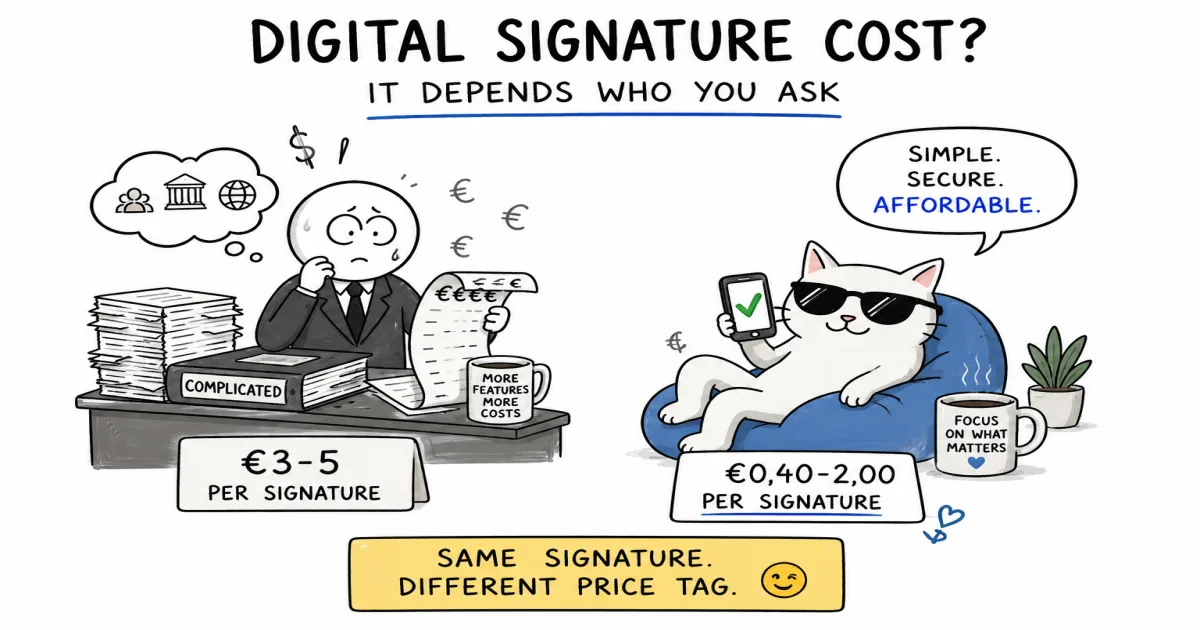
The unit price on a signature quote is almost never the interesting number. What actually drives cost is signature class (SES / AdES / QES), the identity-verification architecture the platform runs, and the volume bracket the quote sits in. Two vendors' quotes for what looks like the same package can differ by an order of magnitude — because the price is compressing different amounts of hidden work into a single number.
Buying a digital signature service should be a straightforward procurement decision. In practice, it rarely is. A Malta-licensed iGaming operator's CFO put this to us at a recent conversation: they were paying meaningfully more per verified onboarding than a competitor was quoting for what looked like the same package. In my experience that gap almost always comes down to what is bundled into the quote, not what is charged for it. This short guide is for anyone looking at a signature-platform quote and wondering whether the number is reasonable, high, or hiding something.
What determines a digital signature price?
Three factors drive almost all the variance you will see between vendor quotes.
Signature class. Under eIDAS Regulation (EU) 910/2014 there are three legal classes: Simple, Advanced, and Qualified. Simple is a click or a typed name — nominally free. Advanced adds cryptographic binding to a verified identity — this is the tier most enterprise contracts settle on. Qualified is the top legal tier, but it requires the platform to operate as a Qualified Trust Service Provider — which carries a substantial fixed annual overhead in licensing, audits, insurance, and supervisory oversight. That fixed overhead must be recouped across every QES signature the platform produces, which is why QES pricing runs meaningfully higher than equivalent AdES at anything short of very high volume.
The practical consequence: AdES is essentially the same cryptographic construction as QES — the same hash, the same key, the same certificate binding, the same evidence — minus the QTSP overhead. That is why AdES is cost-effective at small and mid volumes, while QES only becomes cost-effective at very high signature volumes.
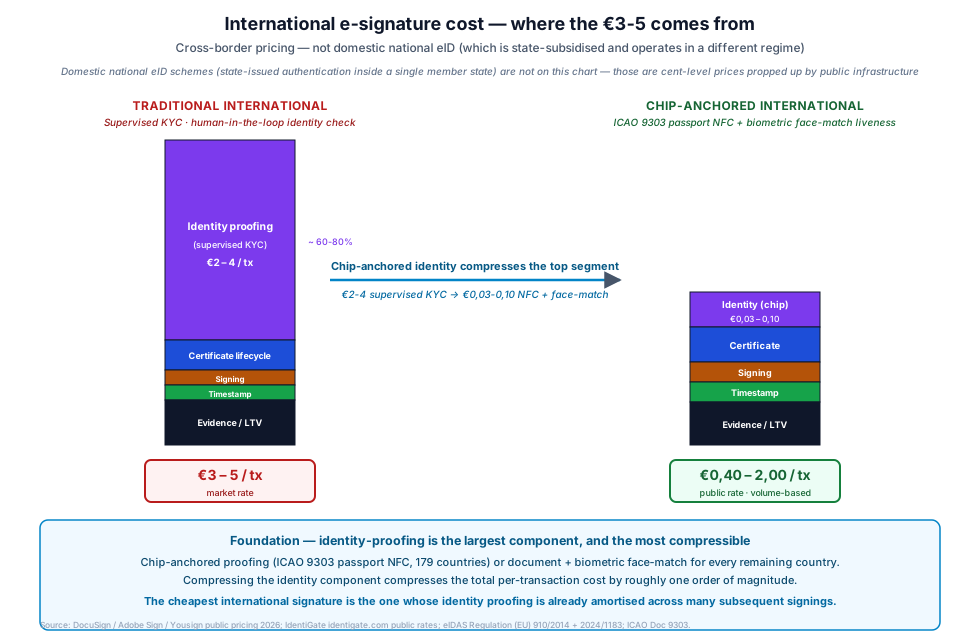
Identity verification. Verifying who is signing is the largest single cost component in almost every signature transaction. A supervised remote KYC session (human reviewer, video call) sits at the expensive end. An automated document check with a selfie is less. A passport-chip read with a biometric face-match is the most efficient at scale and works across 179 ICAO 9303 countries plus document + face-match for the rest. Different vendors architect this layer differently — and that architecture choice is what most often explains order-of-magnitude gaps between otherwise-similar quotes.
Transaction volume. Every vendor prices in volume brackets. Low volumes (a few hundred to a few thousand signatures per month) sit at the high end of the vendor's published range; high volumes (hundreds of thousands per month) sit at the low end. The spread between low-volume and enterprise-volume rates on the same platform is typically several-fold — so one vendor's low-volume quote can look expensive against another's enterprise-volume quote when the two are not on comparable brackets.
The way I typically frame this for a founder or finance lead: the tier tells you the ceiling and the floor, but the identity primitive and the volume commitment are the levers that actually move your bill by an order of magnitude. The legal implications of each tier are walked separately in What Makes a Digital Signature Legally Valid?.
What do published vendor tariffs actually show?
Public vendor pricing sits in a few clean tiers, and understanding the tier structure is more useful than any single number.
Consumer and single-user tiers. The major published e-signature vendors list Personal or Standard plans in the roughly single-digit to low-double-digit US dollars per user per month range — see DocuSign's public pricing page, Adobe Acrobat Sign's business plans, and European vendors like Yousign's published rates for comparable EUR-denominated tiers. These plans bundle a monthly envelope allotment (usually a few dozen signatures) and target individual professionals or micro-teams. On a per-signature basis these plans work out expensive — the fixed monthly floor divided by low volume — but the sticker price is low.
SMB and mid-market tiers (Business Pro, Standard, or equivalent, depending on vendor): published rates typically land in the low-double-digit to mid-double-digit US dollars per user per month range, with envelope allowances scaling up meaningfully. At these tiers with typical usage, effective per-envelope cost falls into a low single-digit dollar range. This is where most published e-signature volume actually sits.
Enterprise and high-volume tiers: essentially never published. Every major vendor's pricing page ends at "contact sales" once you cross the mid-market ceiling. The actual rate is negotiated per-account and driven by signature volume, identity-verification depth, integration surface, and geographic footprint. Cross-border international signing sits in this layer because the underlying identity-verification cost scales past what the mid-market tier assumes.
QES (Qualified Electronic Signature) providers publish differently. Qualified Trust Service Providers such as DigiCert, GlobalSign, and Certum publish qualified-certificate tariffs per certificate per year, or per signing device, plus a per-signature service fee. This is the layer where the "why is QES more expensive than AdES" question actually gets its answer — a qualified certificate is a directly published line-item cost on the QTSP's price list, and it applies regardless of whether the customer signs one document or ten thousand under it.
The overall shape: the market has a low-friction consumer and SMB layer (published, per-user, tiered), a mid-market layer (published, per-user, higher tier), and an enterprise layer (unpublished, custom-quoted). If your usage sits in the enterprise band — high volume, cross-border, mixed AdES and QES — the headline numbers on the published tiers of the smaller plans are not a useful reference class, and asking the vendor for a rate calibrated to your actual profile is the only way to get a comparable quote.
Why do cross-border international signatures cost more than domestic ones?
The short answer: because identity has to be established beyond a single national trust framework, and the traditional way of doing that is expensive.
A cross-border international signature is one where the signer might be from anywhere in the world — a Filipino contractor onboarded by a Warsaw carrier, a Bangladeshi seafarer signing on behalf of a Rotterdam terminal operator, a Turkish supplier signing a Frankfurt procurement contract. Identity for these signers cannot ride on a single member-state eID because none exists that binds them. The traditional vendor answer is supervised remote KYC — a human reviewer, a video call, sometimes a live document inspection — which lands most of the per-signature cost on that verification step. Vendors that publish rates aimed at lower-volume domestic plans are pricing a narrower use case, not a comparable cross-border service, and those two categories should not be compared to each other on unit price.
A Rotterdam-based freight platform I have worked with spent months trying to reconcile why their per-eCMR-signature cost was landing at the high end of the international band — only to discover that the underlying vendor was running supervised remote KYC on every single driver at the point of signing, a cost the vendor had bundled invisibly into the per-signature quote. That is the shape of the invisible-work problem: the unit price looked reasonable in isolation, but the identity architecture underneath was doing expensive supervised work on every transaction.
The way I usually explain this to procurement teams: chip-anchored proofing is not a cheaper way of doing the same thing, it is a different architectural choice that removes the supervised-KYC line from every signature the platform produces. Chip-anchored identity (passport-NFC + biometric face-match, covering 179 ICAO 9303 countries with document + face-match for the rest) compresses the identity-verification cost that dominates traditional international pricing — and that compression is what enables meaningfully lower per-signature rates without sacrificing evidence quality.
Domestic national eID schemes (state-issued authentication used inside a single member state) operate in a fundamentally different regime — propped up by public infrastructure — and should not be compared to any of the cross-border pricing dynamics above.
What should you check in a vendor quote?
Six questions to put to any signature-platform quote before you sign. The vendor's answers will usually tell you more than the headline unit price does.
-
What signature class does this quote produce? SES, AdES, or QES — under eIDAS Article 3(10), 3(11), 3(12). If the answer is "AdES-strength" without further breakdown, ask for the specific ETSI format (PAdES, XAdES, CAdES).
-
What identity verification is used? Supervised KYC, document + liveness selfie, or chip-anchored passport-NFC + face-match. The answer determines the largest single cost line and the evidential weight of every signature the platform produces.
-
Which countries can you actually verify signers from? EU-only, EU + specific third countries, or globally (179 ICAO 9303 countries + face-match for the rest). If your customer base includes non-EU signers, this is often the make-or-break question.
-
Is Long-Term Validity (LTV) embedded in every signature? Under ETSI EN 319 142 (PAdES) or equivalent. LTV is what keeps a signature verifiable years later at dispute. Quotes that don't include it are hiding a liability that surfaces later — walked in What Happens if Someone Denies They Signed Digitally?.
-
Is a qualified timestamp included, or extra? eIDAS Articles 41-42 qualified timestamps come from a QTSP and typically cost extra per token. If the vendor bundles them in the headline price, that is a stronger quote.
-
What is the volume bracket, and what happens outside it? Every quote has one; make sure yours matches your expected monthly volume, and ask what the rate is at the next bracket up and down.
A quote that answers all six of these cleanly is usually a quote you can compare. A quote that answers only three or four is one where the components are hidden and the headline price is misleading. That is the difference between comparing labels and comparing substance.
My take on this: a vendor unwilling to break these six components out is almost always hiding one of them — typically LTV, or the identity-verification architecture. Both surface later, as either audit findings or unexpected component charges.
Where IdentiGate fits
IdentiGate produces Advanced Electronic Signatures at volume-tiered pricing calibrated to the signer profile (chip-anchored ICAO 9303 read where available, document + face-match otherwise) and the expected monthly volume. Our signature platform and evidence layer include Long-Term Validity, qualified timestamp, and chip-anchored identity proofing by default — those are the components most likely to be bundled invisibly (or missing entirely) in comparable quotes from other vendors. Partner-tier reductions are available for early-adopter deployments that commit to volume.
We do not currently offer QES — that is on the roadmap for late 2027 once our own QTSP certification completes. In the meantime, for the small subset of document classes that legally require QES in specific jurisdictions, we integrate with a QTSP partner.
If you have a signature quote in hand and want a walk-through of what its components should look like against the framework above, get in touch — we will send back a specific rate calibrated to your signer geography, volume bracket, and evidence-retention requirements.
More in this cluster
- AdES vs QES: Which eSignature Level Does Logistics Need?
- EU Defence Tenders 2026: Do EDIP and EDF Need QES?
- How Long Do Digital Signatures Remain Valid?
- How Do I Verify Someone's Digital Signature Is Authentic?
- Do Digital Signatures Require Proof of Identity?
- Digital Signature Laws by Country: What's Legal Where?
- What's the Difference Between a Digital Signature and an Electronic Signature?
- Are Digital Signatures Accepted in Court?
Sources
Legal frameworks
- eIDAS Regulation (EU) 910/2014 — Articles 3(10), 3(11), 3(12), 24, 25, 26
- Regulation (EU) 2024/1183 (eIDAS 2.0)
Trust service infrastructure
- ETSI EN 319 401 (TSP General Requirements)
- ETSI EN 319 142 (PAdES — long-term validity)
- EU Trusted List (QTSP registry)
Identity standards
About the author
Mairi Kutberg is a co-founder of IdentiGate, a European identity-verification and digital-signature company building on top of chip-anchored identity-proofing (ICAO 9303 passport NFC), Advanced Electronic Signatures (eIDAS Article 26), and Advanced Electronic Seals. She works with logistics, healthcare, fintech, HR-tech, iGaming, defence, and cybersecurity teams where per-verification cost and evidence-retention obligations are the load-bearing constraints on procurement decisions.