Which Countries Accept eCMR? The Complete 2026 List
42 countries have acceded to the eCMR Additional Protocol on the UN Treaty Collection depositary as of August 2026 — up from 38 at the start of the year, with Albania, North Macedonia, Montenegro, and Serbia acceding during 2026. Secondary trackers (IRU, TransFollow) sometimes report a slightly higher count because they include pilot regimes such as Belgium's Benelux e-CMR arrangement even though formal ratification has not landed. Here's the full list, what each source counts, and what it means for your cross-border freight. Last updated: 22 August 2026.
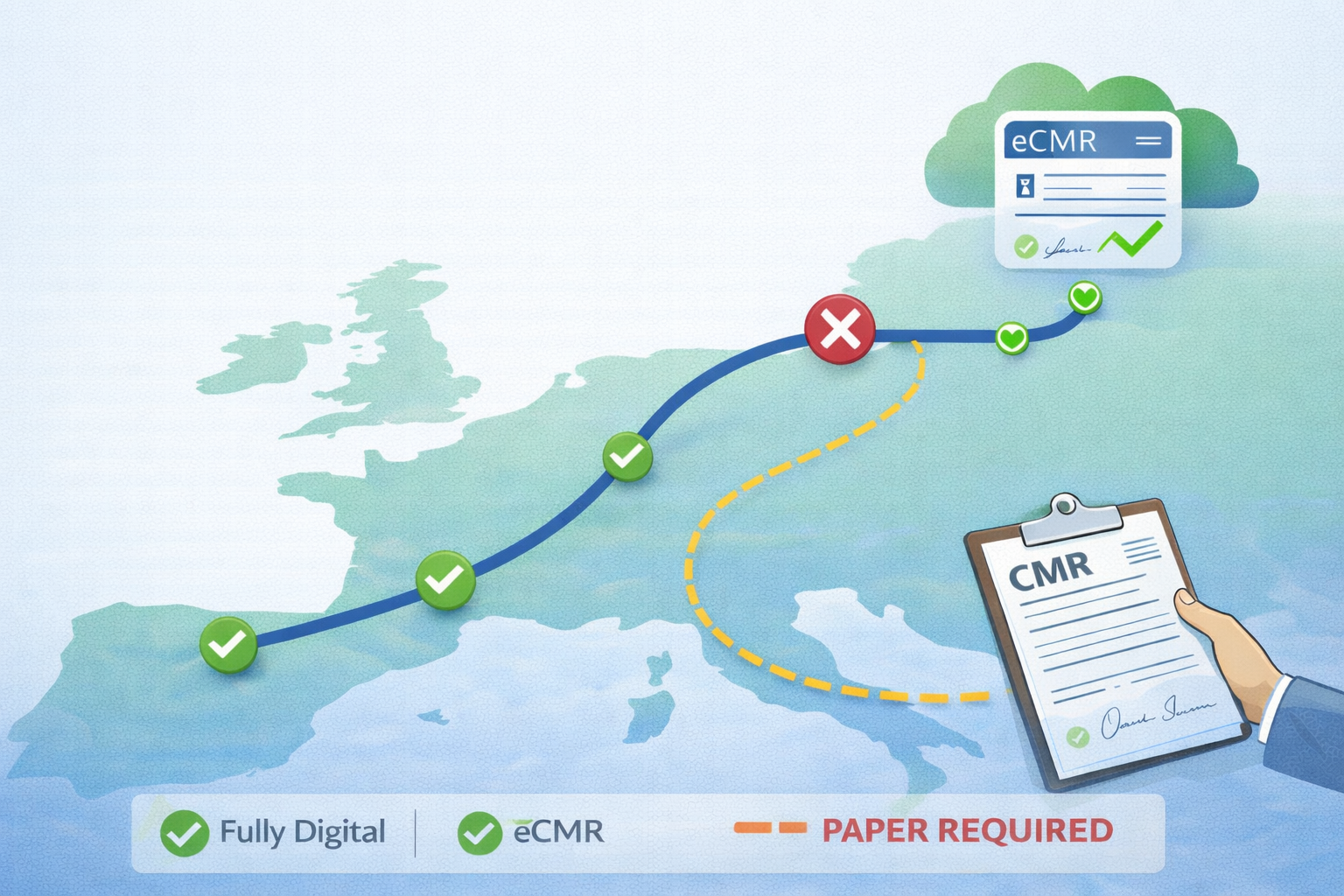
If you are planning a cross-border shipment and want to use eCMR instead of paper, the first question is simple: do both countries accept it? If either the origin or the destination has not ratified the eCMR protocol, you will still need a paper CMR in the cab.
This article provides the complete, current list of countries that have ratified the eCMR protocol — organised by region, with ratification dates and practical notes for freight operators.
The Full List: 42 Countries Have Ratified eCMR
Last verified against the UN Treaty Collection depositary on 22 August 2026.
As of August 2026, 42 countries have formally acceded to the eCMR Additional Protocol on the authoritative UN Treaty Collection depositary record — out of 58 total CMR contracting parties. Four accessions landed during 2026 alone: Albania (7 Apr 2026), North Macedonia (27 Apr 2026), Montenegro (6 Jul 2026), and Serbia (4 Aug 2026). The protocol was adopted in Geneva in 2008 and entered into force on 5 June 2011.
Depending on which secondary source you consult, the country count may look slightly different. IRU has reported 43 in August 2026 (adding Belgium as a de facto participant on the Benelux pilot); TransFollow reported 41 in May 2026 (before the summer accessions landed); ratifications trackers on national trade-body pages can lag by weeks. None of these are wrong per se — they are counting different things. For a corridor decision that hinges on whether a country is bound by the Additional Protocol under international law, the UN Treaty Collection depositary record is the definitive source; for operational feasibility questions (can we run electronic freight documents on this route today?), the pilot-inclusive counts capture arrangements the depositary does not.
EU Member States That Have Ratified (22 of 27)
Austria (August 2024), Bulgaria, Czech Republic, Denmark, Estonia, Finland, France, Germany (January 2022), Greece (October 2023), Hungary (August 2024), Italy (July 2024), Latvia, Lithuania, Luxembourg, Netherlands, Poland, Portugal, Romania, Slovakia, Slovenia, Spain, and Sweden.
Sources: UNECE ratification records, UNECE press release on CMR Convention.
EU Member States Not Yet Ratified (5 of 27)
Belgium, Croatia, Cyprus, Ireland, and Malta have not yet ratified the eCMR protocol as of early 2026. Under the eFTI Regulation, all EU member states must accept digital freight transport information from July 2027, which is expected to drive ratification of the remaining five.
Belgium is a notable case — despite not formally ratifying, the Benelux countries launched a pilot in 2018 allowing electronic documents for border-crossing operations between Belgium, France, and Luxembourg. Belgium is actively working towards formal ratification.
Non-EU European Countries
Albania (April 2026), Armenia (October 2024), Belarus, Montenegro (July 2026), North Macedonia (April 2026), Norway, Russia, Serbia (August 2026), Switzerland, Turkey, Ukraine, and the United Kingdom.
Turkey and Ukraine are particularly significant for European logistics — both are major freight corridors into and out of the EU. The UK ratified eCMR before Brexit and continues to recognise it. The four Western Balkans additions during 2026 — Albania, North Macedonia, Montenegro, and Serbia — close a long-standing gap on the corridor from Central Europe to Greece and Türkiye.
Central Asia and Middle East
Azerbaijan, Iran, Kyrgyzstan, Moldova, Oman, Tajikistan, Turkmenistan, and Uzbekistan.
Several of these countries are relevant for the growing EU–Central Asia trade corridor and the Middle Corridor route.
Note on the count: the authoritative UN Treaty Collection depositary lists 42 parties bound by the eCMR Additional Protocol as of the last update (22 August 2026), enumerated above. Other sources may report 41 (older snapshots pre-dating summer 2026 accessions), 43 (IRU, which includes Belgium as a de facto participant via the 2018 Benelux pilot even though formal ratification is still pending), or higher counts that fold in additional pilot arrangements. All are internally consistent if you know what each source is counting. For a corridor decision that hinges on whether a country is a party under international law, use the UN Treaty Collection record as the primary source and treat secondary counts as operational-feasibility signals rather than legal-status statements.
Countries With CMR But Without eCMR
Approximately 19 countries have ratified the original CMR Convention but not the eCMR Additional Protocol. These include countries like Georgia, Kazakhstan, Serbia, Montenegro, and several others. In these countries, paper CMR remains mandatory.
For the most current and authoritative list, check the UNECE Treaty Database under the CMR Additional Protocol.
What "Ratified" Actually Means in Practice
Ratification means that a country recognises the electronic consignment note as legally equivalent to the paper CMR. It does not necessarily mean that every police officer or customs agent is equipped to process digital documents during a roadside inspection.
As trans.info reported, accession alone does not guarantee that enforcement can process digital documents in daily operations. In countries that ratified recently, the infrastructure for roadside digital inspections is still being built.
The practical advice from industry associations: even when operating within ratified countries, carry the capability to show eCMR data on a mobile device and — during the transition period — keep a paper backup available for corridors where digital readiness is uncertain.
The Cross-Border Rule: One Missing Country Breaks the Chain
The eCMR protocol has a critical operational rule: if a shipment crosses a country that has not ratified, a paper CMR must be present in the vehicle for that transit leg.
A route from Spain to Poland via France and Germany works fully digital — all four have ratified. But a route from Germany to Greece via Serbia requires paper for the Serbian leg, since Serbia has not ratified (though it has participated in pilot programmes since 2008).
For route planners, the ratification status of every country on a route matters, not just origin and destination. One gap forces the shipment back to paper — or at minimum, a hybrid approach.
The EU Endgame: eFTI and Mandatory Digital Acceptance by 2027
The eFTI Regulation changes the equation. From July 2027, all 27 EU member state authorities must accept freight transport information submitted electronically through certified eFTI platforms. This effectively forces the remaining five non-ratifying EU countries to either ratify or implement equivalent digital acceptance.
The industry expects 2026 to be the year of large-scale adoption, with CargoON's research suggesting full industry adaptation by 2029.
Spain is ahead of the curve — its Sustainable Mobility Law targets mandatory digital transport documents by October 2026, ahead of the EU-wide deadline.
In parallel, UNECE is updating the technical standard itself. In March 2026, UN/CEFACT launched a project to update the eCMR standard, aligning it with the eFTI data model and incorporating lessons from implementation over the past years. This will create a harmonised technical foundation for eCMR systems globally.
Beyond Ratification: The Identity Gap at the Border
There is a question the ratification map does not answer: even when a country accepts eCMR, can every party actually sign it digitally?
eCMR requires an electronic signature that verifies the signer's identity and ensures document integrity. For drivers within the EU, national eID systems and the upcoming EUDI wallet provide a path. But for drivers from non-EU countries that have ratified eCMR — Turkey, Ukraine, Moldova, Central Asian states — there is no European digital identity infrastructure available.
This creates a paradox: the eCMR protocol is ratified, the legal framework accepts digital documents, but the driver at the loading dock cannot produce a verifiable digital identity to sign.
We explore this gap in detail in our article on the EUDI wallet's limitations and in our complete guide to digital identity in European freight.
At IdentiGate, we bridge this gap by creating digital identities from biometric passports issued by more than 170 countries — far beyond the 39 that have ratified eCMR. A Turkish driver, a Ukrainian carrier, an Uzbek freight operator — all can obtain a verified digital identity and sign eCMR documents with an Advanced Electronic Signature, regardless of their country's digital infrastructure.
Quick Reference: Can I Use eCMR on This Route?
Germany → Netherlands → Belgium → France: Yes — all ratified (Belgium via Benelux pilot framework).
Spain → France → Germany → Poland: Yes — all ratified.
Germany → Austria → Hungary → Romania: Yes — all ratified (Austria and Hungary as of 2024).
Turkey → Bulgaria → Romania → Germany: Yes — all ratified. Note: Turkish drivers need a digital identity solution for signing.
Germany → Czech Republic → Serbia → Greece: Partial — Serbia has not ratified. Paper CMR needed for the Serbian leg.
UK → France → Germany: Yes — all ratified. UK continues to recognise eCMR post-Brexit.
Germany → Croatia → Slovenia: Partial — Croatia has not ratified yet. Expected by end of 2026.
How to Check Ratification Status
For the most current information, use these authoritative sources:
IRU CMR page — current count of CMR and eCMR contracting parties.
UNECE Treaty Database — official UN source for ratification status with exact dates.
UNECE Latest Ratifications — tracks the most recent accessions.
This article will be updated as new countries ratify the protocol. Last verified: March 2026.
Further reading:
- What Is eCMR? A Plain-Language Guide
- Paper CMR vs eCMR: The Real Cost of Not Going Digital
- The EUDI Wallet Covers 27 Countries. What About the Other 152?
- Digital Identity in European Freight: The Complete Guide
IdentiGate provides digital identity for eCMR signing across more than 170 countries — including non-EU countries where drivers lack European eID access. Learn more at identigate.com
More in this cluster
- Is Sign-on-Glass a Valid eCMR Signature? Barely.
- eFTI 2027 Compliance Checklist: 10 Steps for Freight Ops
- eFTI Article 5: Identity Verification for Freight Platforms
- How to Verify Non-EU Driver Identity for eCMR Signing
Sources
- UN Treaty Collection — eCMR Additional Protocol depositary — authoritative party count and per-country deposit dates (42 of 58 as of 22 August 2026).
- IRU — CMR and eCMR contracting parties — secondary tracker; use for context but check the UN depositary for the authoritative up-to-date figure.
- UN Treaty Collection — depositary records — authoritative deposit dates for the Additional Protocol to the CMR (New York, 20 February 2008; in force 5 June 2011).
- UNECE Treaty Database — UNECE transport agreements status.
- UNECE Latest Ratifications — recent accessions including Armenia, Austria, Hungary and Italy (2024).
- UNECE press release — CMR Convention at 70 — context on the digitalisation push.
- UN/CEFACT 2026 highlights — March 2026 project to update the eCMR standard aligned with the eFTI data model.
- Benelux eCMR pilot extended to July 2027 — Belgium's interim arrangement pending ratification.
- trans.info — eCMR in 2026 — enforcement readiness context.
- CargoON — eCMR digital future of transport documentation — industry adoption projections.
About the author
Gustav Poola is co-founder of IdentiGate. He focuses on the technical architecture of passport-chip identity verification, advanced electronic signature production under eIDAS, and the engineering of identity flows that survive regulator and auditor walk-back.