Why Electronic Bill of Lading Adoption Is Stuck at 11%
Why eBL adoption is stuck at 11% despite DCSA-ready carriers and interoperable platforms — the identity layer nobody is building. The data, the causes, and what actually unblocks it for shippers and consignees moving to 2030 mandates.
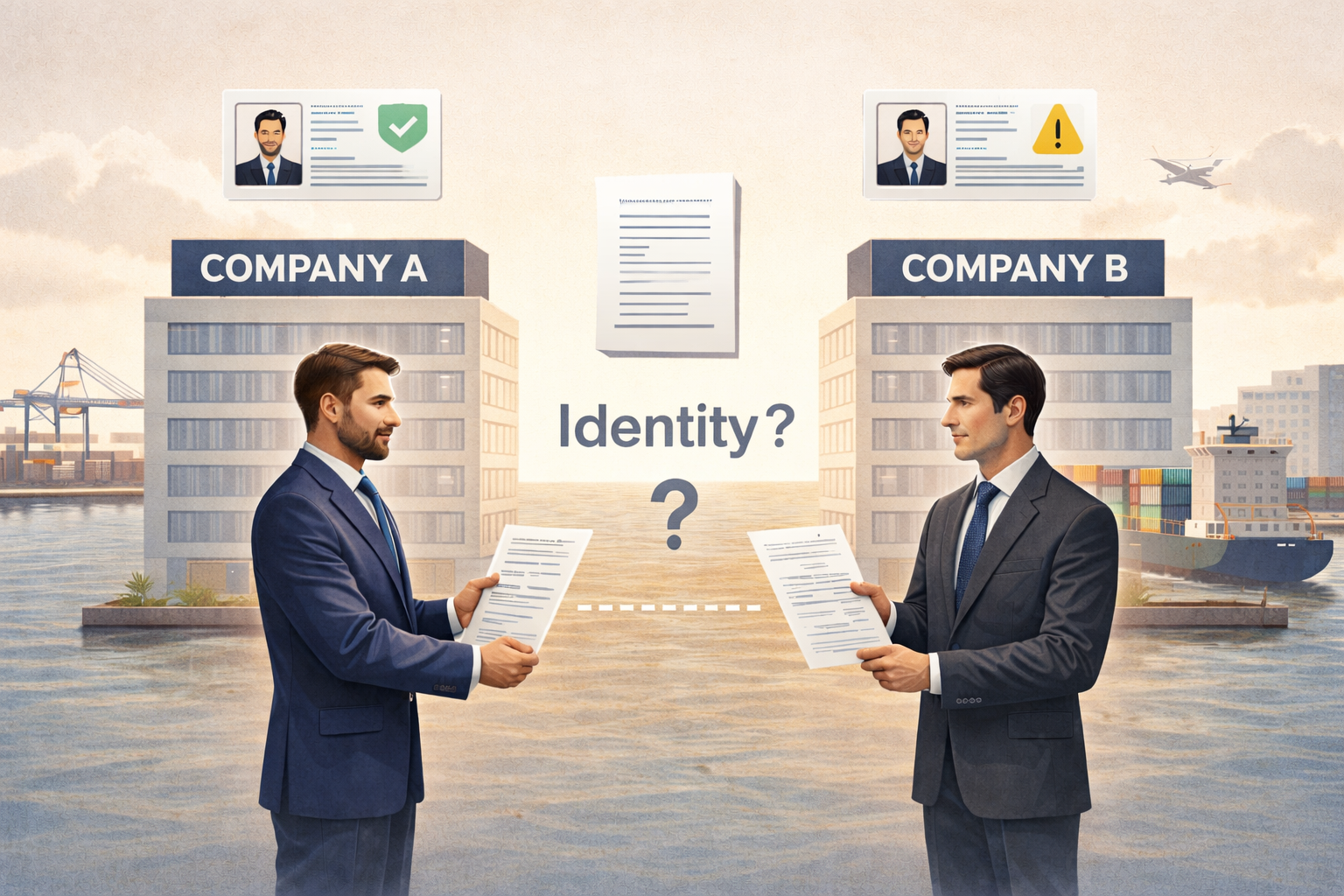
Electronic bill of lading adoption crossed 11% in 2025 (DCSA, 2025). The plumbing works — nine DCSA carriers committed to full eBL by 2030, platforms are interoperable, the UK, Singapore, France, and Bahrain have the legal framework. The missing layer is identity of the parties — shippers, carriers, banks — across jurisdictions that do not share each other's eID.
For thirty years, the bill of lading has been the single most important document in international trade. It is simultaneously a receipt for cargo, a contract of carriage, and a transferable document of title that banks accept as security for trade finance. Four billion paper bills of lading are in circulation at any one time across the $25 trillion global cargo trade (Bloomberg, October 2023). Digitising that flow would reduce friction by days and cost by tens of billions. Yet after a decade of platforms, a UN model law, and a technically ready carrier consortium, the shipping industry has moved only a tenth of the way.
The Technology Question Is Solved
The common story about eBL adoption is that "the technology is not ready yet." As of April 2026, that story is out of date.
On 12 January 2026, a live cross-platform eBL transaction was completed involving COSCO's subsidiary New Golden Sea Shipping, Lenzing Thailand, HSBC Thailand, China Zheshang Bank, and Jiangsu Dasheng Group. The eBL moved between two different platforms — issuance, multiple transfers, bank presentation, and surrender — without breaking the chain of title (DCSA, January 2026). That was the number one technical objection banks had held against eBL: platform lock-in. Solved.
Since 1 January 2024, every IMO member state is required to operate a Maritime Single Window for electronic exchange of arrival, stay, and departure data (IMO FAL Convention amendments). The Facilitation Committee's 50th session in April 2026 approved further cybersecurity amendments, entering force 1 January 2029.
Carrier readiness is also there. DCSA reports that six of its nine committed member carriers completed their eBL implementations by end of 2025, with the remainder on track to be technically ready in 2026. A 2030 milestone of full standardised adoption is publicly committed (DCSA, 2023 announcement).
The document-transfer layer is effectively solved. Adoption should follow. It has not.
The Identity Layer Was Never Mandated
The two major legal frameworks that make eBL legally equivalent to paper — the UNCITRAL Model Law on Electronic Transferable Records (MLETR) and the UK Electronic Trade Documents Act 2023 — both require the system to provide reliable identification, authentication, and integrity. Neither specifies a cryptographic signature level.
The UK Act, which came into force on 20 September 2023, asks for "exclusive control," "authenticity," and "integrity" of the electronic document — and explicitly leaves the question of whether a "qualified" electronic signature is needed open to industry practice and future case law (Watson Farley & Williams analysis). In practice, platforms choose their own signature standards, and the buyer, seller, and financing bank must each trust each other's platform.
As of April 2026, MLETR has been adopted in eleven jurisdictions (UNCITRAL status tracker), notably:
- United Kingdom — Electronic Trade Documents Act 2023, in force 20 September 2023
- Singapore — Electronic Transactions Act amendment in force 19 March 2021 (one of the earliest MLETR-aligned adopters)
- Bahrain — first state to enact MLETR into domestic law
- France — Decree No. 2025-811, first EU member state to fully transpose MLETR
- Germany — regulation implementing core MLETR provisions drafted in 2023; remained unadopted as of mid-2025, expected 2025–2026
- Japan — Commercial Code amendment passed the Diet in June 2025 and takes effect within one year (by fiscal year 2026)
That is eleven jurisdictions out of roughly one hundred eighty that participate in international shipping. A Chinese shipper consigning goods to a Brazilian importer under a Turkish-flagged carrier cannot assume their three legal systems agree on what a valid eBL signature looks like.
The Cost of Unverified Identity: Billions a Year (and That Is Just What Banks Notice)
Fraud is the hidden tax on the identity gap. The ICC International Maritime Bureau routinely verifies bills of lading presented to banks, and its reporting consistently highlights that a large share of suspicious bills of lading are issued by NVOCCs — non-vessel-operating common carriers whose identity and operational status are notoriously difficult to verify from outside their home jurisdiction (ICC IMB). ICC and MonetaGo's 2022 whitepaper Shutting Fraudsters Out of Trade documents multi-billion-dollar annual losses from trade finance fraud exposed by commodity price shocks or external events, with duplicate financing alone accounting for a large share (ICC Commercial Crime Services; MonetaGo, 2022).
Suspect bills of lading contain false content — wrong vessel, wrong dates, wrong cargo description, wrong container numbers, wrong parties — presented to banks to commit fraud, money laundering, capital flight, or sanctions evasion. The thread running through every documented case is the same: at some point in the chain, one of the named parties was not who they claimed to be, and no one in the chain could verify it.
Digitising the document does not fix this. An eBL that transfers cleanly across platforms but whose named shipper cannot be cryptographically verified carries exactly the same fraud risk as a paper bill of lading — just faster.
Where Current eBL Requirements Sit on Identity
| Framework | Document integrity | Party identification | Signature level required |
|---|---|---|---|
| UK Electronic Trade Documents Act 2023 | Reliable system required | "Reliable" — not defined | Left to industry / future case law |
| France Decree 2025-811 (MLETR transposition) | Reliable system required | Reference to eIDAS national schemes | eIDAS levels recognised, not mandated |
| UNCITRAL MLETR (2017 model) | Reliable system required | Not specified | Not specified |
| IMO FAL Convention (MSW mandatory from Jan 2024) | Mandatory digital exchange | Not specified | Not specified |
| DCSA eBL standard | Cryptographic chain of title across platforms | Platform-dependent | Platform-dependent |
| EU eIDAS 2.0 (Regulation 2024/1183) | Applies only to signatures created within scope | Legal or natural person required | Simple / Advanced / Qualified defined |
The pattern is clear. Every framework that could have mandated a cryptographic identity standard chose not to. Each defers the question to "the system" or "industry practice." The result is a patchwork where different eBL platforms accept different identity proofs, each enterprise customer builds its own KYC process bilaterally, and fraud flourishes in the seams.
Why This Is the Same Problem as eCMR — Only Bigger
Readers of the IdentiGate blog will recognise the shape of this problem. In road freight, Commission Implementing Regulation (EU) 2025/2243 of 6 November 2025, Article 5(2)(a)(i), requires every electronic freight transport (eFTI) platform to identify, authenticate, and authorise every business user through an electronic identification scheme meeting at minimum the requirements of eIDAS Article 8(2) point (b) — from July 2027. That is a regulatory answer to exactly the same identity gap: documents are digital, but the people signing them are not reliably identified across borders.
Maritime shipping has not yet had its Article 5 moment. MLETR and ETDA give legal equivalence to paper. Neither mandates the identity layer. And whereas an eCMR is signed by one driver at a truck stop, an eBL moves between shippers, carriers, forwarders, banks, and consignees — typically a handful of parties across several jurisdictions per shipment. The identity surface is far larger. The fraud potential is commensurately higher.
The Non-EU Party Problem, Again
EUDI wallets, rolling out through 2026 and beyond, are available only to EU citizens. Every Chinese shipper, Indian consignee, Turkish carrier, Moroccan freight forwarder, and Nigerian bank that participates in EU-bound trade is outside the EUDI system. For eBL, this is almost every party, on almost every bill.
The IMO's upcoming Maritime Passport digital identity wallet — previewed at FAL 50 in April 2026 and expected to roll out from Q2 2026 — is designed for seafarers, not for the commercial parties on an eBL (Maritime Passport, 2026). It solves a different problem.
The practical identity infrastructure that works for every party on an eBL — shippers, consignees, carriers, banks, forwarders — in every jurisdiction — is a biometric-passport-based cryptographic identity that can be issued to any individual holding a passport from any of the more than 170 states that issue ICAO 9303 biometric passports, bound to a company representative by a scoped delegation, and producing signatures at eIDAS AdES level that any counterparty's platform can verify.
What Has to Change for eBL Adoption to Unstick
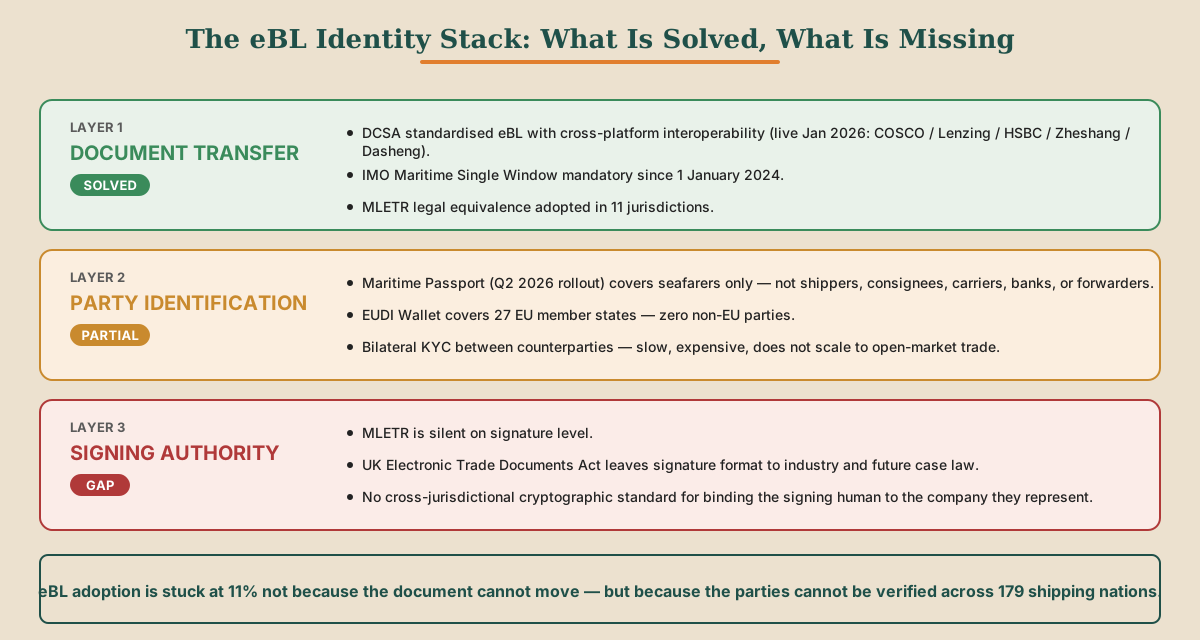
Three things have to stand up together.
-
A verified party layer. Every named party on the eBL must be verifiable by any counterparty, on any compliant platform, regardless of national eID. Biometric passport with NFC chip is the only identity document issued in more than 170 states and cryptographically verifiable without relying on a live government service.
-
A delegation layer. eBL transactions are signed by employees, not by companies. The signing employee's authority to bind the company must be cryptographically attested and revocable. This is the same pattern that applies to AI-agent signing — and for the same legal reason: only legal or natural persons can hold signing authority, and the chain from the agent (whether human or AI) back to the principal must be provable.
-
A signature layer at eIDAS AdES or better. Advanced electronic signatures that bind the delegation certificate and the document hash survive legal scrutiny in any MLETR jurisdiction and directly meet the requirements France has already adopted via Decree 2025-811.
Without these three, eBL adoption remains where it is — stuck in the high-trust, repeat-counterparty corner of the market, where the parties already know each other. Growing beyond 11% requires the identity question to be solved for parties who have never transacted before.
Frequently Asked Questions
What percentage of bills of lading are electronic as of 2026? According to DCSA, eBL adoption crossed 11% in 2025. DCSA's nine committed member carriers have pledged to reach full standardised adoption by 2030.
Does MLETR require digital identity verification? No. MLETR requires a "reliable system" providing document integrity, exclusive control, and authenticity — but does not specify an identity verification standard. Each platform and jurisdiction applies its own.
Is the UK Electronic Trade Documents Act 2023 enough to make eBL work internationally? Only between parties in jurisdictions that have adopted MLETR or equivalent. As of April 2026 that is eleven jurisdictions. For trade involving the other ~170 shipping nations, parties fall back on bilateral contractual arrangements.
How much does bill of lading fraud actually cost? The ICC and MonetaGo's 2022 whitepaper Shutting Fraudsters Out of Trade documents multi-billion-dollar annual losses in realised trade finance fraud exposed by commodity price shocks, with duplicate financing alone a large share. The full cost including unclaimed fraud is larger.
Will the IMO's Maritime Passport solve this? Partially. Maritime Passport is designed for seafarers and entering operational rollout from Q2 2026. It does not cover shippers, consignees, carriers, banks, or forwarders — which are the parties on an eBL.
What should we do now if we are preparing for eBL? Do not wait for the signature standard to be mandated. Build your eBL pilots on identity infrastructure that already satisfies the highest current level (eIDAS AdES), is available for non-EU parties, and binds every signature back to a verified human principal via cryptographic delegation.
The Bottom Line
The eBL industry has solved the hard technical problems and talks as if only "behavioural, cultural, and organisational" barriers remain. A closer read of the fraud data and the regulatory patchwork says otherwise: the cultural barrier is that nobody wants to be the first to accept counterparty risk from a platform whose identity layer is undefined. A well-specified cryptographic identity layer — shipper, carrier, bank, consignee, forwarder, every one of them verifiable against the same standard — is what moves eBL adoption from 11% to the DCSA's 2030 target. The technology is ready. The law is ready enough. Identity is the lock.
Sources
Regulation and standards
- UNCITRAL Model Law on Electronic Transferable Records (2017) — status tracker
- UK Electronic Trade Documents Act 2023
- France Decree No. 2025-811 — first EU MLETR transposition (FIATA overview)
- IMO Maritime Single Window — mandatory since 1 January 2024
- IMO FAL 50 (April 2026) — cybersecurity and digitalisation update
- Regulation (EU) 2024/1183 — eIDAS 2.0
Industry adoption
- DCSA — Electronic Bill of Lading standard
- DCSA — commitment to fully standardised eBL by 2030
- DCSA — 12 January 2026 cross-platform eBL milestone (COSCO / Lenzing / HSBC / Zheshang / Jiangsu Dasheng)
- DCSA — soft barriers to eBL adoption
- Maritime Passport — gold standard digital identity for seafarers, previewed at FAL 50
Fraud and risk
- ICC International Maritime Bureau (IMB)
- ICC Commercial Crime Services — trade finance fraud cost analysis (2022 report co-authored with MonetaGo)
- Bloomberg — $25 Trillion Global Cargo Trade Relies on 4 Billion Paper Bills (October 2023)
- Commission Implementing Regulation (EU) 2025/2243 of 6 November 2025 — eFTI platform identification requirements
Legal analysis
- Hill Dickinson — UK Electronic Trade Documents Act in force
- Watson Farley & Williams — Reliable systems under the Electronic Trade Documents Act
- APEC — Economic benefits of adopting MLETR (2025)
IdentiGate's cross-border digital identity infrastructure supports biometric passports from the more than 170 states that issue them under ICAO 9303, delivers eIDAS-grade Advanced Electronic Signatures, and produces the kind of verifier-independent signature chains that eBL platforms need for every party on a bill. Learn more at identigate.com.
About the author
Mairi Kutberg is co-founder of IdentiGate, where she runs operations and content. She works at the intersection of EU regulation (eIDAS, NIS2, AMLR, eFTI), cross-border digital identity, and the practical compliance angles of advanced electronic signatures.