Can You Use the Same Digital Identity Everywhere?
Yes, in three specific cases that work today — and one that still doesn't. A global digital identity works inside an EUDI Wallet across EU services, across a federation (OIDC, eduGAIN, eIDAS cross-border), and across multiple documents linked into one cryptographic anchor (Unified Digital Identity). It still does not work for unfederated non-EU platforms without a shared trust framework.
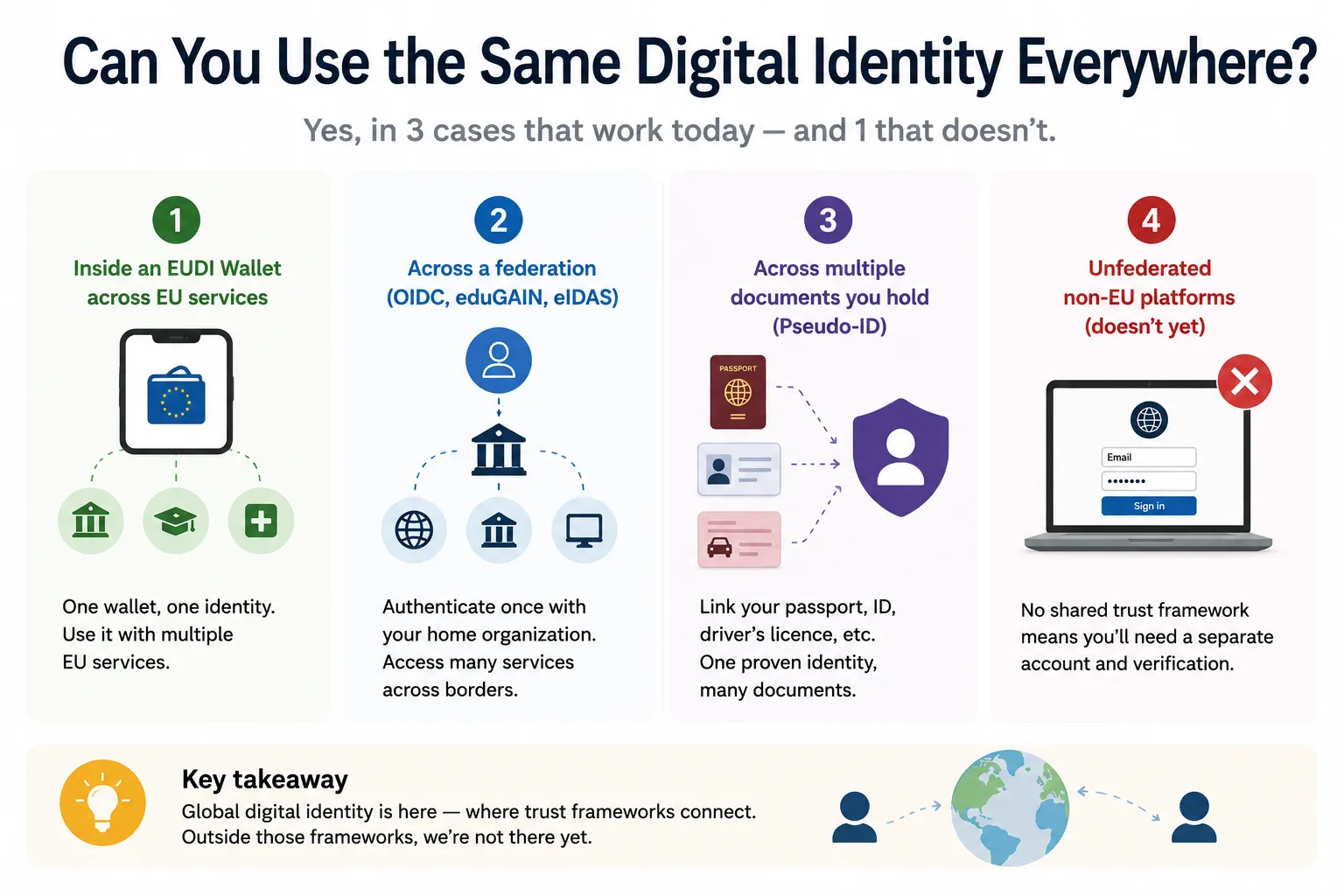
Yes, in three specific cases that work today — and one that still doesn't. A global digital identity works inside an EUDI Wallet across EU services, across a federation like OIDC or eduGAIN, and across multiple documents linked into one cryptographic anchor. It does not work for unfederated non-EU platforms without a shared trust framework.
In our work integrating passport-chip identity verification across EU and non-EU service stacks, the "one identity, every platform" question comes up roughly every other procurement call. A Tallinn-headquartered cross-border e-learning platform that we onboarded last quarter — serving students across the Baltic + Polish + Nordic corridor with a single account per learner — walked into the call assuming a single digital identity would handle everything from admissions to credential issuance to alumni KYC. A Hamburg-based mid-market logistics integrator we work with reached the same conclusion from the opposite direction, expecting passport-chip identity to cover their non-EU supplier onboarding the same way it covered their EU staff. The engineering answer is more layered than either expectation — partially yes, partially no — and the way I usually walk through it on those calls is by naming the three places it already works and the one place it still doesn't. The selective-disclosure plumbing that makes the wallet-mediated case work is the topic of our zero-knowledge proofs post; the holder-binding plumbing for the credential-portability case is in our EBSI holder binding post.
What does "global digital identity" actually mean in 2026?
It means an identifier and its proofs are portable across multiple service contexts without re-proofing the underlying identity at each one.
The cleanest definition sits in the W3C Decentralized Identifiers specification: a DID is "a new type of identifier that enables verifiable, decentralized digital identity… decoupled from centralized registries, identity providers, and certificate authorities" (W3C — Decentralized Identifiers (DIDs) v1.0, Recommendation since 19 July 2022). The 1.1 revision moved to Candidate Recommendation on 5 March 2026 (W3C — Decentralized Identifiers (DIDs) v1.1) with a public comment window through 5 April 2026 and consolidation around the application/did media type. The spec is stable enough that production integrations are landing against it, with the EUDI Wallet stack and the EBSI stack both using DIDs as the natural-person and legal-entity identifier respectively.
What the W3C definition leaves to each trust framework is the question of which verifiers will accept which DIDs — that's the global-digital-identity question in practice. A DID is portable as a string; whether the receiving service trusts it depends on whether the issuing trust framework reaches them. The places where that reach exists today are concrete. The places where it doesn't are equally concrete.
The three places it already works
The first answer to "can I use the same digital identity everywhere" in 2026 is: yes, here, here, and here.
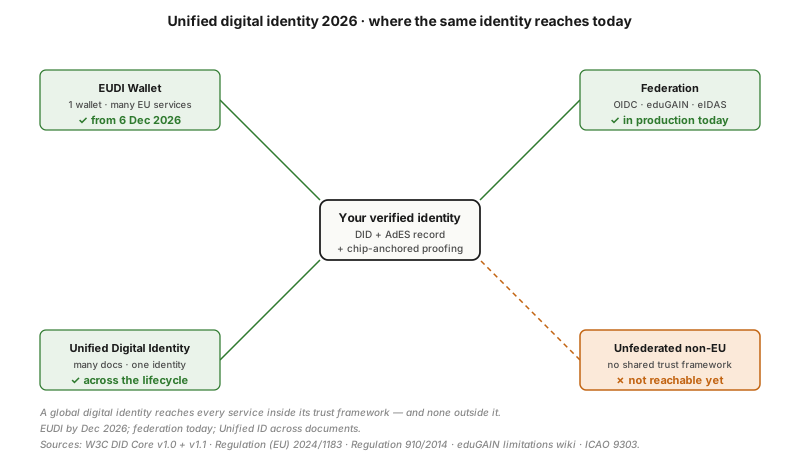
Inside an EUDI Wallet across EU services. Once each Member State has at least one wallet available — the deadline under Regulation (EU) 2024/1183 is 6 December 2026 — the same did:key natural-person identifier in the wallet can present credentials to multiple EU service providers without re-proofing. A user with a French EUDI Wallet can authenticate to a Spanish municipal portal, an Estonian university service, and an Italian e-prescription pharmacy using the same wallet, the same private key, the same selective-disclosure protocol (EUDI Wallet Architecture Reference Framework). That's a global digital identity inside the EU's trust framework boundary. We integrate against this in production today.
Across a federation (OIDC, eduGAIN, eIDAS cross-border). Federation is the older pattern that still does most of the unified-identity heavy lifting in 2026. A Polish university student authenticates once at the home institution; eduGAIN propagates the assertion across academic services in roughly 75 countries; the student doesn't re-create accounts at each platform (eduGAIN Limitations — GÉANT wiki — useful precisely because it documents the constraints, not just the wins). OpenID Connect (OIDC) extends the same idea to commercial platforms; eIDAS cross-border node interoperability extends it to public-sector services across Member States. The federation answers "is this person the user the home identity provider says they are" without each service re-running identity proofing.
Across multiple documents the same person holds (Unified Digital Identity). This is the case the consumer question often actually means, though they phrase it as "everywhere". A person holds a passport, a national ID card, sometimes a driving licence; in many regulatory contexts they are treated as three different identities by three different systems. The Unified Digital Identity approach links them into one cryptographic anchor: the user verifies each document with our app (passport NFC chip for the 179 ICAO 9303 countries, document authenticity plus biometric face match for every remaining country), and the resulting AdES-bound record under eIDAS Article 26 ties the documents to a single proven identity. From the service side, the user appears as one consistent identity rather than three; from the user side, losing one document doesn't lose access. We describe the same idea at the Unified Digital Identity product page.
The pattern across all three: a global digital identity exists wherever a verified trust framework reaches. EUDI Wallet's framework reaches every EU service that consumes it; eduGAIN's reaches every member federation; Unified Digital Identity reaches every system that consumes the AdES binding record. None reaches everywhere — they each reach somewhere.
Where doesn't it work yet?
Outside any of those trust frameworks, particularly across unfederated borders.
A Turkish supplier presenting digital identity to an EU customer hits the edge case immediately. The Turkish national eID does not federate into the EU eIDAS interoperability node (Regulation (EU) 910/2014 — eIDAS); the customer's procurement system reads the eID as "non-EU document, manual review required". The same supplier presenting a biometric passport to that customer hits a different edge: the passport's NFC chip is verifiable offline under ICAO 9303, the cryptographic chain holds, but the customer's procurement system may not have an integration to consume that primitive yet. The technology works; the receiving system doesn't.
What I'd push back on here is the framing that this is a fixable gap in the foundation layer. The foundation layer — the chip read at the document — already works for 179 countries and produces a primitive that any verifier could consume if they integrated it. The gap is on the consumer side: receiving services in non-federated jurisdictions have to choose to accept the primitive. That choice is procurement, not engineering. We've watched several cross-border deployments stall on this in the last twelve months — not because the identity primitive failed but because the receiving service had no integration path for it.
The Reddit version of the question — "Can I use the same digital identity everywhere?" — is implicitly asking whether the user can avoid re-proofing across every service. The honest 2026 answer for an EU user staying within EU service contexts is largely yes. For a non-EU user crossing into EU services, partially. For an EU user crossing into non-EU services, generally not yet. The gap is shrinking, but the shrinking happens one bilateral integration at a time.
What does true unified identity actually require?
Three things together — and the consumer question usually conflates them.
A stable identifier. A DID, or some equivalent globally-unique string the user can present to multiple verifiers. W3C DID Core 1.0 is the standard (W3C DID v1.0); did:key (for natural persons) and did:ebsi (for legal entities on the EU's EBSI ledger) are the two production methods in EU identity stacks today. Selecting the right DID method matters less than committing to one and keeping it portable across the user's lifecycle.
A reproducible identity-proofing event tied to that identifier. The DID is just a string. What makes it a global digital identity is the underlying proofing event that says "this DID belongs to a verified person". For 179 countries that primitive is the biometric passport NFC chip (ICAO 9303); for the rest it's document authenticity plus biometric face match (FaceTec liveness) at NIST SP 800-63A IAL2. Both produce a state-anchored or vendor-attested record that can be retained as an AdES artefact and presented alongside the DID.
A trust framework the receiving service consents to. This is the dimension the technology cannot solve on its own. eIDAS cross-border, EUDI Wallet, eduGAIN, OIDC federation, and bilateral commercial agreements are all examples of trust frameworks. Each defines which verifiers accept which proofs. The global digital identity question becomes operational only when the user, the issuer, and the verifier are all members of the same framework — or when an interoperability layer connects two frameworks.
The mistake in most "one identity, everywhere" pitches is treating the first two as sufficient. They are necessary but not sufficient. The third — trust framework reach — is what decides whether unified identity actually works in any given deployment.
What this means for your platform stack
If you are integrating identity for a platform serving EU users in 2026, the architectural read is:
- For an EU-citizen user base, the EUDI Wallet trust framework reaches you by 6 December 2026. Integrate against the EUDI Wallet Architecture Reference Framework and let users present credentials via SD-JWT today (see the post on selective disclosure); BBS+ predicate proofs land 2027+.
- For a non-EU user base, the same EUDI integration does not reach you yet — you need a foundation-layer primitive that works across countries. Chip-read passport-NFC for 179 countries plus document and face match for the rest gives you global coverage at the foundation layer; the global digital identity sits on top of that primitive once you've chosen which trust framework to align with.
- For a multi-jurisdiction user base, plan the integration around Unified Digital Identity semantics rather than around any one national eID. Users hold multiple documents over a lifecycle; the platform should treat the AdES-bound proofing record as the user identity, not whichever document was presented first.
The procurement question that catches platforms in 2026 is treating "global digital identity" as a single buy. It isn't. It's three buys — identifier, proofing primitive, trust framework — and the value of each depends on the others. Get any one wrong and the user re-proofs everywhere; get all three right and the same digital identity actually does work everywhere your trust framework reaches.
Sources
Primary — DID and Verifiable Credentials standards
- W3C — Decentralized Identifiers (DIDs) v1.0 (Recommendation, 19 July 2022)
- W3C — Decentralized Identifiers (DIDs) v1.1 (Candidate Recommendation, 5 March 2026)
- W3C — Verifiable Credentials Data Model 2.0 (Recommendation, 15 May 2025)
- EUDI Wallet Architecture Reference Framework
- OpenID Foundation — OpenID for Verifiable Presentations 1.0
Primary — EU trust frameworks and federation
- Regulation (EU) 2024/1183 — eIDAS 2.0 / EUDI Wallet — EUR-Lex
- Regulation (EU) 910/2014 — original eIDAS — EUR-Lex
- eduGAIN Limitations — GÉANT wiki
Primary — identity-proofing primitives
- ICAO Doc 9303 — Machine Readable Travel Documents
- NIST SP 800-63A — Identity Proofing and Enrollment
- NIST SP 800-63B — Authentication and Lifecycle Management
About the author
Gustav Poola is co-founder of IdentiGate. He focuses on the technical architecture of passport-chip identity verification, advanced electronic signature production under eIDAS, and the engineering of identity flows that survive regulator and auditor walk-back.